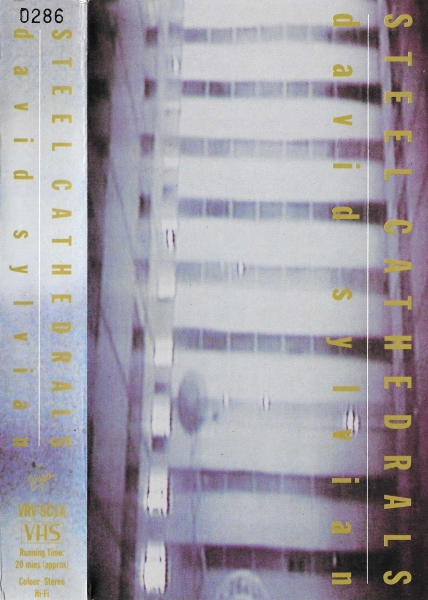
In a 2010 interview, David Sylvian was asked to identify how his experience of the East had influenced him as a human being. ‘I think it affected me in ways that have been so completely absorbed and assimilated that it’s hard for me to comprehend the degree to which I’ve been influenced by my engagement with Eastern culture,’ was the preface to his reply. ‘I might point to the influence of Zen Buddhism and, to a lesser extent, Shintoism and the guiding roles they’ve played in my personal evolution. The beautiful artifice of popular culture and the mutability of persona. The embrace of one’s masculinity and femininity on equal terms, without conflict.
‘Then there are the friendships which grew over time with Japanese artists, musicians, composers, all of whom hold an important place in my heart. Musicians and collaborators such as Ryuichi Sakamoto, Toru Takemitsu, Otomo Yoshihide, Toshimaru Nakamura and, more recently, Dai Fujikura. Visual artists such as Shinro Ohtake, Shinya Fujiwara and Atsushi Fukui. I found a compatible aesthetic in many aspects of their work, particularly with Ryuichi, which reflected my own. I found a community of contemporaries in Japan which I failed to find in my own homeland.’
Shinro Ohtake had by then been in David’s circle for over 20 years. His first published involvement with Sylvian, as far as I can make out, was his art direction and design work for an additional booklet that accompanied the Japanese edition of Weatherbox, the supplement being a collaboration with Russell Mills that made the Japanese version even more spectacular than its UK counterpart. A simple line sketch exists of Sylvian, drawn by Ohtake in October 1990 at the time of the installation Ember Glance: The Permanence of Memory staged by Sylvian, Mills and Ian Walton in Tokyo. Shinro’s artwork was then featured on the live Sylvian/Fripp album, Damage, the deep red of a crimson light bulb flooding a scene from his exhibition Retina, the walls covered with paper cuttings in his familiar ‘scrapbook’ aesthetic. When Sylvian chose to rework these live recordings to his own liking, his remix came with all new artwork, but the artist was the same. ‘I asked Shinro to create a new piece for the re-release of Damage,’ David explained. ‘It’s a computer-based work which is an area of investigation Shinro’s been drawn to of late. I won’t go into a description of the work, which is abstract in nature, other than to say it has an obvious link to the previous cover art.’ (2001)
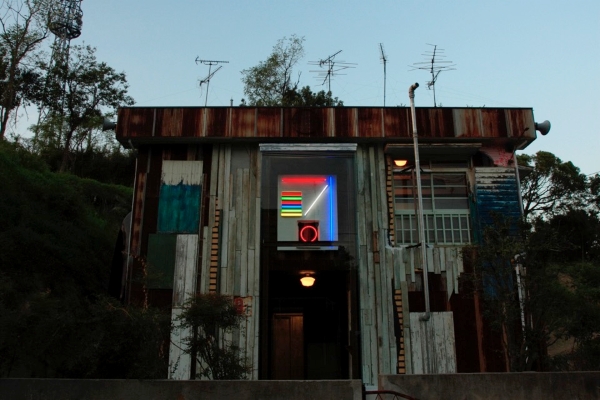
2006 would be a momentous year for Sylvian’s friend. A dizzyingly extensive exhibition of his work, Shinro Ohtake Zen-Kei: Retrospective 1955-2006, opened at Tokyo’s Museum of Contemporary Art in October, showing over 2,000 artworks encompassing his childhood to the exhibition date. The scale of the retrospective was said to be unprecedented for a living Japanese artist. At the same time, Ohtake strengthened his ties with the Benesse Art Site on Naoshima by designing one of the Art Houses in the Honmura district of the island, ahead of the Standard 2 exhibition which also opened that October. The concept of this project, which had begun in 1998, is explained on the Benesse website: ‘Artists take empty houses scattered about residential areas and turn the spaces themselves into works of art, weaving in history and memories of the period when the buildings were lived in and used. Going from one of the houses to another, visitors pass through the Honmura district, where everyday life unfolds around them, in the process not only engaging with works of art but also sensing the layers of time and history interwoven in the community and the fabric of local people’s lives…A truly organic project that changes day-to-day, it has evolved to present a new model of community, characterised by positive interaction between urban and rural, young and old, residents, and visitors…
‘“Haisha”, meaning “dentist”, was once the home and office of a dentist, and Shinro Ohtake converted the entire building into a work of art. The house incorporates an eclectic array of stylistic elements, appearing in some places like a sculpture, in others like a painting, and in still others like a collage or scrapbook. The title of the work, Dreaming Tongue, represents the process of holding something in one’s mouth and recalling a dream by retracing the taste and scent.’
Below: David Sylvian with Shinro Ohtake, installing Ohtake’s retrospective at the Museum of Contemporary Art, Tokyo, 2006. Photograph by Yuka Fujii.
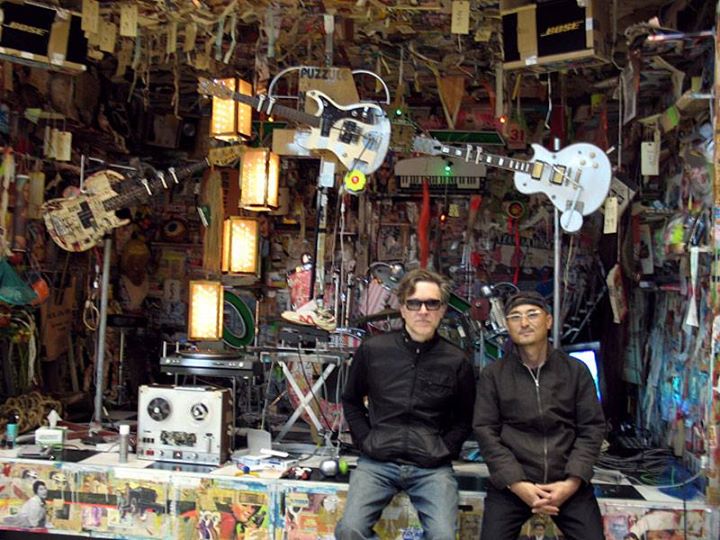
Shinro would be responsible for further deepening Sylvian’s interaction with the culture and natural environment of Japan. ‘I visited Naoshima twice,’ David recalled. ‘Once in the company of Shinro Ohtake when the commission was offered me. We stayed maybe 2 nights. And during the opening of the festival. I’m guessing 4 or 5 nights.’ (2021)
That initial visit was reportedly in February 2006. ‘I was commissioned by the Benesse Foundation to produce a work for the Standards 2 festival within minutes of my landing on the island,’ he further explained. ‘This allowed me to explore the landscape with the possible commission in mind. The remit stated that, on reaching the Foundation’s offices, the public would be handed an iPod with which to explore the surrounding villages, museums, and “Art Houses” whilst absorbing the audio accompaniment. In effect, it was to be a work that tied these contrasting elements together in some fashion.’ (2010)
It was an opportunity to develop some thoughts that were already fermenting. ‘I had a very vague idea for an instrumental piece I wanted to work on that involved certain elements, and when I visited Naoshima and was given the commission, I saw a connection between the nebulous idea that was beginning to take shape, and how it would apply in that particular context, so I went ahead and started on that basis. And it seemed to work very well, although the piece obviously developed and evolved possibly in a different way than it would have done because of the commission, because of the context.’ (2007)
‘I attempted to create a work that increased the awareness of other dimensions of reality whilst complementing, contrasting, and extending the one physically at hand. A multiple exposure, a layering, mapping reference points both real and imagined…The intention was that the audio be played at low levels so that the sounds of the environment merged with the recorded elements.’ (2010)
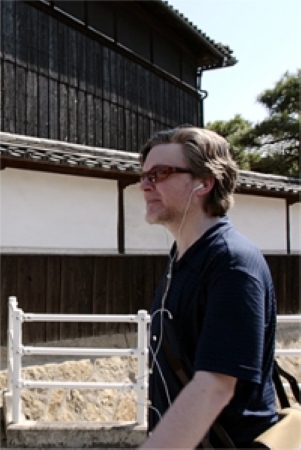
Sylvian’s contribution would take its place alongside exhibits spread throughout the island. A contemporary festival map can be viewed here. Photographs from the time posted in the galleries at davidsylvian.com show the work of some of the other participating artists.
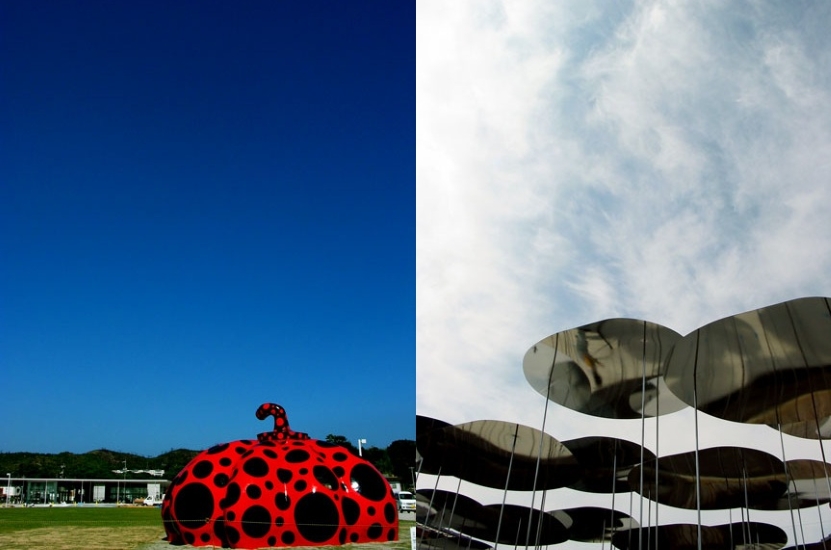
Above left: ‘Kusama Red’, Yayoi Kusama: ‘Red Pumpkin’.
Above right: Kazuyo Sejima & Ryue Nishizawa/SANAA, ‘Sora’.
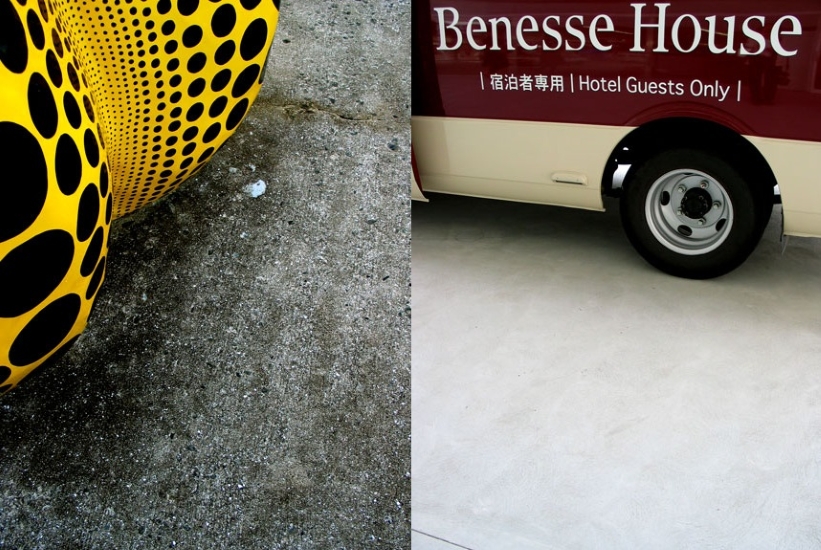
Below left: ‘Kusama & concrete’, Yayoi Kusama: ‘Yellow Pumpkin’.
Below right: ‘Service’, the Benesse House courtesy bus.
A first-hand visitor account from 2007 captured the impact. ‘I took a trip to Naoshima during the Standard 2 exhibition specifically to hear the Sylvian piece. What a beautiful location – a small island with a couple of villages, and the artworks scattered in various locations. Shuttle buses were running regularly all over the island but I instead opted to hire a bicycle and cycle for a few days. One could thus travel anywhere anytime, and a brisk circuit of the island could be made in less than an hour. However the island invites slow and contemplative exploration rather than velocity…
‘The Sylvian work is by far and away the most “ambient” track I’ve ever heard by him, a soundscape of fragments rather than a piece of music. Various sounds advance and recede between long silences or the faint sound of wind. Wooden shutters closing, distant seagulls, metallic scrapings, creaking boards, boat horns, birdsong and tinkling bells, shuffling sounds, crows, and haunting voices reminiscent of Akira Rabelais’ Spellewauerynsherde…
‘The track was designed to be listened to on earphones while walking around the island. To put it bluntly, I found the experience staggering. The piece, being constructed to a great extent of many sounds recorded on the island, blended perfectly with the ambient sounds surrounding me as I walked and cycled – I would hear a wooden impact to my left and turn to see a local Naoshima resident sliding shut an old door. Minutes later I’d hear a similar sound and turn round only to realise it had come from the iPod… Seagulls would drift in and out, sometimes real gulls flying overhead, at other times part of the soundscape on the earphones. I would hear strange creaking noises as I passed through a forest filled with birdsong and then later recognise it as the creaking of wires and ropes on moored boats as I cycled along the waterfront. It was a wonderfully disorienting and immersive experience….an intertwining of memory with the present, of reality with the not-yet-experienced …and never before in living memory have I felt so incredibly aware of every small detail of my immediate environment.’
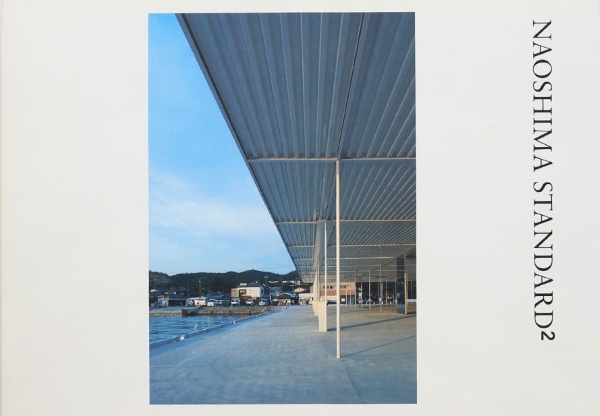
The visitor recollected hearing ‘sounds which come from more conventional musical instruments in the mix, however not “musical” as such. Waves of fuzzy electronic buzzes, occasional bells, a distant drone for a few seconds, a couple of isolated notes from a horn here and there – in terms of sonic and melodic content a bit like the shuffling sounds of players tuning up (although in terms of their presence in the soundscape they worked beautifully). But while moving round the island, their presence merely formed sporadic points of “instrumental” reference – it was by far and away the environmental sounds that made the experience.
‘If you compare to any other Sylvian pieces (e.g. Approaching Silence, ‘The Beekeeper’s Apprentice’, etc), the instruments here are far more sparsely scattered with plenty of space in between during which only silence or environmental noises or voice can be heard. The overall impression is of silence with occasional sounds, although there is in fact very faint sound for most of the duration.’
It was, he concluded, ‘A most enriching journey. Inspiring and thought-provoking.’
Sylvian described some of the layers that he sought to cultivate within the piece, consistent with the visitor’s experience. ‘The “loud weather” referred to in the title was in reference to the emotional life of the island, complemented by its spiritual ancestry and its influence on everyday life. There’s repeated reference to labour, creative endeavour, an affirmation of life or its possible futility. Then there are the associative landscapes that pull in a wider web of connections from around the world, alluding to a greater wealth of resources and cultural exchange. Through it all blows the winds of pollination, cleansing, eradicating, alive with the voices of generations…’ (2010)
An artist-approved commentary on Sylvian’s installation work stated: ‘This idea of the superimposition of landscapes and of a multi layered dimensionality came about due to the fact that the Chichu Art Museum, located on the island, designed by the architect Tadao Ando and owned by the Fukutake Foundation, is situated beneath ground level and housed in that structure are four of Monet’s water lily paintings. The 20th century French landscape of Giverny as seen through Monet’s eyes housed beneath the earth of a Japanese Island floating in the Seto Inland Sea. There’s even an interpretation of Monet’s garden, incorporating many of the plants he cherished, close to the entrance of the museum.’ (2011)
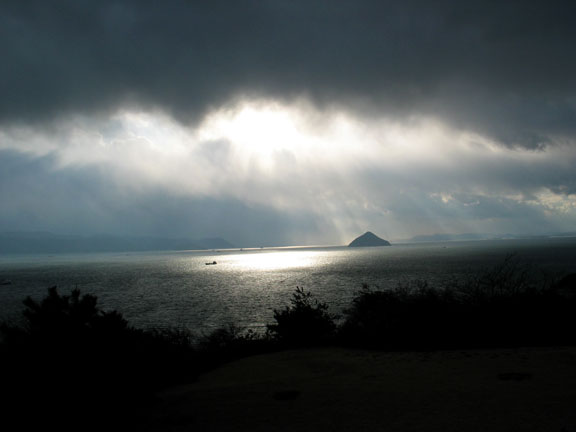
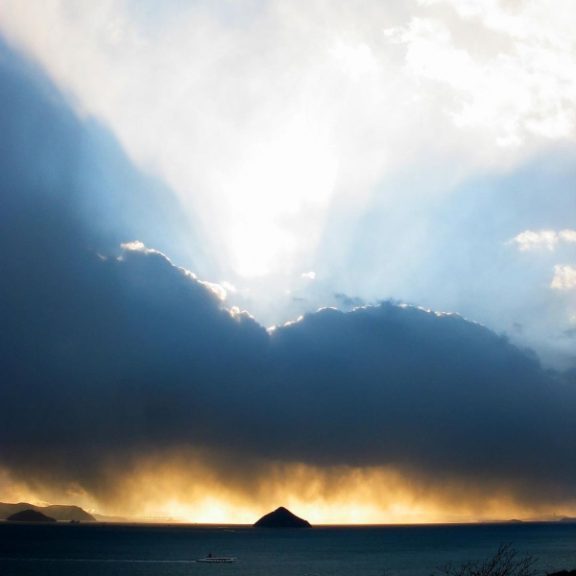
In January 2007, when preparing a mix of the music for commercial release, Sylvian was faced with the challenge of how to achieve something akin to listening on an iPod enveloped by environs of Naoshima, but this time for purchasers who would hear the work in their own home. Indeed, our quoted traveller heard the piece divorced from the sights and sounds of the island, presumably in the stillness of a hotel room, and could not conceive how his immersive experience outside could possibly be replicated away from its original context. ‘Listening to it as a standalone recording,’ he wrote, ‘captures none of the power of that experience. The work was most definitely a site-specific piece of art. Heard elsewhere it would be a completely different beast, perhaps interesting as an example of the art of soundscaping, but detached from its true essence. Akin to observing an animal in a zoo rather than in its natural environment.’ (2007)
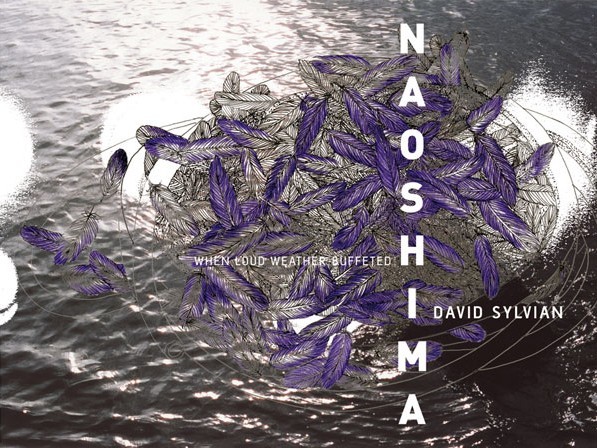
‘When Loud Weather Buffeted Naoshima was commissioned by the Naoshima Fukutake Art Museum Foundation on the island of Naoshima, Japan as part of the Naoshima Standard 2 exhibition which ran from Oct 2006 to April 2007,’ read the press notes for the cd release. ‘The composition is site specific. In fact, Sylvian has said that the work isn’t really complete until the sounds of the town Honmura are incorporated into the listening experience. For the samadhisound release of When Loud Weather… Sylvian has incorporated some of the sounds of the island into the final mix. Whilst this obviously doesn’t compare to the experience of listening to the work in situ, it goes some way towards creating an echo of it. In the process, Sylvian’s created a piece which might find new and interesting interpretations in a variety of unanticipated contexts.’
The samadhisound release was made available only in a limited edition housed in a beautiful DVD digipak that was distinctively crafted by house designer Chris Bigg, with cover art by Sachiyo Tsurumi. No download was offered and once the physical edition was sold out it was deleted from the catalogue. ‘As the Foundation have decided to make the audio a part of the permanent collection on the island it will be there that the work will remain accessible once the samadhisound edition is ended,’ confirmed the official announcement. (2007)
The piece runs for over 70 minutes and I have to admit struggling to find the right context to enjoy it when it first came out, being time starved from the demands of a busy job. At some stage I formed the impression that nothing much happens across the duration of track, but in recent years I’ve come to realise that this was a false conclusion. Learning more about how the piece was intended to be experienced on the island, an encounter I was not privileged to enjoy, makes me approach listening now as the catalyst to take me to an island in the Seto Inland Sea through imagination. The music has the power to transport us to a location we may have never visited, and to hold us there.
Sylvian’s reference to ‘a wider web of connections from around the world’ was prompted by the presence of Monet’s waterlilies, canvasses which are the product of a very specific time and context, yet are also a testament to cultural cross-pollination in the Japanese-influenced garden at Giverny. A consistent spirit carries over into his music for Naoshima. Alongside Clive Bell, an experienced player of many Eastern wind instruments, his ensemble embraced Norwegian trumpeter Arve Henriksen and Akira Rabelais from the US – artists both deeply inspired by Japan. Arve’s presence is most keenly felt through his extraordinary falsetto vocals, his being the first vocal we hear around 2 mins into the piece (see ‘A Certain Slant of Light’ for Sylvian’s comments on the Norwegian’s prowess with both his chosen instrument and vocal cords).
‘The sweet voice of Arve Henriksen’ is followed at 2 min 40 seconds by the first of many samples taken from ‘‘found’ recordings sent to me by Rabelais as heard on his debut samadhi release,’ Sylvian confirmed (2023). As our island visitor had suspected, these chants derive from the same source material as those heard on Akira’s 2004 samadhisound cd Spellewauerynsherde. I have written previously about the origins of these Icelandic vocalisations which are rendered with such heartfelt expression (see here). That a contemporary Norwegian vocal and Icelandic voices rescued from decades-old tapes should find their home on a composition designed to be heard in situ on a Japanese island, and for the result to sound “right”, seems to me to be resonant of the cross-cultural connections that Sylvian found on Naoshima.
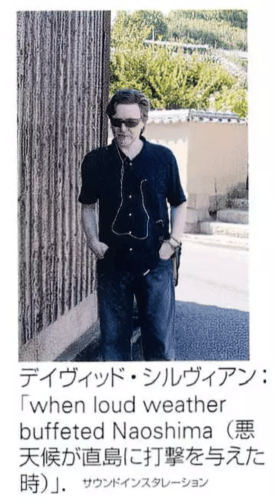
When I spoke to Akira in 2023, I enquired about his involvement with Sylvian for When Loud Weather Buffeted Naoshima. ‘He was doing an installation piece for that museum which is a very interesting place. And I think he was a bit irritated with what he had done and was trying to make sense of it. So I basically just made some suggestions and gave him some very minor little things to add in to it.’ These extended beyond the Spellewauerynsherde voices. ‘I was doing some short field recordings at the time. One is of the subway in North Hollywood, just the train, to give it some motion. My hand in that was very minimal, it was more about talking through what he was doing.’
Sylvian has described the process of bringing the piece into existence. ‘…Naoshima is the result of painstaking work,’ he stated. ‘If you work your way through three minutes a day, you’re doing well. Eventually you make your way through the entire duration of the piece, then you return to the top and start over. You repeat this process countless times over the period of about a month before the piece is finished’ (2022). It was a challenge that held attraction. ‘Installation work was another arena in which to explore established interests under specific guidelines which could/should prove challenging, potentially resulting in the kind of solutions which help develop this area of work in new and interesting directions.’ (2010)
‘It’s all about process and realisation. Do I come close to conveying the initial goals that brought the composition into existence? It’s a challenge where failure is a constant possibility. That’s the edge where I find the greatest satisfaction’ (2021). Rabelais says that ‘subconscious process’ was important in his own practice. ‘The way I did Spellewauerynsherde was I would work on the pieces and then I would put them on repeat, low volume, in my apartment and kind of meander around and go about my business. What I enjoy the most is leaving, going to work and coming back, encountering them in a “music from a different room” kind of way, a “letting them inform my subconscious” kind of way of working.’ (2023)
Periodically throughout When Loud Weather… we can identify waves of Fennesz guitar that swell and then dissipate (for instance at around 24, 35 and 42 minutes). It seems apt though that breath is the source of the predominant sounds, wind instruments that muster both the human history in that location and the sea breeze which animates the natural environment. Clive Bell told me about his session for the piece: ‘David took me into a studio in London, I don’t recall where exactly, just the two of us. I took shakuhachi (Japanese flute), khene (Thai mouthorgan) and some other small Asian wind instruments. I improvised the whole thing, without hearing the other recordings, but David was clear what he wanted and gave me plenty of direction. By this stage he knew what those instruments sounded like.
‘David stressed that he wanted me to “underplay” the instruments, to explore what happens if you don’t put quite enough air into the mouthorgan, for example. On the shakuhachi, you normally make a strong tone by carefully focussing the breath on the embouchure (i.e. the edge of the mouthpiece). But what happens if you don’t do that? If the breath focus is weak or understated, so the instrument maybe sounds like it’s dying? This was the brief.
‘We tried different things out on these lines, with discussion between takes. I was impressed that David had a clear idea of what he was working towards. Of course I couldn’t hear the other instruments at that point, but I understood he was going to mix several voices and instruments together to make a textural piece. When you know that, you can relax and play less, leaving plenty of room for everyone else.
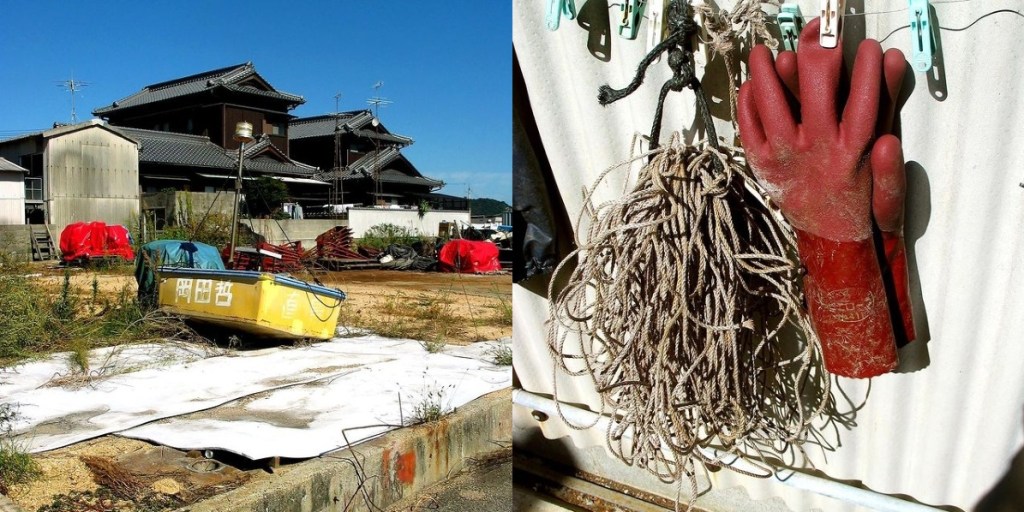
‘I have been in studios with producers whose ideas were just beginning to form, but in this case David’s producing was highly focused, so we got the thing done to his satisfaction fairly quickly. When the album came out I was very impressed by his vision. The album was pretty experimental but I would say very successful, and it works well even without being at the Naoshima museum. It sounds like wind blowing through an abandoned boatyard – which could be a scene from a Tarkovsky film.
‘Among shakuhachi players, there’s a saying that you are trying to create the sound of wind in a dying bamboo grove. I don’t know whether David has heard of that. In any case, his music is an interesting variant on the same idea.’
Clive’s comments about instruments that sound as if they are being starved of breath brought to mind a photograph shared on David Sylvian’s instagram entitled simply ‘When Loud Weather Buffeted Naoshima’. A wind-powered musical contraption is mic’d up for recording, but looks in a sorry state with the veneers falling away from its keys.
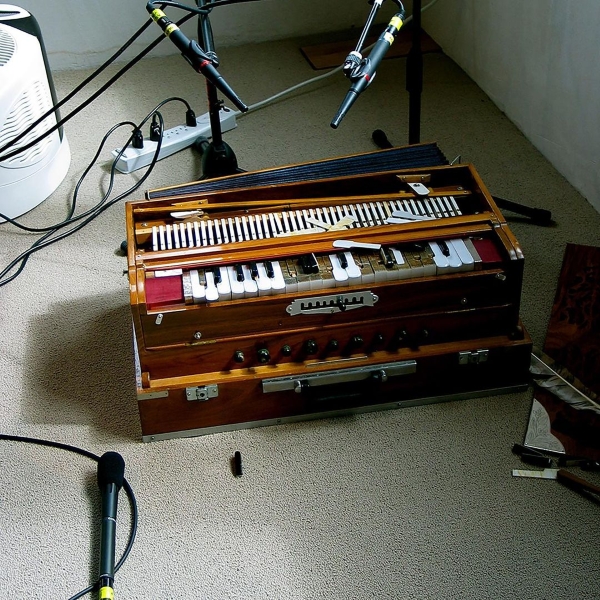
‘The photo has an Indian harmonium,’ Clive explained, ‘as used by many Indian and Pakistani musicians to accompany singers. You’re right, it doesn’t look in good shape. The bellows may have contributed wheezing and gasping noises on the album.’ (2026)
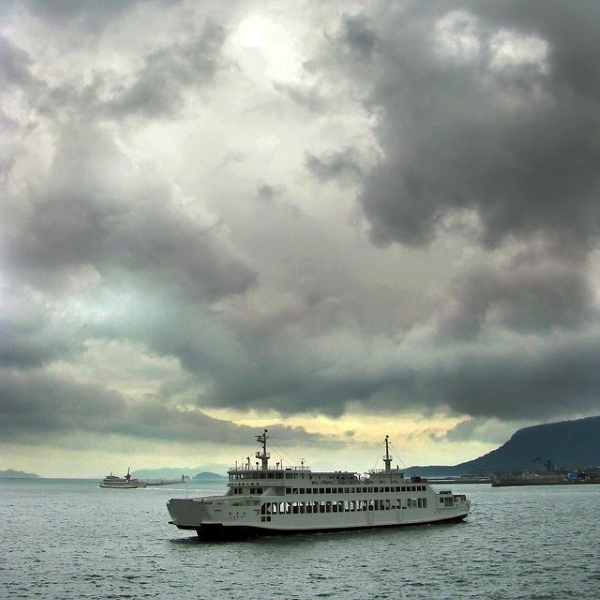
The addition of sounds that bring to life what one might hear simply walking around the island was a device that the first-hand visitor account found particularly affecting. At times what seems to be the creaking of ropes and cables conjures the shoreline as boats stress their moorings. For all its artworks, Naoshima is a fishing community at heart, something conveyed in Sylvian’s photographs of his time on the island, published first on his website and then on instagram where they bore the title ‘Indications of Labour (Naoshima)’. When Yayoi Kusama’s 2 metre-tall ‘Yellow Pumpkin’ sculpture was washed away by Typhoon Lupit in 2021, Sylvian’s expressed concern was the impact of the extreme weather on the safety and livelihoods of the inhabitants, rather than fate of any artwork.

The art of recreating sounds from life was a hallmark of the work of one of Sylvian’s favourite film directors, who was renowned for adding “ambient” sound after a take. ‘In terms of A[ndrei] Tarkovsky’s influence,’ he said, ‘look at …Naoshima as an exercise in a cross between the work of a musician and a Foley artist.’ It was a direction that he would develop in future years and express an interest in further exploring. Playing the Schoolhouse, he said, was ‘somehow related to …Naoshima in terms of composition if not in genesis. Creating a piece like …Naoshima is work intensive. I’d pursue something along similar lines if it covered new ground.’ (2021)
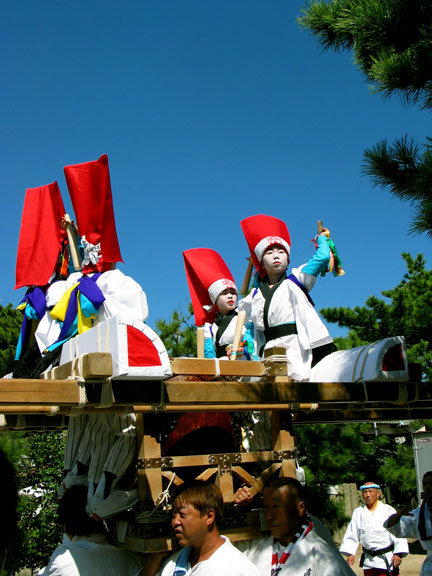
The samadhisound release carries a message of thanks to both Shinro Ohtake and to Yuka Fujii, the latter having also accompanied Sylvian to the island. The label website hosted a video piece by Fujii in 2007 called Transient. It was what Yuka termed a ‘cine-photo’ presentation of her work. Included in the footage, said the commentary, were ‘images featuring those of young Japanese boys drumming on a raised portable shrine at an Autumn festival in Naoshima, Japan…This video also introduces the work (digital painting) by the late Japanese artist Mitsuru Tokutomi.’ The soundtrack was an excerpt from When Loud Weather…, with a quotation from a poem by R.S. Thomas, ‘The Flower’, on screen in the closing moments.
‘These individual works stand firmly on their own merits, but the aim in recontextualizing them is to create an audio/visual poem united in its spiritual essence.’
Below: David Sylvian’s photograph of the boy drummers being carried aloft (‘Dedication 1’), from the galleries at davidsylvian.com
‘When Loud Weather Buffeted Naoshima’
Ensemble: Clive Bell, Christian Fennesz, Arve Henriksen, Akira Rabelais, David Sylvian.
Composed by David Sylvian
Produced by David Sylvian. From When Loud Weather Buffeted Naoshima by David Sylvian, samadhisound, 2007.
Commissioned by Naoshima Fukutake Art Museum Foundation
Naoshima Standard 2
Exhibition period: 7 October – 24 December 2006 and 24 February – 15 April 2007
Organised by Benesse Corporation and Naoshima Fukutake Art Museum Foundation
‘When Loud Weather Buffeted Naoshima’ – official YouTube link. It is highly recommended to listen to this music via physical media or lossless digital file. If you are able to, please support the artists by purchasing rather than streaming music.
Yuka Fujii: Transient, is the cine-photo version 2 – 5:25min. /osmosis film 2007
My thanks to Clive Bell and Akira Rabelais for their contributions to this article. Thanks also to javier/Paul for posting his experiences of visiting Standard 2 on the japansylvian.com message board in 2007. Full sources and acknowledgments can be found here.
Download links: ‘When Loud Weather Buffeted Naoshima’ (Apple)
‘David Sylvian created an audio installation for Naoshima Standard 2 composed of sounds created by himself and a small ensemble of musicians using traditional instruments in an unorthodox manner accompanied by computer processed sounds and the human voice. [He] was inspired by the spirit of the island, its climate, and its natural beauty.’ Naoshima Standard 2 exhibition catalogue, 2006
‘It’s basically an exercise in musique concrète meets Foley artist.’ David Sylvian, 2023