As David Sylvian’s In Praise of Shamans tour reached the West Coast in April 1988, he was interviewed for a piece in the Los Angeles Times. It was put to him that the ‘New Age tag has cropped up frequently’ in connection with his music. ‘It’s a very easy category to throw me into,’ Sylvian observed. ‘The music generally isn’t aggressive and therefore they define it as easy-listening, and they think I could belong to that category. And also some of the philosophies of life that I speak about they think may bear some resemblance to New Age.
‘I find that generally, what New Age set out to achieve… in that the work should have a specific function and induce a certain state of mind in the listener, I tend to think that it fails, quite badly… They approach the work on the intellectual level rather than the creative level. I think that somebody like Brian Eno and people that have worked with him for some time – Harold Budd, Michael Brook, Jon Hassell – in many ways achieve the aims of the New Age group far more profoundly than New Age itself.
‘If you want to put me into that category, then I’m happy to fit alongside Brian Eno, Harold Budd and so on. But if you’re putting me alongside the general catalogue of New Age then I’m very unhappy.’
Sylvian’s views accorded with those of Harold Budd, the same subject arising in a discussion with a New York Times journalist the previous year. ‘The composer Harold Budd writes music that is consonant, slow-moving and atmospheric,’ stated the resulting article. ‘But it is not, he insists, New Age music, the marketing term for the pastoral, repetitive background music heard in upscale homes and restaurants. “When I hear the term New Age,” he said yesterday, paraphrasing Hermann Goering on culture, “I reach for my revolver.”
‘“Seriously,” he added, “I’m fighting tooth and nail against people throwing me into that bag. There’s nothing there in that music, absolutely no sinew – nothing to confront you with an issue that hadn’t occurred to you before. I don’t think of myself as making music that is only supposed to be in the background. It’s embarrassing to inadvertently be associated with something that you know in your guts is vacuous”.’
Of the Eno cohort name-checked by Sylvian in the LA Times, he had by now already worked with Jon Hassell on Brilliant Trees, where Hassell shared writing credits for both the title track and ‘Weathered Wall’, and for the instrumental footnote to that project, Words with the Shaman. Michael Brook would very soon take part in the Rain Tree Crow sessions and then assume a place in the Sylvian/Fripp touring band for their The Road to Graceland shows. Sylvian’s link up with Harold Budd would come some years later.
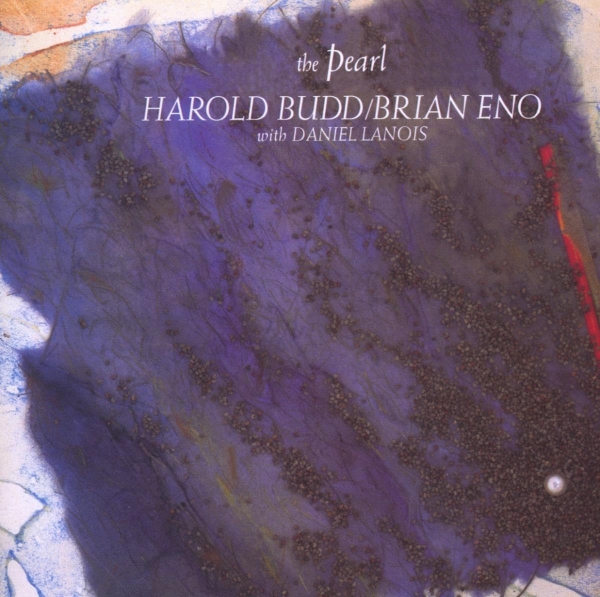
My own first experiences of Harold’s work came through the exquisite Eno/Budd release Ambient 2: The Plateaux of Mirror (1980), having been introduced to the series by a university friend, and then the equally captivating The Pearl (1984). It’s practically impossible to pick favourites from Ambient 2, but the glistening of ‘First Light’ and the perfectly described ‘Wind in Lonely Fences’ are representative of Eno’s sound environments that provide the stage for Budd’s piano. The Pearl develops the collaboration into deeper electronic territory, such as ‘Against the Sky’, and there is more emphasis on the shadows, as in ‘Dark-Eyed Sister’.
It was The Pearl that sparked another collaboration, Sylvian being so taken with the cover image by Russell Mills that an invitation was issued to the artist to create artwork for the compilation of Japan’s work – Exorcising Ghosts – which followed just a few months later.
Fast forward to the start of the next millennium and Sylvian had now taken up residence in the USA. It was then that he heard an unreleased opus by Harold Budd, who had been let go by his record company. ‘Amazingly, I first heard the album in 2001, when I tried to help Harold find a deal for that album,’ said Sylvian of Avalon Sutra. ‘Everyone turned it down.’ This lack of appreciation of a recording that represented the artist at what seemed to be the peak of his powers was deeply disappointing for Budd and staggering for Sylvian, who later described Harold as, ‘An artist who cannot get arrested in his own country.’ (2018)
Fortunately, the experiment of self-releasing Blemish in 2003 inadvertently created a platform for Sylvian to assist Budd directly. ‘The first reviews that appeared were so promising,’ said Sylvian of Blemish, ‘they generated an awful lot of interest. From there, distributors came on board and wanted to be a part of it, and so the notion of a label began to grow. In truth, we were struggling to keep up with everything that was happening. But it was a gratifying struggle, because we were able to do deals on our own terms, and things were just evolving beautifully. At the end of this period we had a label, we had distribution, and everything seemed to be set up for the future. It’s now very gratifying to have a label and to be able to offer a platform to artists we admire, such as Harold Budd.’
‘I finally met Harold for the first time in 2003 in LA,’ recalled Sylvian. Budd remembered it as the breakthrough in the struggle to get his latest work out into the world. ‘It wasn’t until I met, by accident, David Sylvian in Los Angeles and we had lunch. He asked me somewhere along the line if I would consider putting Avalon Sutra out on his small private label, samadhisound. I didn’t hesitate for a second. I must say that David Sylvian’s artistry and music I admire so much. Of all my contemporaries it is he who I find the most interesting.’
Avalon Sutra would be released in the first week of 2005 as samadhisound catalogue number ss004, following on from Akira Rabelais’ disc Spellewauerynsherde (ss003). Budd’s album was released as a two cd set with the second being an extended remix, ‘As Long as I Can Hold My Breath (by Night)’, which was created by Rabelais with some additional piano overlayed by Harold (read more about how that came about here).
The samadhisoud announcement positioned their release of Harold Budd’s music as the final instalment of his recording career. ‘Avalon Sutra is to be California-born American minimalist composer and pianist Harold Budd’s last recorded work. Avalon Sutra (released as a 2 disc set) is a suite of short, heartbreaking ambient pieces, featuring Budd’s delicate piano improvisations, lush string arrangements and warm electronic drones. The second disc (‘As Long As I Can Hold My Breath’) features a startling remix by LA based electronic composer Akira Rabelais, sending Budd’s arrangements into Feldmanesque eternities of sound.
‘Best known for his collaborations with Brian Eno, contributing his stunning piano work to key recordings such as 1980’s Ambient 2: Plateaux of Mirror, Budd has produced a series of remarkable minimalist compositions and recordings, including Pavilion of Dreams, The Pearl and The Room, which have earned him worldwide respect.
‘On Avalon Sutra, Budd’s valedictory release, he has created brief, snapshot like compositions, made all the more fragile and impermanent by his glistening piano work. Avalon Sutra has a bittersweet, autumnal quality – the composer’s trademark “loveliness” deepened and perturbed by the brevity of these pieces. If “ambient” music characteristically works to sustain a mood of intimacy, warmth, meditative ecstasy, such moods, which are certainly present in Budd’s work, are never allowed to last too long on Avalon Sutra. There’s a cumulative sadness and beauty to the way that these mood pieces linger briefly, stop and transform into something new. Budd’s gorgeous, angular string arrangements amplify this feeling.
‘Avalon Sutra brings to a conclusion thirty years of sustained musical activity. Asked for his reasons, Budd says only that he feels that he has said what he has to say. With characteristic humility, he concludes, “I don’t mind disappearing!”’
John Gibson is a guest player on the album, his saxophone as prominent on the opening ‘Arabesque 3’ as Harold’s piano. Gibson’s bass flute for ‘How Vacantly You Stare at Me’ is particularly touching. There are strings too, with quartet arrangements composed by Budd for ‘It’s Steeper Near the Roses’ which is ‘for David Sylvian’ and ‘Three Faces West (Billy Al Bengston’s)’, the title a reference to the West Coast artist.
‘Although this lovely piece from Avalon Sutra is dedicated to David Sylvian,’ stated Harold’s official facebook of ‘It’s Steeper Near the Roses’, ‘the inspiration for the title came from a dream. In this dream, Harold was walking up a hill with his late mother, Dorothy. They came upon a fence that blocked their progress, and scanning the hill for alternate routes, Harold remarked to Dorothy, “It’s steeper near the roses”.’ (2015)
Sylvian linked the retirement announcement with the general reaction of other labels when presented with music Budd had crafted so carefully: ‘I think that period of refusal of some of his best work may have had something to do with his desire to call it quits at this point in time.’ Harold considered Avalon Sutra to be ‘devastatingly pretty’. (2005)
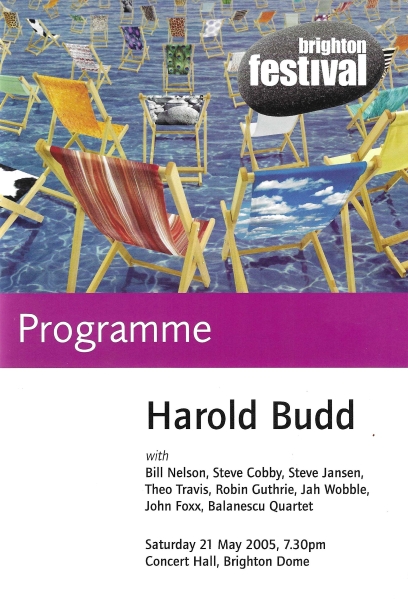
There was a farewell performance too – on 21 May 2005 at The Dome in Brighton on England’s South coast. ‘It is not often that an out-of-the ordinary event comes our way,’ wrote Festival Music Programmer Guy Morley. ‘This concert with Harold Budd is just that: tonight’s Brighton Festival performance is his final concert…Harold’s music comes from the heart and its simplicity belies his originality. His legacy, apart from his own albums, will be his influence and, of course, his charm and personality, which have produced some great collaborative work. Tonight’s performance has been curated and devised by Harold Budd. It should be taken as a celebration and not a tribute.’
The set began with Harold performing pieces from Avalon Sutra with the Balanescu String Quartet. After some of his string quartet compositions came successive duo performances with Theo Travis (later to appear on Nine Horses), Bill Nelson and John Foxx. The second half of the show kicked off with a solo gong performance by Steve Jansen, before musicians successively took to the stage for an ensemble performance. The whole thing played out under lighting designed by Russell Mills who was present that evening.
Jansen said of his solo: ‘I hadn’t done it before but I had the opportunity to have a go in soundcheck. The aim with that is to get a sustained ambience going which changes tone and timbre depending upon where the gong’s hit and how hard. It’s a bit like playing a drum roll except on a gong with soft beaters. It was based upon a recording Budd had made on one of his earlier albums’ (2017). Steve’s performance would be the catalyst for his recording with Foxx and Steve D’Agostino, A Secret Life.
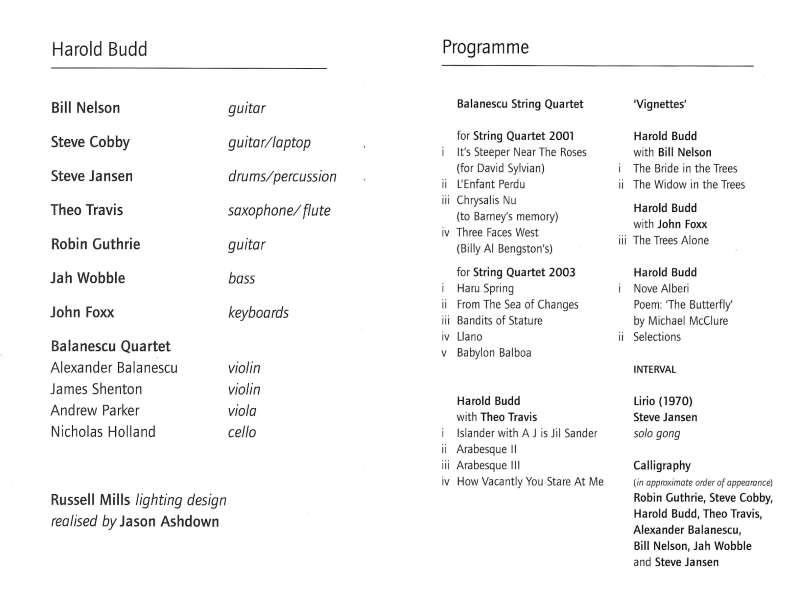
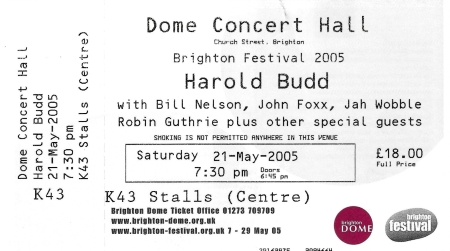
‘We wish to thank all the artists who have performed tonight,’ continued the programme note, ‘as well as Adrian Molloy and Richard Chadwick of Opium (Arts) UK and David Sylvian, for their help and support in bringing this unique event to you this evening.’
Of course, as it turned out, this would not be the final time that Harold played in front of an audience. There would be a follow up recording on samadhisound, the download-only Perhaps, put out in 2007. It’s another remarkable release, being an entirely improvised solo piano performance given in memory of a former faculty colleague of Budd’s. Samadhisound announced it as: ‘A beautiful live recording by Harold Budd performed as tribute to his late friend, and associate teacher at the then newly formed California Institute of Arts, Jim Tenney. The album, entitled Perhaps, was recorded live at CalArts in December 06, [and] runs at an uninterrupted 70mins.’ An accompanying essay by Matthew Weiner on the label’s site described the work as ‘reflective, simmering with a unique sense of purpose…Perhaps is poised to stand alongside the ambient pioneer’s most heartfelt, eloquent statements, evoking a lovely solace that is at once contemplative and alive, alternatively filled with moments of joy, wonder and mischief.’
Sylvian included the track ‘Templar’ on the samadhi sampler cd included with his tour programme for his The World is Everything tour later the same year.
‘That decision to say that I quit was very rash and very silly,’ Budd would later admit. ‘It’s very simple… I was living alone in the Mojave desert and nothing was happening with my own career and I felt very very sorry for myself. I’m embarrassed to say that – it’s true. I had a very hard time. I started to run away and pack my bags and catch a train or something. Avalon Sutra was already recorded when I was let go by Atlantic Records. I had a record and I couldn’t give it away. No-one wanted it in America – which re-fuelled my real distaste for the music business in this country.’
‘I was, and remain, so proud to have put this beauty out into the world,’ Sylvian would later say of Budd’s inaugural samadhisound release. ‘Sadly/unbelievably, no one else would give it the time of day. Whose shoulders does this shame fall upon? Surely the best of Harold Budd’s later works?’ (2021)
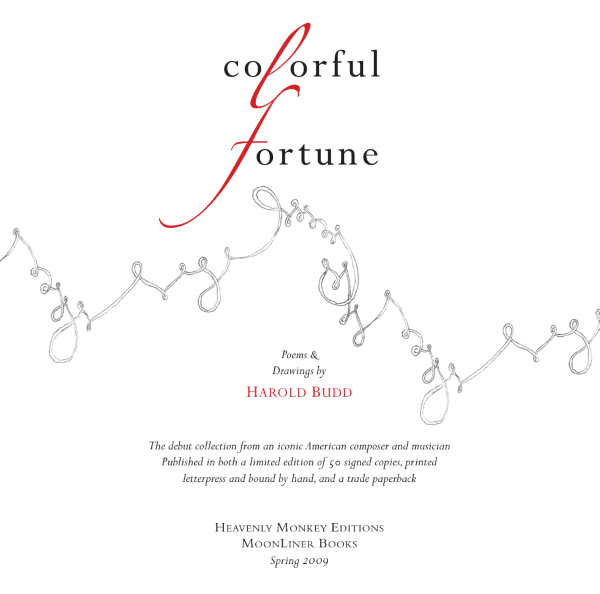
David Sylvian would again play a part in ensuring Harold’s work reached interested parties when Budd published his first volume of poetry in 2009. Keith Lowe, bass player on the Nine Horses records and on stage with Sylvian, recalled: ‘While I was still practicing bookbinding, David Sylvian suggested I bind a book of Harold’s poetry and that set in motion a cherished friendship and beautiful period of performing together. Under the moniker Moonliner Books I published the book Colorful Fortune. I hand bound the special edition while world renowned book binder Claudia Cohen bound the deluxe edition, all under the guidance of Rollin Milroy of Heavenly Monkey press. When he came to Seattle for our book release and concert he stayed at my house and we practised in my living room…. hearing him play the piano in my home was a treat I will never forget…In a career filled with blessed moments, performing with him was a highlight of the first degree. A sweet and gentle man with a quick cutting wit and a radiant smile, it was a joy to be in his company.’ (2020)
Included in that volume were poems that Budd recited on some tracks for his album By the Dawn’s Early Light (1991), a cd notable for Bill Nelson’s guitar contributions – check out ‘The Photo of Santiago McKinn’, ‘Down the Slopes to the Meadow’ – which features Nelson’s fellow Gone to Earth alumnus B.J. Cole on pedal steel – and ‘Saint’s Name Spoken’. For the latter, Budd half-sings the words later printed in Colorful Fortune to his own piano and Nelson’s acoustic playing, which is not so far removed from that heard on the exquisite ‘Answered Prayers’.
Heavenly Monkey would produce a further limited edition of Budd’s subsequent poetry in 2016, Aurora Teardrops. There were two limited runs, the most exclusive coming in an edition of 26 signed by Budd, Jane Maru – whose vibrant batik designs are interleaved with the verse on translucent pages that resemble their original silk – and David Sylvian, who penned an introduction.
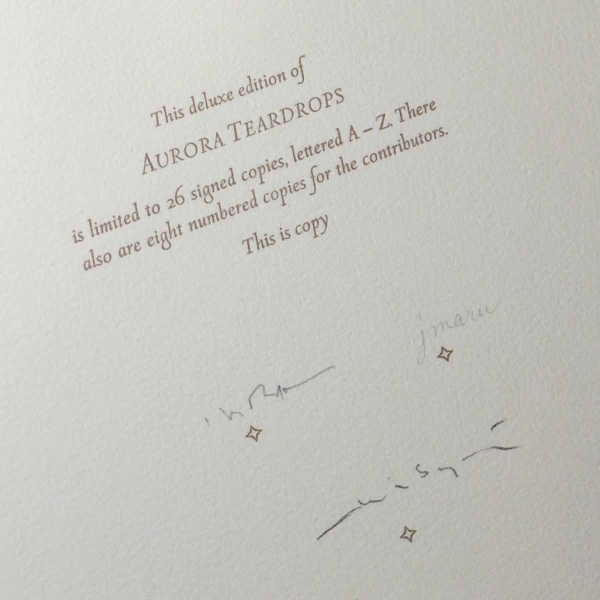
‘Harold Budd’s poetry moves us with a remarkable economy of means. To write of it directly would be superfluous as any additional elucidation is unnecessary. One could possibly describe how its power of seduction is achieved, like sweat pouring from the arc of a woman’s spine. Seduction and beauty, or seduction via beauty, is an apt description as any of Harold’s body of work in both words and music. It’s that perfectly placed emphasis, a melodic simulacrum of a torrent of cascading cherry blossoms; fourth note in a cluster of seven.’
‘As our lips glance innocently
We, each of us
alone
afraid
Ask, and
Ask –
With no sound.’
(‘As Our Lips Glance’)
‘As much as the work reflects Harold’s admiration and love for manmade architecture in its clarity and purity of form, it also revels in the beauty of the architecture of the natural world and, in particular, the feminine body. As with any sculptural object, there’s a passionate yearning to touch and be touched. The touch is real, realised, sensual, and fantasised; played out only in the bright darkness of the imagination. At once it’s a touch that’s non-physical, that shoots its arrows directly at the heart.’
‘Twenty-three thousand years
Alone
Without a breath on my neck
Your breath
(Whoever you would be)
No hand on mine
No unintended grasp’
(excerpt from ‘Aurora Teardrops’)
‘I detect a laconic warmth that exhales from this skeletal framework, a love and loathing at the limitations of language, reaching out into prairie darkness in search of an echo. A romantic flirtation with the elemental world, a dance, not unlike desert sand, caught in tiny hurricanes, hurrying ephemerally across the emptied plains. At times the romance becomes haunted by the acknowledged mortality of the author, the tragicomic solitude of one who yearns for love and, in a sense, a word that it in its grandiosity sits uncomfortably next to Budd’s own, the immortality it bestows. Love, reciprocated and otherwise. The desire to be consumed and the consuming acknowledgement of its absence.’
‘I could compose a love poem
(If I were in love –
I may be close).
Were it sung by David Sylvian
it would enter Paradise
(which may be close).
I could find the cadence
Of being alone
and chant silently in Paradise
(and bring it to a close).’
(‘Close’)
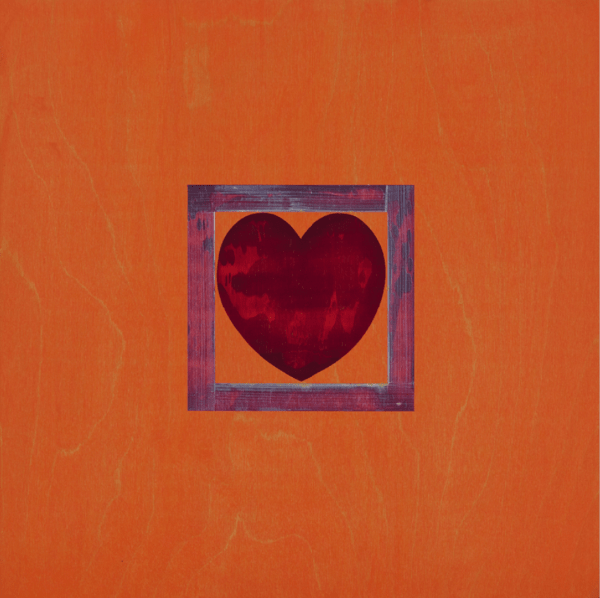
‘Harold, so drawn to the emblematic heart in the work of his friend, Billy Al Bengston, broadcasts, sonar-like, the yearnings of his own. There’s no attempt at concealment, no decorous distraction, no sleight of hand. Radiating out from between the lines, the bones of the ribcage, love from the resonant heart of a soulful man.’
Sylvian sincerely admired Budd’s creativity and was both encourager and a practical help in connecting the man with his audience. The two never directly collaborated, however, save Sylvian’s oversight of the additional piano that Harold recorded to augment Akira Rabelais’ extended remix for the second disc of Avalon Sutra.
The admiration was reciprocated, Harold responding to the question, ‘Who are you inspired by?’ without hesitation: ‘Very definitely David Sylvian. I love what he is doing now…His last album that I’ve heard is called Manafon, and he’s using musicians who are more from the free music scene. And he’s putting his lyrics and his voice – we know what his voice sounds like, that very feathery, sensuous sound – putting it to very rough music and I think it’s a tremendous breakthrough for him. If he ever wanted to break away from being somewhat soft, you know, a little bit not so heavy, he’s done it – and I admire him immensely for that. I think it’s a magnificent move for him. Plus, I like him personally.
‘I’ve always liked him as an artist. I don’t know anything about Japan. I came on the scene long after Japan, so I don’t know anything about the music, I’m not there…Sylvian snuck up on me 20 years ago, I guess. So that’s post Japan.’ (2010)
‘The one collaboration that never occurred and never would occur would be David Sylvian, whose work I admire above all others,’ said Budd in a 2014 interview. ‘I just love everything he does. There is a really good reason, it’s because although one thing is good and another thing is good, putting them together doesn’t make it twice as good. In fact it could be a disaster, and I’ve never wanted that to happen.’
Budd saw similarities in their output, describing their music as ‘contemplative, a little bit abstract, maybe too abstract at times.’ Not that he saw this as a flaw: ‘So what? Art without risk is pointless.’
He was also alive to the distinctiveness of their respective craft, his own recordings having a sense of ‘openness’, whereas, ‘When I was recording with David Sylvian, who is into layering, just putting together these amazing layers of sound, I was so impressed by that. There are just people who can do that better than me. I’m just not a musician.’
‘You’d say that he’s an obvious, yet missing, collaborator but David is on a quest that’s completely personal. I don’t think that I should butt in. Even if I was asked, I think it should happen on its own terms. He is going to a place that I am not part of. I admire it as an artist – everything he does. But it’s best if he continues on his quest alone. He’s an artist whose language is changing so radically that it’s really a language that he has to develop on his own. He has close companions that belong with him but I’d rather have a view than be a participant.’
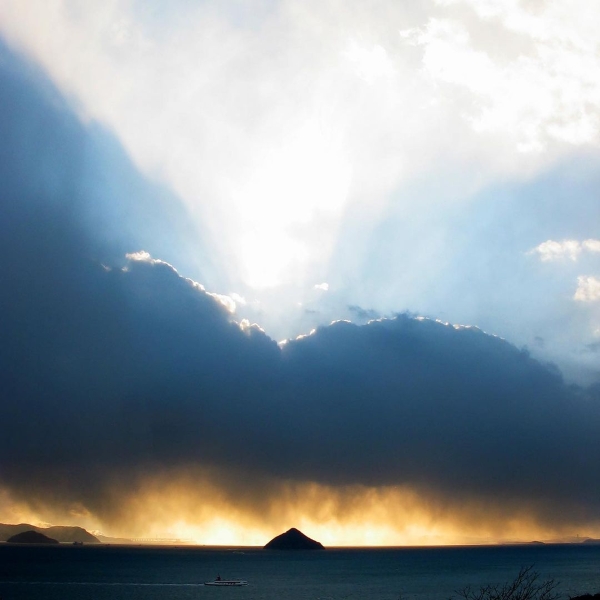
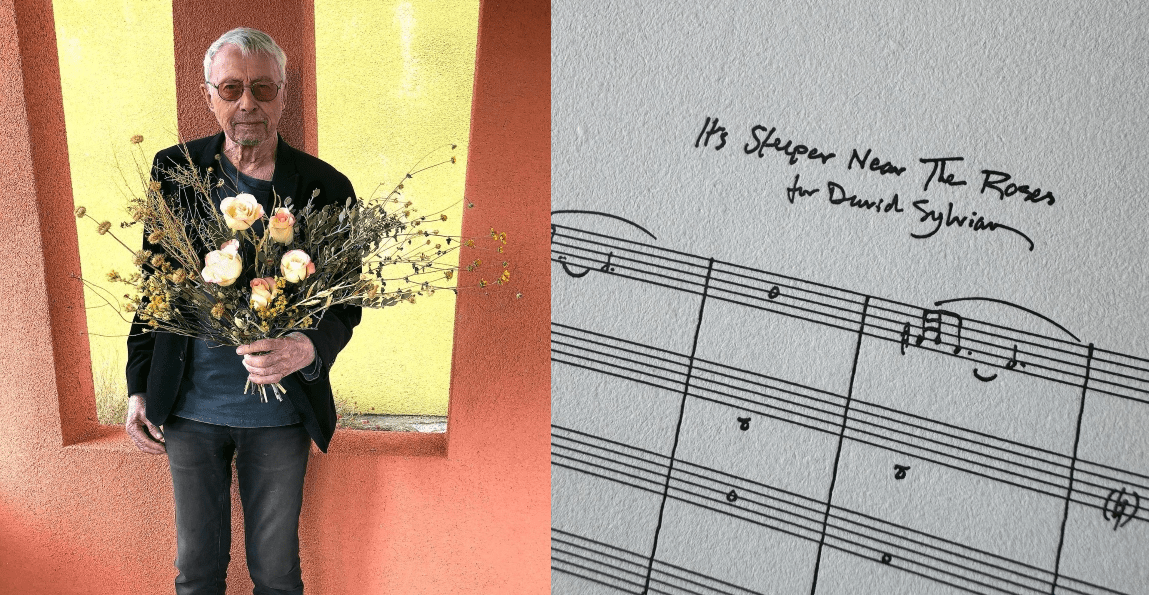
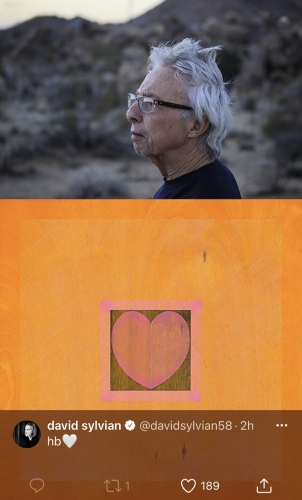
Harold died in December 2020 having suffered a stroke and then contracted coronavirus at a time of lockdown during the global pandemic. Tragically, his loved ones were unable to visit him in hospital because of the restrictions then in place. David Sylvian paid his respects by posting a picture of Harold above one of Billy Al Bengston’s heart paintings, with a heart emoji of his own.
Subsequently, Sylvian shared three images on instagram (including the one included in the featured image of this article). ‘These aren’t my photographs of Harold Budd. He’d occasionally share images taken by a loved one. These three encapsulate Harold as I knew him. I hope the photographer(s) in question doesn’t resent their residing here.
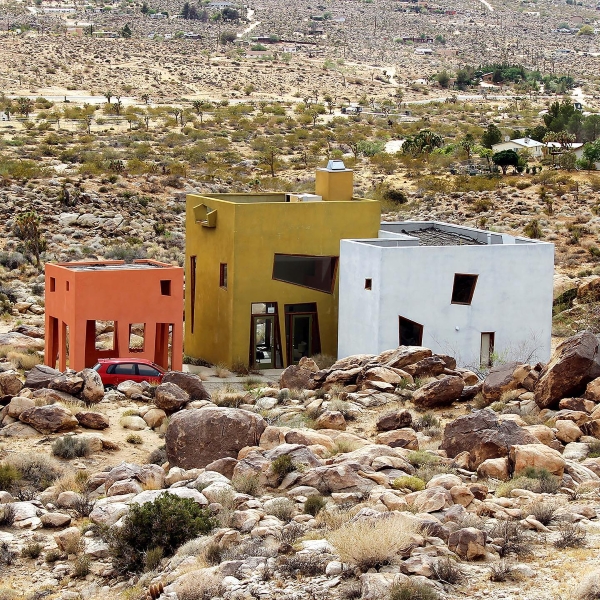
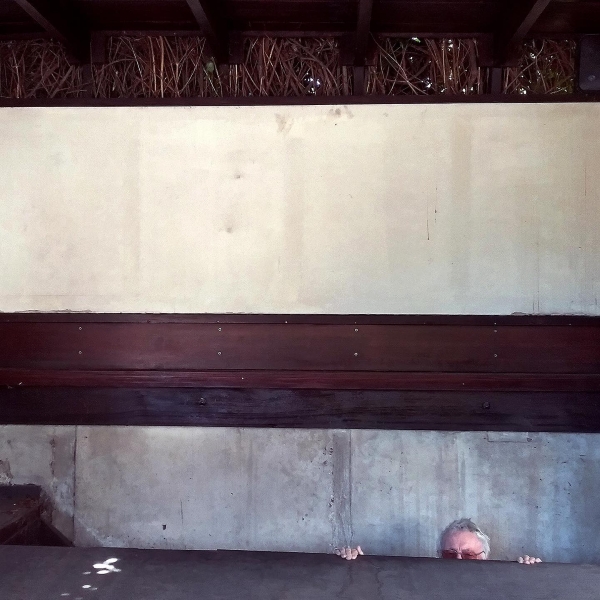
‘The monument house in Joshua Tree, designed by Josh Schweitzer, was Harold’s home from home. A beautiful folly in the desert which was, outside of Harold’s longing for Europe, his true natural environment. In his lifetime he didn’t feel appreciated by his countrymen. He believed a certain European sensibility had a greater appreciation for his work. It would’ve been wonderful if some of the sentiments expressed in the obits had been voiced during his lifetime. He didn’t ask for recognition but the lack of it left him feeling isolated, unmotivated perhaps. He filled the void with his love of love and that, in some instances, spurred him on to create more work. I once said every home should house at least one copy of a work by Harold. A sentiment that still holds true.’
A tribute from Keith Lowe read, ‘Harold Budd, one of my favourite composers and piano players passed on last night…His gift of understated beauty and deeply thoughtful music enriched my life in a way I’ll forever be thankful for. Thank you Harold for all the exquisite beauty you brought into the world.’
Bill Nelson posted a fulsome and moving message on his website, Dreamsville. ‘Harold’s music was sublime, poetic, warm, achingly beautiful, but also intellectually sharp and precise, like ice carved by sunshine into delicately adorable shapes. His touch on the piano was sensitive and subtle, capable of the greatest tenderness. He often spoke of the “loveliness” that he was chasing, an absolute and undeniable affirmation of transcendent beauty. I was privileged to sit alongside him and add my guitar to his piano playing, but as wonderful as those moments were, my most precious memories of Harold are those when we spent time together as friends…He was a beautiful soul and I will miss him profoundly.’
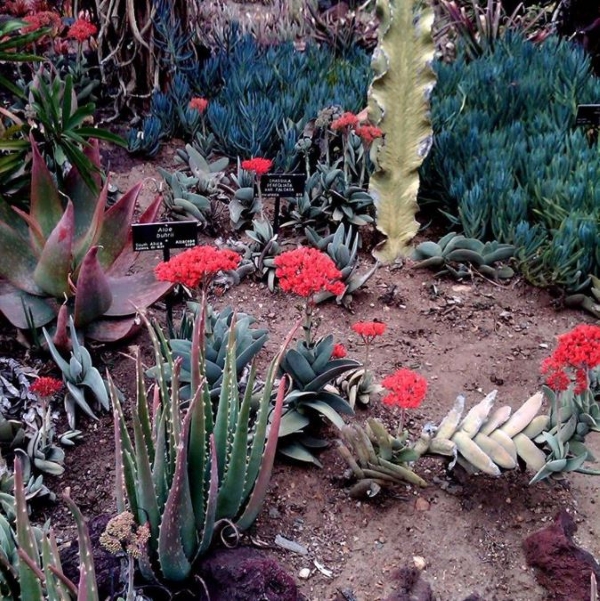
Sylvian would also reveal that ‘one of his final compositions is based on ‘Damage’. I was/am deeply touched by this and many other aspects of our friendship. Afternoons spent exploring his beloved cactus gardens at The Huntingdon in Pasadena. His poetry, emails, were immensely distilled. So in a sense, to speak of him is to say too much.’
‘It’s Steeper Near the Roses (for David Sylvian)’
String Quartet: John Acevedo – violin; Peter Kent – violin; James Sitterley – violin; Marston Smith – cello; Harold Budd – all other instruments, string arrangement.
Music by Harold Budd
From Avalon Sutra by Harold Budd, samadhisound, 2005
‘It’s Steeper Near the Roses (for David Sylvian)’ – official YouTube link. It is highly recommended to listen to this music via physical media or lossless digital file. If you are able to, please support the artists by purchasing rather than streaming music.
‘Templar’
Harold Budd – piano
Music by Harold Budd
From Perhaps by Harold Budd, samadhisound, 2007
On the closure of samadhisound the rights to Avalon Sutra and Perhaps were returned to the artist. Both albums were subsequently re-released with new artwork. Darla records put out Avalon Sutra, still available on bandcamp (both physical and download). Root Strata released Perhaps in physical format (vinyl and cd) for the first time. These are long since sold out, but the download can be found here.
The original pdf insert that accompanied the samadhisound download only release of Perhaps can be viewed here.
A small number of copies of Harold’s first book of poetry, Colorful Fortune, are available direct from Keith Lowe, priced at US$35 plus shipping. There are also a handful of copies signed by Harold, priced at US$125 plus shipping. Each book comes with a small promotional card. Contact moonlinermusic@mac.com for more information.
Steve Jansen has a page on his website dedicated to Harold’s farewell concert at the Brighton Dome, including photographs and some soundcheck/rehearsal video footage here. Russell Mills has a series of shots giving an impression of the lighting here.
David Sylvian quotes are from 2005 and Harold Budd quotes from 2014 unless otherwise stated. Full sources and acknowledgments for this article can be found here.
Download links: ‘First Light’ (Apple); ‘Wind in Lonely Fences’ (Apple); ‘Against the Sky’ (Apple); ‘Dark-Eyed Sister’ (Apple); ‘It’s Steeper Near the Roses (for David Sylvian) (bandcamp); ‘Three Faces West (Billy Al Bengston’s)’ (bandcamp); ‘How Vacantly You Stare at Me’ (bandcamp); ‘Templar’ (boomkat); ‘The Photo of Santiago McKinn’ (bandcamp); ‘Down the Slopes to the Meadow’ (bandcamp); ‘Saint’s Name Spoken’ (bandcamp)
Physical media: Ambient 2: The Plateaux of Mirror (Amazon); The Pearl (Amazon); Avalon Sutra (bandcamp); Perhaps (discogs); By the Dawn’s Early Light (discogs)
‘I was having such a difficult time…I thought [Avalon Sutra] was a really good album, a good strong album. A mutual friend of David Sylvian’s and me got us together for lunch in LA…and David said he would like me to consider giving him the album and having it earn some money. That’s the way he put it, “You might as well have it earn some money while you’re just kind of brooding about things.” .And I thought, well this is a very sensible idea…I gave it to David and I’m so happy with what happened. His production value is so acute and so sensitive and art-driven. He’s a true artist that guy.’ Harold Budd, 2012
Related articles featuring the wider samadhisound catalogue:
The Good Son – She is Not
Blemish (remixed by Akira Rabelais) – End Times
Cancelled Pieces – Playground Martyrs (reprise)

Brilliant…as always.
Many thanks!
LikeLiked by 1 person
Thank you for reading.
LikeLike
I have copy ‘R’ of Aurora Teardrops. You have to hold and feel the book to understand how beautiful it really is. Heavenly Monkey did a wonderful job and it represents Harold Budd wonderfully. Some of the poetry is striking – almost haiku-like.
LikeLiked by 1 person