In the months that followed the autumn 1987 release of David Sylvian’s Secrets of the Beehive, listeners came to recognise its restraint and sensitivity as marks of a very special album. The nine tracks from ‘September’ to ‘Waterfront’ took only around 35 minutes to experience. There was not a spare musical gesture throughout the running order, all that was present was what was necessary to give expression to the compositions that had come so naturally and unexpectedly to the songwriter as his Gone to Earth press tour had come to an end.
I think the first time I discovered that the album may not be exactly what Sylvian had envisaged was a 1988 interview with guitarist David Torn in which he discussed his involvement with Secrets... ‘He was that man that rang me,’ said Torn of first contacts, expanding on the recording at Miraval Studios in the South of France: ‘I really was left this wild card position where he didn’t know what he wanted me to do before I started reacting to the tracks. So we did a solo on ‘The Boy with the Gun’ and I played my koto guitar on ‘Maria’.
‘He’d run pieces on tape and I’d just react to them and start playing. David would play it back and say, “the area that you were in here, give me something more.” We spent two or three days doing some really nice things. Some pieces worked and some didn’t. ‘Ride’ was my favourite track but – and I hope David’s going to read this – it isn’t on the record.’
Wait… what? There’s an out-take from Secrets of the Beehive that one of the key participants considers to eclipse the highs of ‘Orpheus’ and ‘Let the Happiness In’? I could scarcely believe what I was reading.
Sure enough, in Sylvian’s exquisite Vaughan Oliver designed lyric book Trophies, with fold-out cover artwork by Russell Mills, there were the words to this unknown melody, presented alone as ‘step four’, just as ‘Ghosts’ had been presented as the single lyric in ‘step one’. Sylvian certainly regarded the composition as a significant one. I would read the lyrics through and wonder how it might be given voice: an impossible challenge.
Sylvian would later express sentiments similar to those of Torn. ‘It was my favourite also. I was crushed when I wasn’t able to finish it first time around due to time and budget constraints’ (2002). When the sessions wrapped up, ‘Ride’ remained ‘far from complete due to my dissatisfaction with the rhythm track.’ (2021)
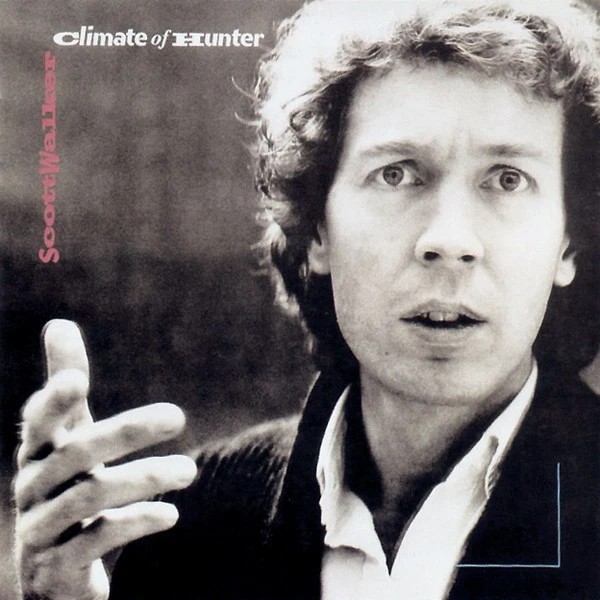
To mark the release of Brilliant Trees in 1984, Sylvian had appeared on Ryuichi Sakamoto’s Sound Street radio show in Japan. One of the pieces he selected for broadcast that day was ‘Track Seven’ from Scott Walker’s album Climate of Hunter, which had been released on Virgin Records earlier the same year. ‘It disappeared without trace,’ commented Sylvian on the LP. ‘Nobody really bought it…I used to hate his voice. I found it too melodramatic, but just this album changed my mind. I don’t know why. The music’s really basic…It’s just got a sort of atmosphere to it. It’s really interesting, and I like it.’
US-born Scott Engel took the stage name Scott Walker as part of The Walker Brothers, whose members were not actually related. The outfit enjoyed two chart-topping singles in the mid-1960s with the ballads ‘Make it Easy on Yourself’ and ‘The Sun Ain’t Gonna Shine Anymore’. Splitting shortly afterwards, Scott then produced four solo records – Scott through to Scott 4. As sales dramatically diminished for the final instalment, which failed even to chart, he went on to release some ‘easy listening’ covers albums before The Walker Brothers were reformed, scoring another hit with ‘No Regrets’ before their final album Nite Flights.
The four songs that Scott penned for that final disc, including the title track and ‘The Electrician’, pointed towards the uncompromising musical direction in evidence on Climate of Hunter. The credits of the latter include some familiar names to Sylvian enthusiasts: Mark Isham, Brian Gascoigne and Phil Palmer all being participants in his ’80s work. One musician present would go on to work with Sylvian in the future: free improvising saxophonist Evan Parker.
‘My experience of working with Scott Walker was short but unforgettable,’ Parker remembered. ‘I was puzzled about why he wanted me. I was not known as a session player…I asked his office to get Scott to call me. He made clear immediately that “this is not a funk session”, that he knew my work and had the idea of piling up layers of it. He mentioned Ligeti. At that point I was in. I feel that those tracks on Climate of Hunter were the start of what became an ever more radical direction in his music. His subsequent commitment to explore to the limits make him one of the great individuals of our times.’ (2019)
Climate of Hunter was ranked at No 5 in NME’s top albums of 1984, ahead of Prince’s Purple Rain (8) and U2’s The Unforgettable Fire (35), with Brilliant Trees at No 41, but – as Sylvian intimated – sales of Scott’s album were unspectacular, peaking at 60 in the UK chart. Virgin had waited a long time for the first fruits of the twelve-album deal that they had struck with Walker and relations with the label became strained after Scott began studio sessions with Brian Eno and Daniel Lanois in the control room, only for the project to be abandoned. This line-up sounds truly intriguing, all the more so with the news that Robert Fripp was also involved, the recordings happening around the same time that Sylvian was laying down Gone to Earth.
Fripp: ‘David asked me to play on the album Gone to Earth. It was the second session I did with the new standard tuning, which was difficult because I hadn’t really found my way around it. The other session with the tuning was with Scott Walker; Eno was producing, and Daniel Lanois engineered. Scott came up with these absolutely hair-raising parts. So, I had to go back to the old standard tuning, so I could play them.’ (2022)
As the ‘8os drew to a close, Walker was in deadlock with Virgin whilst Sylvian had a song he believed in but which he had not been able to complete to his satisfaction for his latest record. Somewhere along the line, David decided that his unreleased opus might be a good fit for Scott. ‘I originally sent a composition to Scott just to see if he’d be interested in recording it. It was actually ‘Ride’…I felt it would have suited Scott’s vocal style. And he responded well and asked to meet up. And we did. We talked about recording albums. The initial idea of recording one track just evolved into multiple albums. For some reason I never fully believed that this was going to take place. But if I could be in any way of assistance helping Scott get back into the studio recording again, I thought, that’s fine by me. I needn’t be involved in the project. So I was basically there for that purpose, I felt.’ (2000)
‘Some collaborations have an inevitability about them, are well balanced in what each has to offer. I didn’t believe this of Scott and I. We both had our work, didn’t truly have the need of the other. I’d offered him the song ‘Ride’ for his consideration…To his manager’s astonishment he asked to meet (apparently he turned down all offers). He wanted to write more pieces together. I agreed but felt I was helping him out of his deadlock with Virgin, certain that nothing would come of it. I spoke with V[irgin]. They agreed to fund two albums. The condition being if Scott walked, I’d finish both. Since Scott had walked away from the album he’d started with Lanois and Eno he was in limbo. Virgin told him he’d have to produce demos before he’d be allowed back in the studio. That was never going to happen. We’d meet, talk, share references. I [was] still of the mind this would never happen so I started Rain Tree Crow. He called me in the studio: “Got tired of waiting for me?” He’d been bought out of his contract, was free.’ (2021)
Despite Walker solving the label impasse, the plan to collaborate was still being referenced in Sylvian’s promotional interviews after the Rain Tree Crow project was completed. Indeed, it was spoken of as more of a certainty than a mooted post-Gone to Earth reunion between David and Robert Fripp. As it was, Sylvian/Fripp would soon come to fruition whereas Sylvian/Walker never materialised. Sylvian: ‘After I moved to the US I got a message he wanted the chord sequence for ‘Ride’. Was surprised. Nothing more came of it.’ (2021)
With respect to Sylvian’s incomplete recording of the track, the advent of the world wide web brought the fan community together in ways that were previous inconceivable and a flurry of online excitement ensured when the briefest loop of the song started circulating, apparently shared by someone with access to the studio tapes. Finally, here was something on which to hang my imaginings about the missing component of an album which had now been treasured for years. An accompanying image of a BASF tape shows the track sequenced after ‘Orpheus’ and before ‘Let the Happiness In’, at the mid-point of the running order.
As Sylvian returned to the public spotlight with Dead Bees on a Cake at the end of the ’90s, his first solo record since Secrets of the Beehive, he declared his intention to progress with a retrospective project for which Virgin had been pressing for years. ‘There are aspects of it I really am looking forward to,’ he said. ‘I am going to re-perform a number of the pieces from the past. Then there were some really strong pieces that just don’t make it on to the final albums due to budget restrictions or whatever other problems, obstacles that I’ve come across over the years. There’s some really beautiful material that’s just never seen the light of day, and I hope to incorporate a number of those pieces on the album. So there is reason for me to feel enthusiastic about completing the project.
‘There’s a piece called ‘Ride’ from the …Beehive sessions, which was actually the centrepiece of the album. I mean it kind of made sense of the whole for me. It just never got completed due to budget restrictions, you know I ran out of money, Virgin weren’t willing to put more into it so the album had to be wrapped up as it was. There’s actually two tracks from that series of sessions [with ‘Promise (the cult of Eurydice)’], ‘Ride’ being by far the most important track.’ (1999)
When the compilation came in 2000, we could finally hear the entirety of the song rather than that tantalising but unsatisfying lo-fi mini-edit. Listening to the track whilst reading the credits was like stepping back to re-live that first experience of …Beehive in 1987. The languorous introduction reintroduces us to some principal players: Phil Palmer’s finger-plucked acoustic guitar, Mark Isham’s lyrical trumpet, and Ryuichi Sakamoto’s crystalline piano. Sylvian’s reconciliation with his brother, Steve Jansen, for the later stages of the Dead Bees on a Cake recordings provided the opportunity for the rhythm to be reconstructed as Sylvian envisaged, brushes to the fore as the song begins.
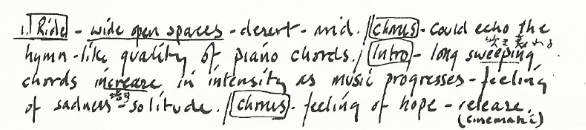
One of the delights of ‘Ride’ is the way the dynamic evolves as the piece progresses, opening out into the choruses where Ryuichi’s string arrangement swells. Sylvian’s handwritten notes for Sakamoto provide pointers on the feel he was looking for. ‘Wide open spaces’ is underlined, ‘desert – arid. Chorus – could echo the hymn-like quality of the piano chords. Intro – long, sweeping chords increase in intensity as music progresses – feeling of sadness – solitude. Chorus – feeling of hope – release (cinematic).’
Percussion accents add momentum in the choruses. Interviewed for Anthony Reynolds’ book Cries and Whispers, Danny Cummings recalls that he ‘played batá on ‘Ride’, they’re Afro-Cuban religious drums which I was obsessed with at the time, so I was so happy to hear them recorded in such good quality by [Steve] Nye’ (2018). These hand-struck drums are surely what we hear on the excerpt of the original recording, but by the time the song was finally released the credits informed us that all percussion parts were performed by Steve Jansen. Danny Thompson is present on double bass, less prominent than in the online snippet and certainly less so than for the pièce de résistance that is ‘Mother and Child’, and we hear those electric guitar responses that David Torn remembered fondly back in the 1988 interview. Sylvian’s vocal was recorded especially for Everything and Nothing.
‘Messages ran all over town
Words without sound
Condemned me
And left me for dead
All over again
It wasn’t the first time, but this time
Things will never be the same’
Sylvian has often spoken of the need to reflect both light and dark in his work so as to represent something that is true to our human experience. Secrets of the Beehive contrasts the domestic violence of ‘When Poets Dreamed of Angels’ with the anticipation of ‘Let the Happiness In’, a conscious opening of the soul to a hope that seems assured of fulfilment. ‘Ride’ embraces both sentiments. The opening verse depicts an individual all but destroyed, yet as the music broadens out horizons in the chorus, the call is to ‘ride’: to move forward, damaged but defiant, to put the negative beneath you and to seek release by focussing heavenwards.
‘Ride
Ride the very thought into the ground
In the church of lost and found the angels cry
Ride
Ride until the darkness closes in
Until the ravaged soul begins to reflect the open skies
Ride’
The pattern repeats in the second verse which recounts a striking scene of devastation – likely an allegory for the loss of traditional faith – and hopelessness (tilting at windmills)…
‘The chapel was burned
Razed to the ground
From the darkest of clouds
Small birds tumbled like rain
Time and again
You may go charging at windmills
In these days
Absurdities never change’
…but again the listener is buoyed as the musical arrangement rises towards the release of the chorus, the song’s final lines encapsulating the imperative to beat our own path, free as the eagles that ride the thermals above us.
‘Ride
Saddle up your thoughts and run to ground
In this world of lost and found the eagle flies
Ride‘
Running at 8 minutes, ‘Ride’ would have been by far the longest track had it been included on Secrets of the Beehive, a centrepiece of substance, drawing together the album’s thematic and musical threads. There was talk of reissuing the 1987 album with the tracklisting that the artist had originally intended. Sylvian commented, ‘You know, I would love to do that,’ (1999) – but as yet the ambition has never been realised.
‘I never felt that the outtakes that appear on this this album are sub-standard in any way,’ Sylvian said when Everything and Nothing was complete. ‘They were just out of context or I didn’t have time to complete them. But they are as strong as much of the other material that I was recording at that moment in time. ‘Ride’ is as strong as, if not stronger than, just about anything on Secrets of the Beehive, for example. So I had no concerns about going back and fishing these out; it was actually a pleasure to bring them to completion.’ (2000)
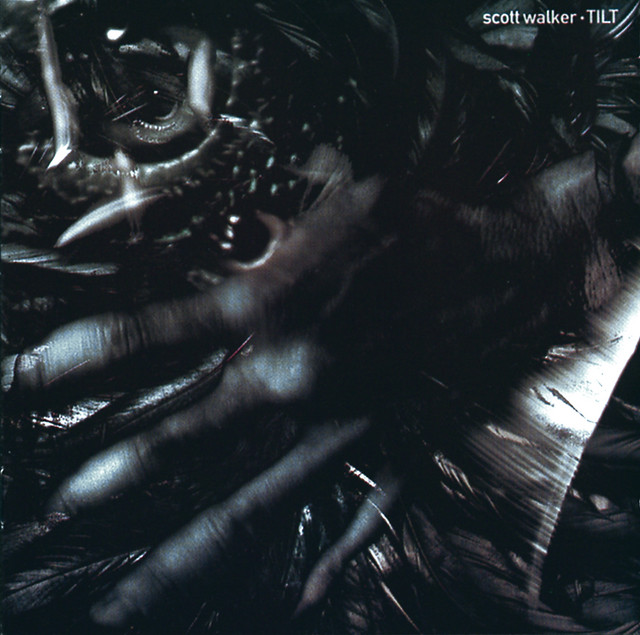
The album that Scott Walker released to follow on from Climate of Hunter was Tilt. It was not released until 1995, but most of the songs were written around 1991-92, the period when the possible ‘two vocalists’ album with Sylvian might have been recorded. The were again cross-overs in the musicians present – David Rhodes and Brian Gascoigne had worked with Japan/Sylvian previously and John Giblin would go on to appear on Dead Bees on a Cake. Sylvian selected the opening track, ‘Farmer in the City’, when compiling a playlist for Apple’s iTunes in 2009. ‘The greatest voice of his generation’, David commented. ‘As a composer, his trajectory has been like that of a flare sent up from the darkness of a small boat in uncharted waters.’ Tilt was a journey deeper into the avant-garde. Sylvian: ‘It was and remains a remarkable work.’ (2005)
When reflecting on the collaboration that never came to be, Walker drew a distinction between his own outlook and that of Sylvian. ‘He’s much more of an ethereal merchant than I am,’ he said of David. ‘I am a man who struggles with spirituality, whereas he’s given in to it. My album and the one before it [Tilt and Climate of Hunter] are about struggle in the Dostoyevskian sense. It’s a real fight for me in every line. Whereas he’s given in to a state of grace.’ (1998)
Sylvian grew to admire Scott’s work pre-dating Climate of Hunter, that which he had described as overly melodramatic in the radio interview with Sakamoto in 1984. Confirming Walker as an inspiration, he said: ‘With the exception of a couple of mis-steps in the early ’70s, I’d say all of his solo work makes for essential listening, particularly the Scott series and from Climate… to Soused (plus 4 [tracks] from Nite Flights).’ (2021)
There are certainly parallels in the two artists’ willingness to eschew the commercial in favour of explorations into the margins of what a song can be. Scott Walker could have continued to record ballads for the masses but chose a path that was true to himself, even if his potential audience reduced as a result. Sylvian would be oft begged to record another Secrets of the Beehive but chose a different direction which ultimately led to Blemish and Manafon, two records unlike any others I have ever heard.
Sylvian acknowledged Walker as a pioneer after the recording of Blemish. ‘I feel that at this point in the evolution of song (to quote Mr Porter) anything goes. It’s what we can pull from the more general field of song writing into the present time that might still have currency, that a writer may connect with, turn it on its head, and spit back out as an entirely new breed of song, that’s of interest. Tom Waits drags the blues kicking and screaming into the 21st century and in doing so renews its currency and extends its vocabulary. Singer/writers such as Robert Wyatt, Scott Walker pull on half a century or more of influences to create a vocabulary of their own. I have attempted to find my own way with song.’ (2004)
Blemish, it seems to me, was the manifestation of an artistic outlook that Sylvian said the pair shared, his quote coming from around the time of their possible collaboration. The two may not have directly worked together, but their subsequent work bears this common essence: ‘The only person I’ve found to agree with me on a certain approach to writing is Scott Walker in a comment he made to me. I mentioned something about recording an album being very difficult and very painful, and he said, “that’s the way it should be, if it isn’t there’s something wrong.” That’s what I’ve always felt to be true, but a lot of people I’ve worked with don’t share that. It is important, because the actual process of writing and recording, although it is a by-product of your life’s experience, it itself becomes a life experience through the process of making it. It becomes part of your learning process. The process of making a record is normally very difficult; very challenging and emotional on all different kinds of levels, but by the time you complete a project it holds within it that experience. That emotional depth is captured in the work somehow. And that can be brought out through the excavations of the listener if they care to probe that deeply.’ (1991)
For a nod to Scott from the Blemish period, listen to Sylvian’s refreshed arrangement of ‘Maria’ from Secrets of the Beehive for his Fire in the Forest tour, and compare it with Walker’s setting for ‘It’s Raining Today’ from Scott 3. They each pursued the artistic path, rather than a “career” in music. Sylvian: ‘It was an evolution, growing up in public etc. By the time I’d come to my senses I’d realised what it was I didn’t want and what it was I was going to have to sacrifice to do differently. I daresay there aren’t that many of us that have taken this particular divergent path away from the spotlight to the periphery but I’m certain that in most cases it’s a matter of personal necessity…Survival wouldn’t be too strong a word to use, certainly in someone like Scott’s case. The spotlight was ill-fitting.’ (2010)
A few days after Walker passed in 2019, David shared on social media: ‘Scott was complex, as uncomfortable/unsettled in the world as was his later work. The Scott albums of the late sixties and everything he created post Climate of Hunter was a creative leap into the unknown. Possessor of “the voice” so many of us believed unsurpassable.’
In a more extensive tribute published in The Guardian, he wrote: ‘Those of us who spent time with Scott clearly encountered the same man, but came away with different interpretations or impressions of him, as he only gave away so much. He appeared to me to be highly complex, neurotic and uncomfortable in his own skin, which created the image of an antisocial man who might have longed to be anything but under different circumstances – he’d sometimes surprise me, turning up in a crowded backstage environment, seemingly at ease, commenting playfully on the performance. He was vulnerable in many respects, but not a pushover. He liked a joke, but wasn’t into small talk. Guarded but intellectually and artistically rigorous, and entirely authentic.
‘He was in a contractual bind when I met him, and we’d come up with a plan that’d put an end to the predicament. I never truly believed we’d see it through, not that it was unrealistic, but I hadn’t anticipated this might be the outcome of our first meeting and it would’ve meant a good deal of commitment on both our parts. Then there was procrastination on Scott’s part, which meant that at the end of every phone call, letter, or meeting, there was no clearer indication of the content of the proposed album other than a few chord sheets taken from Messiaen along with some requested literary references. About a year after we first met, I was in the midst of recording another album, and Scott called the studio. He was laughing, kidding me: “So you got tired of waiting, huh?” But the good news was that a company had bought him out of his contract with Virgin, and he was now free to pursue his vision unhindered by CEO oversight. That was a blessing for us all due to the quality, the unfettered originality, of the resulting work.
‘As a vocalist, at the height of his popularity, he was unsurpassable and influenced multiple generations as a result. His later work impacted many of the same artists whilst reaching newly receptive listeners who’d not hold him to the same standards of his earlier work. It was a real rebirthing of the artist that only a few manage to achieve in the world of popular music. The work Scott produced as a young man, and particularly that of his later years, will endure, as it is authentic, heartfelt, and visionary, produced in an environment, a genre of the arts, where such qualities are rarely encouraged or embraced.
‘Musically and lyrically, he ultimately charted a path that was entirely his own, beyond imitation; a singular path created by a visionary artist. His influence, should others wish to follow, might encourage the path of no compromise, allowing oneself to mature as artist, and trusting the resulting work will find an appreciative audience. “To be an artist is to fail, as no other dare fail,” as Beckett wrote.’
‘Ride’
Mark Isham – trumpet; Steve Jansen – drums, percussion; Phil Palmer – acoustic guitar, Ryuichi Sakamoto – piano, synthesiser, string arrangement; David Sylvian – synthesiser, vocal; Danny Thompson – double bass; David Torn – electric guitar
Produced by Steve Nye and David Sylvian. Remixed by David Sylvian with Dave Kent. From Everything and Nothing, Virgin, 2000.
Taken from the Secrets of the Beehive session, completed 2000.
Music and lyrics by David Sylvian
lyrics © copyright samadhisound publishing
‘Ride’ – official YouTube link. It is highly recommended to listen to this music via physical media or lossless digital file. If you are able to, please support the artists by purchasing rather than streaming music.
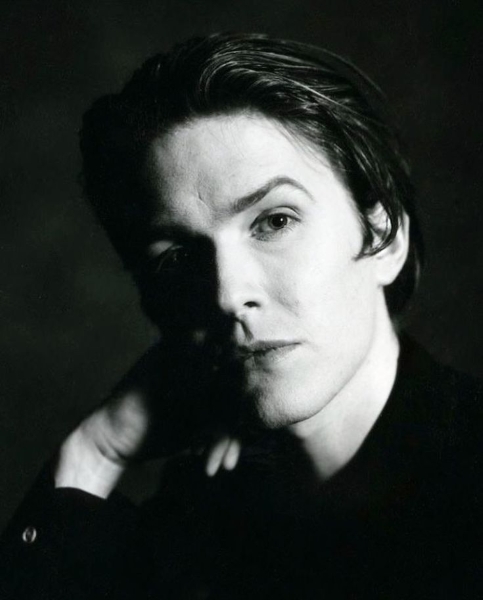
The featured image for this article is a promotional photograph taken by Nick White in 1987.
Full sources and acknowledgements for this article can be found here.
Download links: ‘Ride’ (Apple), ‘It’s Raining Today’ (Apple), ‘Track Seven’ (Apple), ‘Farmer in the City’ (Apple)
Physical media links: Everything and Nothing (burningshed), Scott 3 (discogs), Climate of Hunter (discogs), Tilt (discogs)
‘I considered ‘Ride’ the centrepiece of Secrets of the Beehive. However, it acquired a rhythm track I found problematic but the budget ran dry before this could be addressed. [I] managed to redress this and add [the] vocal prior to parting ways with Virgin.’ David Sylvian, 2021
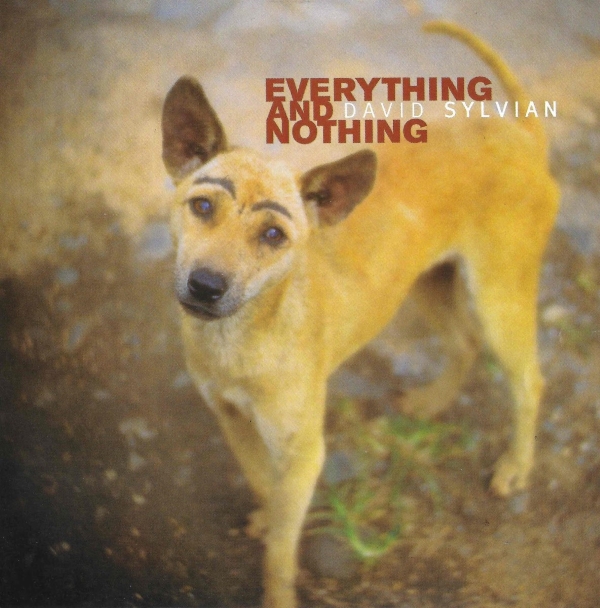
More about Everything and Nothing:
The Scent of Magnolia
Albuquerque (Dobro #6)
Aparna and Nimisha (Dobro #5)
Bamboo Houses (remix)
Come Morning (remix)

Wonderful piece David.
THANX
LikeLiked by 1 person
Thanks for reading, Nick.
LikeLike
Certainly a lovely song with a certain gravitas of its own but I love Secrets of the Beehive. I don’t think it needs Ride. As an album it is an astonishing work.
LikeLiked by 2 people
Great song, love the change of key into the chorus and that brilliant chord back into the verses, but for me the remake suffers from a too-rigid rhythmic approach from Jansen and Sylvian’s ultra-dry vocals. What a shame we never heard it with its original ‘Secrets’ vibe.
LikeLiked by 1 person
I’m forever hoping we one day see a reissue of Secrets of the Beehive with a working (even if rough or incomplete) cut of “Ride” from the original sessions, and preferably with the original track sequencing. I love the version of “Ride” we got on Everything and Nothing, but I’ve longed to hear the song in its original sound world since hearing that 20-second bootleg snippet years ago. Perhaps one day.
LikeLike