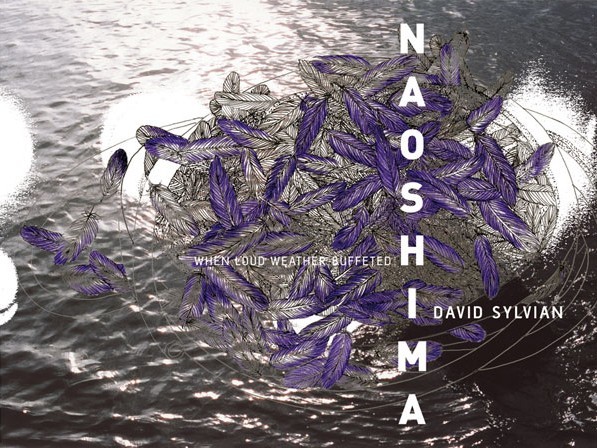
When Loud Weather Buffeted Naoshima

‘musique concrète meets Foley artist’

In a 2010 interview, David Sylvian was asked to identify how his experience of the East had influenced him as a human being. ‘I think it affected me in ways that have been so completely absorbed and assimilated that it’s hard for me to comprehend the degree to which I’ve been influenced by my engagement with Eastern culture,’ was the preface to his reply. ‘I might point to the influence of Zen Buddhism and, to a lesser extent, Shintoism and the guiding roles they’ve played in my personal evolution. The beautiful artifice of popular culture and the mutability of persona. The embrace of one’s masculinity and femininity on equal terms, without conflict.

‘Then there are the friendships which grew over time with Japanese artists, musicians, composers, all of whom hold an important place in my heart. Musicians and collaborators such as Ryuichi Sakamoto, Toru Takemitsu, Otomo Yoshihide, Toshimaru Nakamura and, more recently, Dai Fujikura. Visual artists such as Shinro Ohtake, Shinya Fujiwara and Atsushi Fukui. I found a compatible aesthetic in many aspects of their work, particularly with Ryuichi, which reflected my own. I found a community of contemporaries in Japan which I failed to find in my own homeland.’

Continue reading “When Loud Weather Buffeted Naoshima”

Snow Borne Sorrow – Gone from the Landscape

‘a glorious piece of composition’

The final chapter of David Sylvian’s second volumesample of lyrics and poetry, Trophies II, contains a selection of compositions conceived as poems rather than words to be sung to music. The final piece is entitled ‘Gone from the Landscape’, and I remember how it pulled me up short when I read it for the first time. This was, after all, a volume published early in 1999 and containing the lyrics to Dead Bees on a Cake, undoubtedly some of the most joyful Sylvian has ever penned. Of course, the darkness is always lurking close to the surface, but here at the end of the book a shadow is cast heavy:

Continue reading “Snow Borne Sorrow – Gone from the Landscape”

The God of Single Cell Organisms

‘the muscle that connects me with the world’

Two voices share the listener’s focus on the opening track of Uncommon Deities, Jan Bang and Erik Honoré’s reimagination of the audio-visual installation of the same name staged at their Punkt Festival in 2011. First, David Sylvian reads Paal-Helge Haugen’s poem ‘The God of Single Cell Organisms’ in English translation, his precise diction crisply conveying the poet’s characterisation of a forgotten lesser deity who ‘in his impotence…seeks refuge among the microbes.’ As we grapple with the concept of a god who is so insignificant that ‘we cannot find him there, with our immense microscopes,’ a tight burst of bowed strings serves as the introduction to the second voice.

Continue reading “The God of Single Cell Organisms”

When We Return You Won’t Recognise Us

‘the interior life of a community’

March 2009. The venue is on the north-east coast of Gran Canaria, the near-circular island surrounded by the Atlantic Ocean. Part of a Spanish archipelago but geographically much closer to Africa. In fact, at its closest point, Morocco is less than a hundred miles to the East. Centro Atlántico de Arte Moderno (CAAM, or the Atlantic Centre of Modern Art) in Las Palmas has dedicated exhibition space to the second architecture and art biennial of the Canary Islands, with parallel presentations taking place at a number of venues across Gran Canaria.

Continue reading “When We Return You Won’t Recognise Us”

Atom and Cell

‘a small seed that burrowed its way into my mind’

Manhattan, 10th September 2001. ‘That’s where the story starts,’ David Sylvian confirmed to the host of BBC Radio 3’s Mixing It programme. ‘That’s because I was in New York the night before the attack took place. I was there with my wife and family, and Ingrid turned around to me and said, “There’s a really ominous feel in the city tonight, you know, that something awful is going to happen.”’

Continue reading “Atom and Cell”