
The Attenborough Centre for the Creative Arts is part of the University of Sussex, occupying an impressive building within their Brighton campus. Originally opened in 1969, the architecture was the design of Basil Spence, facilities being housed within three red-brick rings which apparently represent the unity between the arts. Despite earning listed building status in recognition of its architectural significance, the space was closed in 2007 due to funding difficulties. It ultimately reopened for public use in 2016 following extensive refurbishment.
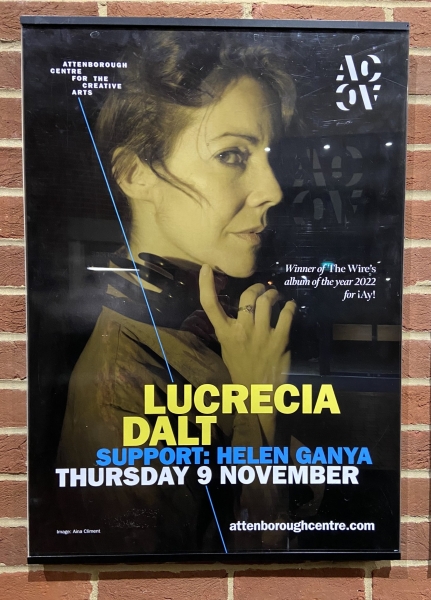
My first visit was on 9 November 2023. Wooden cladding lends the 350-seater auditorium an organic warmth that’s unexpected, given the stark brickwork exterior. I was drawn here for one of the final shows by Lucrecia Dalt in support of her much-lauded album, ¡Ay!. During the course of that year, Dalt performed 40 shows, commencing in her native Colombia and followed by extensive dates across Europe that were punctuated by visits to the US, Mexico and Canada. The first UK date of the year had been at London’s Kings Place in January, the publicity declaring: ‘Lucrecia Dalt presents a new duo show centred around her album ¡Ay!…On this record Dalt channels innate sensory echoes of growing up in Colombia, where traditional instrumentation encounters Afro-Latin syncopations and sci-fi meditations that bend time and topography.’
That same month, The Wire magazine published its run-down of the Top 50 releases of 2022, placing ¡Ay! in the number one slot. Curious to check out what had so impressed the critics, I tracked down the cd which undoubtedly became my most-played album of the year. The Wire noted that Lucrecia’s ‘music has turned away from abstraction and grown into something more alive. Where once her voice crept about below the surface, gurgling with effects or masked by reverb, in the opening seconds of ¡Ay!, she sounds transformed.’ Another characteristic of the stylistic shift was the impetus provided throughout by percussionist Alex Lázaro, who breathed a contemporary life into the familiar bolero rhythms of Dalt’s upbringing. She found in these sounds an effective antidote to the bleak Covid-19 times from which the album emerged: ‘It was cosy music to me and I wanted to return to that cosiness in the pandemic’ (2023). Music had the power to bridge the miles and her enforced isolation from family in Colombia. ‘I was here [in Berlin, her home at the time], they were there…The best way for me to describe it would be the memory of cosy meetings at home with my uncles, the family gathering and talking. The music was just there – very present.’ (2022)
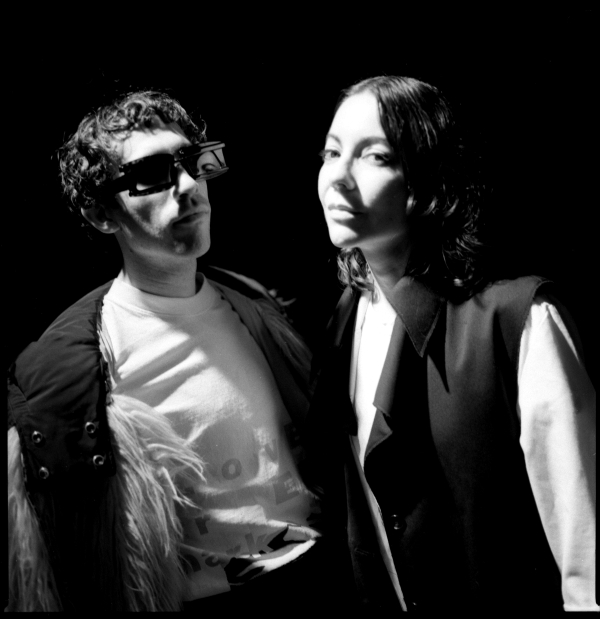
By the time of the gig at the Attenborough Centre in Brighton, Dalt and Lázaro had perfected their live duo rendition of ¡Ay!. The performance displayed an equilibrium established through compatible but opposite energies. If Dalt was the ice – cool, understated, static, reserved – then Lázaro was the fire – a bundle of exuberant (but precisely controlled) energy, flamboyantly leaping around to access the surrounding percussion, some mounted on stands above him. It reminded me that the physical and visual aspects of a well-honed performance are at the heart of the thrill of witnessing live music.
Supporting The Wire’s coverage of ¡Ay!‘s release in October 2022 was an online feature in which Dalt shared ‘a long playlist of tracks that inspired breakthroughs during the making of her brand new album.’ Lucrecia gave an example of such influence: ‘While frustrated one day while working…and wanting to trash my song ‘Enviada’ for spiralling into a deep state of corruption, Scott Walker’s ‘It’s Raining Today’ affronted me with some much needed questions: What if there was a sudden stop in the song? What if there was a cluster of strings and synths on one side of the track, alienating it completely? What if my voice sounded even deeper? And what if all this creeping around could be balanced with a simple flute hook like the one in Roberto Carlos’s ‘Detalles’, and end in a slow tumbao delight like that of ‘Yo No Tengo Pena’ by Angel Canales and Markolino Dimond?’
Alongside selections from the likes of Serge Gainsbourg, Harry Belafonte and Alice Coltrane on the playlist was ‘Canton’ by Japan. ‘I’ve been listening a lot to David Sylvian and Japan,’ Lucrecia told another interviewer, ‘and I just fell in love with that exact type of synth sound you hear on Tin Drum’ (2023). She professed that her Prophet synthesiser, used extensively as one of the lead voices on ¡Ay!, was her favourite instrument at the time.
Once the album was complete, Dalt decided to make contact with Sylvian. Both were residents of Berlin for a time in the late 2010s, but evidently they hadn’t become acquainted. Sylvian had once listed her album Ou in a magazine playlist of music he was enjoying: ‘I was really surprised…it was a very obscure record. It was an art project, it wasn’t really publicised, so I was really surprised that he even found it.’ There was an awareness of her work, at least, and a message was sent tentatively via twitter. ‘Sometimes you just feel compelled, and you’re like, “Maybe I’m embarrassing myself, but I’m also being honest, so what the hell?”,’ she shared. ‘I wrote to him when I finished ¡Ay! to say that I admired his work, that I found it compelling and beautiful, and that some of the decision-making on the album was actually influenced by his sound, specifically with a Prophet synthesiser. So we met in that context of starting to share thoughts and ideas.’
Sylvian enthusiastically recommended the latest project on social media, writing: ‘Lucrecia kindly shared a preview of her latest album ¡Ay!. I believe it’s her strongest, most accessible work to date. Sensual, seductively surreal… In some respects it puts me in mind of the classic Comme à la Radio by Brigitte Fontaine.’ ‘Eventually, it became an invitation, and then eventually it became much more,’ explained Dalt.
In March ’23, she posted shots and a reel on instagram walking in the White Sands National Park and subsequently with Sylvian, evidently taken during a visit to his New Mexico home. The couple travelled together for Dalt and Lázaro’s show in Mexico City towards the end of May, each sharing pictures from the trip online, then Sylvian designed a promotional graphic for the final European leg of the ¡Ay! tour, including the show at the Attenborough Centre in Brighton. ‘He became everything: my mentor, my partner,’ Lucrecia recently told the New York Times.
Attention was by now firmly on the follow-up release to The Wire’s album of 2022 and Dalt was looking for a new context for its recording. ‘I was very ready to move out of Berlin, because I felt like I completed a cycle. I was living there for 11 years, and there was a moment in time that I felt I needed a closer sensation to something that I could call home that I wasn’t feeling there. I guess it has to do with many things. Growing up in Colombia, I was craving more sun. I was craving more time to just be still. I met someone who was living in New Mexico, and it felt like the perfect situation to try it out…’
A fresh environment also meant that all efforts could be directed towards creating new work. ‘This is the first time I allowed myself that space, because in the past I would be touring and travelling while I was recording…With the previous one, I was all over the place and I was doing like seven projects at the same time. That affects how you work on a project, and I loved dedicating all this time to this one. It’s something that I just want to do all the time now, if I can afford it.’
The contentment was evident in an instagram post from February 2024. ‘In the faraway, working on a new album and soundtracks. A form of self-imposed sabbatical. Overjoyed.’ The accompanying picture was a studio set-up in Sylvian’s home, the black mannequin hand familiar from the ¡Ay! tour and its publicity atop one speaker and one of the models of a human skull created by David Greenwood for the Sylvian/Fripp installation Redemption atop the other.
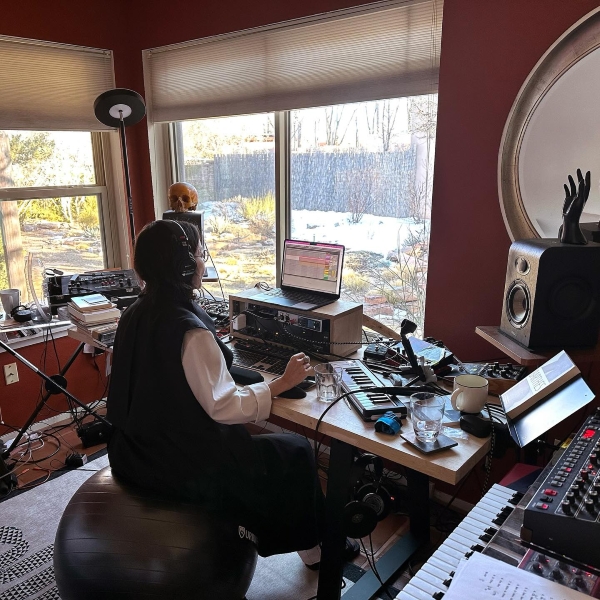
Almost a year passed before we would hear the first fruits of this time devoted to crafting sound. ‘This is the first record that, every day, I wake up with coffee and work for 12 hours or something, alone most of the time, until I have collaborators and then recordings and then mates and so on.’ The new surroundings proved conducive. ‘I tried really not to force it and be honest. When I feel like something is flowing, then it does and I do it. And that could be at 4am, it could be at any time. In the middle of the night I wake up and I’m like, “I have to do that!” and that’s why I really love to have the studio at home, because that way I feel I can just sit down whenever I want.’
A teaser video was uploaded on social media platforms in January ’25 announcing – with only a few days’ notice – the release of ‘Cosa Rara’ by Lucrecia Dalt, featuring David Sylvian. A black car – bearing the name of the song as its license plate – roars from a standstill to high speed on the open road, silhouetted mountains marking out the desert from the horizon.
‘Un día bien
un puma negro
el calor va desgarrando el suelo
a ciento cincuenta
van rebasando el ritmo del deseo’
‘A good day
a black puma
the heat is tearing up the ground
at one hundred and fifty
they’re overtaking the rhythm of desire’
‘This song originated from a drum loop that Alex Lázaro sent to me — like a secret agent of sound infiltrating my brain, every loop he makes feels like it’s got the DNA of the song embedded in its groove, and I just have to wait with a microphone in hand for the moment of fine-tuning to bust it all out,’ said Lucrecia in the release notes.
‘I just arrived here, I was driving through landscapes that are very desert-like and I think it was a time that, maybe I’m wrong, but maybe because I was reading a book that talks about John von Neumann that was the person that ultimately helped Oppenheimer. And I went to White Sands [where the world’s first nuclear bomb was tested in 1945 under Oppenheimer’s leadership], and all those thoughts combined into a road story, and ‘Cosa Rara’ with the rhythm that Alex had, combined into that.’
Then the arrangement of the piece was crafted through details. ‘I spent a lot of time, I guess it would be called sound designing, but I just call it musical decision-making because it’s fundamental. Without that little element, the song doesn’t make sense to me. There is all the structure, like in ‘Cosa Rara’, there is a little bumpy filter, and the whole song makes sense to me because of that or because of that little breath at the end. Everything becomes the composition in that way.’ Next the response of others was added, with bass player Cyrus Campbell taking the ‘rough idea of what the bass should be’ and developing his own interpretation. David Sylvian was credited not only for voice and feedback guitar, but also as co-producer and creator of the final mix, aspects that will be explored in a subsequent article.
‘This song is very visual for me, imagine the atmosphere of that video by Bos Hog – ‘I Dig You’ [see here]; a couple, full of chemistry, driving through deserts…’
‘a su lado va
un prometeo
en un pacto fino en México
y lo que to encuentras… en pedacitos todo el conspirer
Cuerto sis
ojos rolando van
alterando el rato (our own rapture)
suerte vil
adoración total
cosa rara hoy’
‘besides her
a prometheus
in a fine pact out in Mexico
and what is found: fragments of their conspiring
Room six
eyes rolling
altering time (our own rapture)
vile luck
total adoration
a strange thing nowadays’
‘The lyric paints an urban experience of the sublime, a deliciously lurid scene between two lovers, revelling in each other’s presence so fervently that they create a wild magnetic force field, attracting all sorts of delightful chaos around them. They disrupt the fabric of reality, with anomalies seeping in from the edges of perception.’
The emotions on ¡Ay! had been filtered through an invented extra-terrestrial figure, Preta, but now the approach is more direct. ‘I think it’s always a kind of fear to talk about personal stuff – or, I always felt it that way. I always felt vulnerable to speak about my own issues. And maybe because of that, and also my nerdy part, in the past I wanted to use more like a heavy concept and rely on that to be able to create. It was a tool.
‘But in this one – it’s definitely part of the relationship that was being born during that time, with someone who is also very sensitive, to let yourself go in the sound, in the feeling and allow it to be.’
Lyrics, then, that have their roots in reality, but ‘Cosa Rara’ is still touched by the surreal. ‘The story of this song…is to me almost like a neo-noir film by Nicolas Winding Refn. I love to think about stories just like that, as if there’s a weird phenomenon happening, but it’s not too far from how you might be feeling when you fall in love, because everything in you is altered and you perceive reality totally differently. So in a way, it’s like, how do I use metaphor, surrealism, and whatnot to make it a little bit more abstract and more interesting to me.’
‘después del fin,
respiro urgente
una luz blanca por todo el desierto (pregunta)
¿tienes fuego? (gotta light?)
le dice desgarrando su pensar’
‘after the end,
urgent respite.
a white light covers the desert, asking,
“gotta light?” (gotta light?)
he says, while tearing her thoughts apart.’
Dalt summons the spirit of David Lynch in these lines where the road-tripping couple, she says, ‘accidentally get to experience that bonkers scene from episode 8 of Twin Peaks: The Return, ‘Gotta Light?” Following footage of the detonation of that first atomic bomb in 1945 New Mexico, the viewer is transported forward in the programme to 1956 where two woodsmen appear and stop a couple’s car, repeatedly asking them: ‘Gotta Light?’ Terrified, the motorists flee.
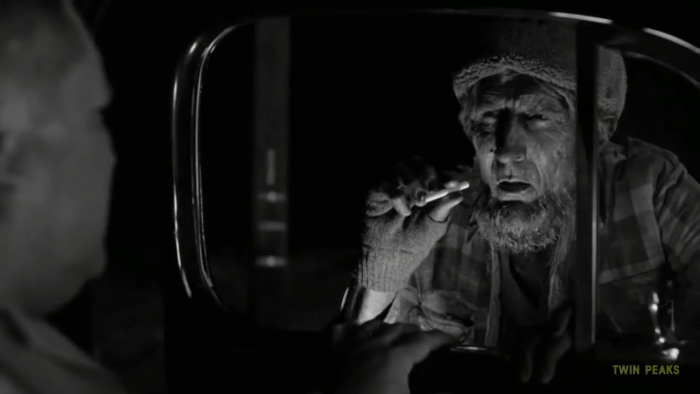
Lynch passed away just a fortnight before ‘Cosa Rara’ was released. In the hours after the news broke, Dalt shared another image from this Twin Peaks episode on her social media, taken from a sequence where a woodsman murderously invades a radio station and commandeers the airwaves, accompanying it with her words of tribute:
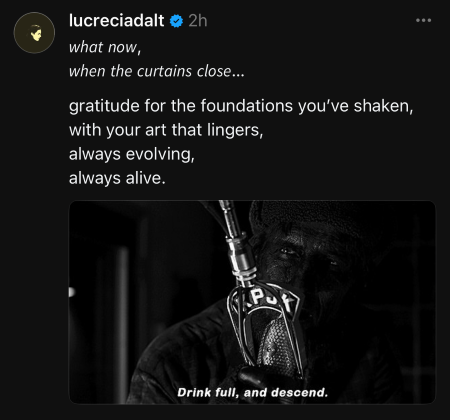
‘In case my last post wasn’t in any way clear due to message vs image,’ she explained, ‘the image belongs to part 8 (‘Gotta Light?’) of Twin Peaks: The Return, which to me is one of the most inspiring, mind-bending, unexpected pieces of art made for tv.’
Following the Twin Peaks reference in the ‘Cosa Rara’ lyric, there follows a crash and a change in momentum. Lucrecia: ‘As the first part of the track came together, I felt this wild urge to slow everything down to a sultry dub tempo, and that’s when David jumped in, adding his own unique flavour, textured voice, and guitars.’
Gravel-toned, Sylvian’s words convey both abandon and jeopardy:
‘We are out of favour
a danger to ourselves
it’s not amphetamines, it’s something else
my body’s smeared in bloody red
she said she loved me
but I don’t trust her yet
I’m not quite lucid, I’m far from clean
I’m plummeting slowly, doused in dopamine
the walls are thin, my nerves are shot
I’m vulnerable and I know it
is that door locked?’
The smash that brings the first phase of the song to a juddering conclusion is a reference to the protagonist lovers’ ‘fetish for car crashes’ which itself ‘alludes to the possibility of death…or a superconscious afterlife having experienced true devotion – hence: ‘my body smeared in bloody red’ or ‘I’m plummeting slowly, doused in dopamine’.’ Dalt would take the title of her subsequent album from Sylvian’s spoken-word coda – A Danger to Ourselves – with a later track picking up on the surreal fascination. ‘Mala Sangre’ (‘Bad Blood’) ‘depicts a crime scene of two lovers who just died in a crash, but the police find severe anomalies,’ the lyric describing ‘an amorous bloodletting act’.
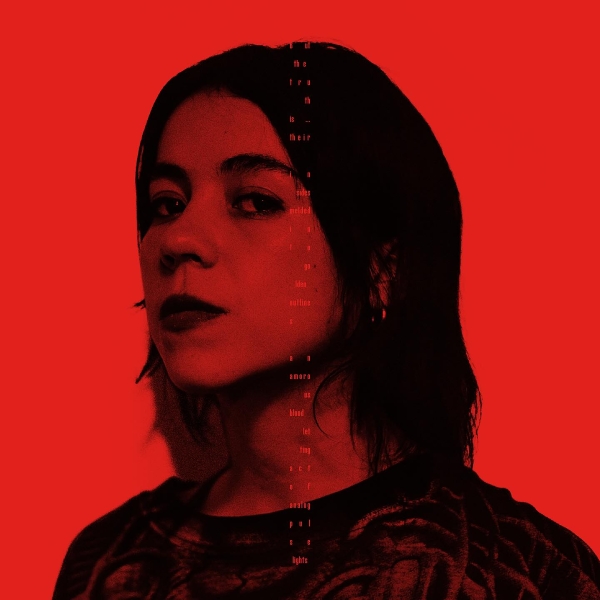
In a reveal staggered over a number of weeks running up to the release of the 7″ vinyl of the single, the ‘b’ sides were unveiled piecemeal. The first is a complete reinvention of the song from Guatemalan cellist and vocalist, Mabe Fratti. ‘And ‘Cosa Rara’ unfurls,’ posted Dalt, ‘transformed into its own enigma, this new playa version crafted by my dear and astonishingly gifted Mabe Fratti.’
Then came ‘the release of Matias Aguayo’s latest and final iteration of ‘Cosa Rara’. If you know the original song, it unfolds in dual segments – part A, vocalised by myself, refracted through Mabe Fratti’s lens, while part B, imbued with David’s haunting register, now cloaked by Aguayo in a shadowy, dopamine-soaked dub…So, delve into Matias’ version, turn off the lights and lose yourself in its rhythm and unsettling allure.’
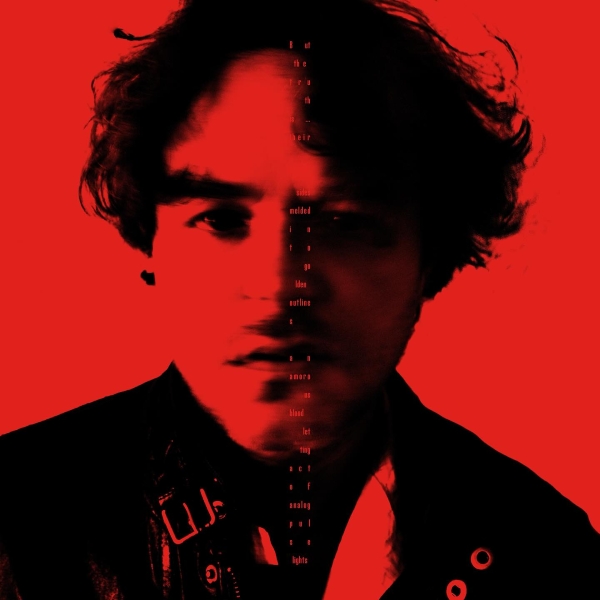
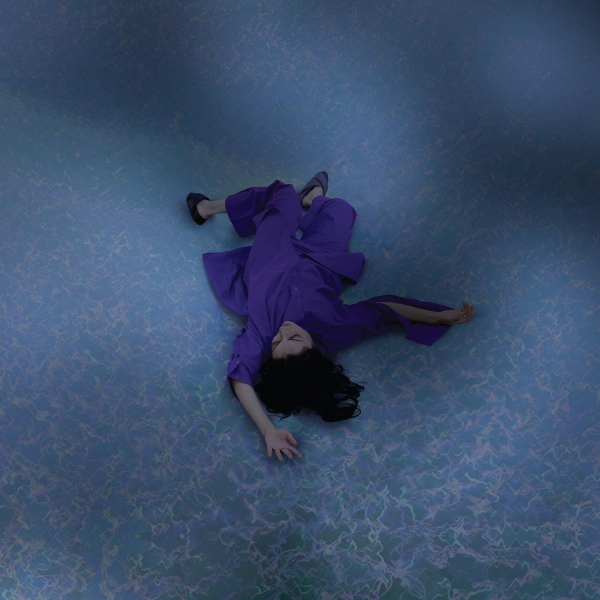
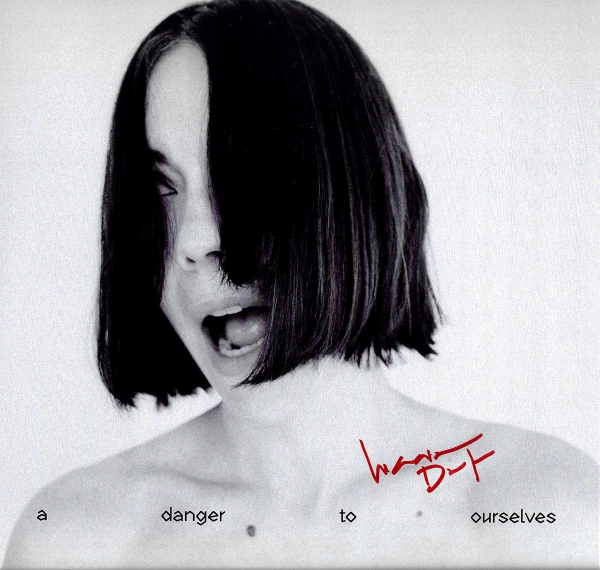
The initial single pressing was limited to 500 copies and sold out well ahead of its release date. This led to a repress which sported alternative cover art based on Yuka Fujii’s photograph of Lucrecia. Another new aspect of the second edition, which I suspect may have been missed by some, was that Aguayo’s ‘dopamine dub’ was presented on the vinyl in an extended version which twice repeats Sylvian’s part, the first clean and then the second radiating the treatments familiar from the first release. At the time of writing, the extended version has not yet been made available as a download.

‘Cosa Rara’
Cyrus Campbell – electric bass; Alex Lázaro – percussion; David Sylvian – feedback guitar, vocals; Lucrecia Dalt – all other instruments, vocals
Music by Lucrecia Dalt and Alex Lázaro. Lyrics by Lucrecia Dalt and David Sylvian.
Mixed by David Sylvian
From A Danger to Ourselves by Lucrecia Dalt, RVNG Intl (2025). Produced by Lucrecia Dalt and David Sylvian.
‘Cosa Rara (feat. David Sylvian)’ – official YouTube link. It is highly recommended to listen to this music via physical media or lossless digital file. If you are able to, please support the artists by purchasing rather than streaming music.
‘Cosa Rara (Matias Aguayo’s dopamine dub)’
Matias Aguayo – additional instruments, arrangement, production and mix
From ‘Cosa Rara’ (7″ single, first edition) by Lucrecia Dalt, RVNG Intl (2025). Produced by Lucrecia Dalt and David Sylvian.
‘Cosa Rara (Matias Aguayo’s dopamine dub)’ – official YouTube link. It is highly recommended to listen to this music via physical media or lossless digital file. If you are able to, please support the artists by purchasing rather than streaming music.
‘Cosa Rara (Matias Aguayo’s dopamine dub – extended)’
Matias Aguayo – additional instruments, arrangement, production and mix
From ‘Cosa Rara’ (7″ single, second edition) by Lucrecia Dalt, RVNG Intl (2025). Produced by Lucrecia Dalt and David Sylvian.
All Lucrecia Dalt quotes are from interviews in 2025, unless otherwise noted. Full sources and acknowledgements can be found here.
The featured image is the cover of the first edition 7″ vinyl of ‘Cosa Rara’, photograph by Yuka Fujii.
At the time of writing, Lucrecia Dalt’s playlist of tracks connected with the making of ¡Ay! can be explored here.
Lucrecia Dalt official sites: website, instagram, threads, bluesky, x, bandcamp, facebook
Download links: ‘Enviada’ (bandcamp), ‘Cosa Rara’ (bandcamp), ‘Cosa Rara (en la playa)’ (bandcamp); ‘Cosa Rara (Matias Aguayo’s dopamine dub)’ (bandcamp)
Physical media: ¡Ay! (bandcamp); ‘Cosa Rara’ 7″single, second edition (bandcamp); A Danger to Ourselves (bandcamp)
‘I create a lot of images that derive from movies and I complete them…Like how ‘Cosa Rara’ was imagined as a kind of road song that can be, in a way, a [David Lynch] Wild at Heart kind of vibe, but they get to experience whatever we saw in episode 8 of Twin Peaks, for example. I find it’s one of the most beautiful pieces David Lynch ever made. I felt the tension of terror and the music, and all the references there I found so appealing. I use my canvas to imagine things along the way in a parallel world.’ Lucrecia Dalt, 2025

After purchasing the single from Bandcamp, I edited together the song and the “dopamine dub” to create a slightly extended version in which the “sultry dub tempo” gets to linger for an extra minute before Sylvian’s vocal enters the mix.
LikeLiked by 1 person