I have written before on this site about the impact of attending the Punkt festival in Kristiansand, Norway, for the first time in 2011, drawn there by David Sylvian’s involvement as Artist in Residence. There were so many first experiences, hearing musicians play live whose work I have subsequently taken time to explore and which I have found to be tremendously enriching. On the opening evening alone there was Arve Henriksen, John Tilbury, Evan Parker, Sidsel Endresen and Philip Jeck. All gave performances in an art gallery surrounded by David Sylvian and Atsushi Fukui’s installation Uncommon Deities. Recorded readings by Sylvian and live recitations of the Norwegian originals by both Paal-Helge Haugen and Nils Christian Moe-Repstad were interspersed with the music, Sylvian observing proceedings from the sound desk at the rear of the space. What a line up to have in one room.
‘Philip Jeck studied visual art in the 1970s and has been creating sound with record-players since the early ’80s,’ read the introductory artist biography in the festival brochure, ‘working with many theatre and dance companies and playing with musicians/composers such as Jah Wobble, Steve Lacy, Christian Fennesz and Gavin Bryars. He has released nine solo albums, the most recent An Ark for the Listener on the Touch label…In 2009 he received a Paul Hamlyn Artists Award for Composers and in 2011 a Prix Ars Electronic Award of Distinction.’
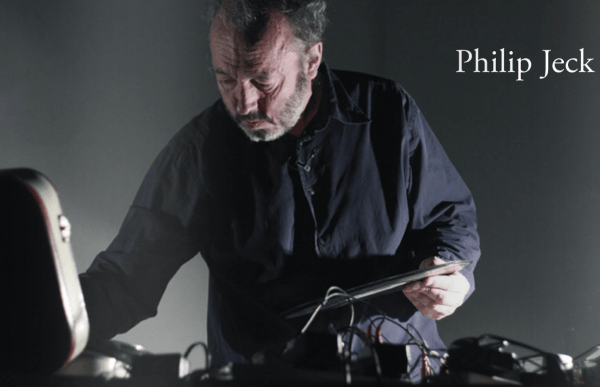
Philip would appear on stage with David Sylvian later in the programme for the one and only live performance of Plight & Premonition, the inaugural instrumental release by Sylvian and Holger Czukay. However, it was in the intimacy of the art gallery, as he evolved sounds with his pair of ‘carry-case’ portable record players, that one really appreciated his skill at summoning up an enveloping sound environment, within which Sidsel Endresen performed her improvised vocals.
‘My work is sourced from second-hand vinyl records which arrive via gifts and junk shops,’ said Jeck, ‘They contain much of the history of music. I continue to rework with them finding new meaning and emotional connections out of the “memory” recorded in each groove that can resonate with the listener. Each project I undertake is informed and determined by its place and time making each event a unique experience.
‘Here are some reviews which explain better than I some of my works:
“…with each new album, British turntablist Philip Jeck seems to be progressing closer and closer to his own warped conception of a kind of vinyl heaven: a place, perhaps, where forgotten records slowly dissolve into space, leaving only a vapour trail of their music hovering in the atmosphere.” (Stylus)
“…The impact Jeck makes with his limited means is hugely, billowingly poignant… it evokes a simultaneous sense of persistence and decay, both a profound sadness and a sense of joy.” (The Wire)’
At the heart of Jeck’s artistic practice was what he described as ‘an exploration of my continuing interest in the decay and rebirth of all that we hear and see.’
An Ark for the Listener was based on something that I knew well from my school studies, the album being ‘a meditation on verse 33 of The Wreck of the Deutschland, Gerard Manley Hopkins’ poem about the drowning on 7 December 1875 of five Franciscan nuns exiled from Germany.’ If you listen to tracks such as ‘The All of Water’ and ‘Chime, Chime (Re-rung)’, you will have a taste of the atmospheres that Philip concocted in real time that September evening in Kristiansand.
Sylvian’s appearance as Artist in Residence at Punkt marked a time of relatively heightened public activity. Died in the Wool, an album of Manafon variations, whose lead architects included Punkt festival founders and curators Jan Bang and Erik Honoré, had been released the preceding May. A standalone and expanded edition of his Amplified Gesture DVD, showcasing the work of free improvising musicians, was advertised in the festival programme for issue in September 2011 – although we would have to wait much longer to have it in our hands.
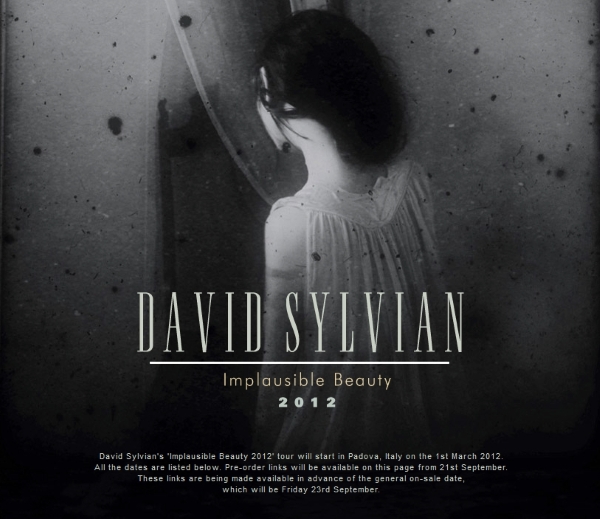
There was even a calendar bearing Sylvian’s keenly observational photographs, identifying interest, beauty and humour in the everyday, entitled Implausible Beauty. As 2011 came to an end, fans were pleasantly surprised by the announcement of a multi-city European tour under the same name, taking in landmark venues such as London’s Royal Albert Hall which Sylvian had last graced for a couple of nights with Robert Fripp back in 1993.
‘Some may have christened the project “The Implausible Tour”,’ read the samadhisound newsletter, ‘as David has become increasingly reclusive and private in most aspects of his life and the notion of live performance seemingly anathema to him. However, recently, he has found a line-up of musicians with whom he’s genuinely excited to perform live and to whom he’s most grateful for their commitment.’
Sylvian expanded on the topic in an online interview to coincide with the announcement: ‘The notion of a tour has been floating in the ether for a couple of years but, when considering recent releases, I couldn’t, in my own mind and within seemingly tight restrictions, make the transition from studio to stage. It’s the smallest of gestures or coincidences that can take something that seems completely unlikely into the realm of possibility. This is generally the coming together of one or two elements that act as catalysts for what will be. Working with Jan Bang might be considered one such catalyst. There’s an ease and a trust that’s growing between us that it’d be interesting to explore further in a live context which is where Jan appears to be very much at home. I’ve had notions in the back of my mind regarding the material, how it might be tackled. There are numerous possible permutations so it boils down to what appeals to me at any given point in time and what is a real possibility. Ditto the visual element of the performance.
‘It gets increasingly harder to put together the show one would like to take on the road, so one tends to wait until the cards line up in one’s favour. I think that’s currently what’s happening here.’
Alongside influential Punkt co-founder Jan Bang in the band line-up announced were guitarist Eivind Aarset, a stalwart of the Kristiansand event, fellow Norwegian and trumpeter Gunnar Halle, pianist Sebastian Lexer, and Icelandic cellist Hildur Guðnadóttir, a sample of whose playing had appeared on the title track of Died in the Wool. ‘I will be joining the lovely David Sylvian next year for his Europe tour,’ she wrote on her website. ‘It is a very exciting ride and I hope to see you all out there somewhere.’
Like Philip Jeck, Hildur was a Touch recording artist at the time, her debut release on the label, Without Sinking (2009), becoming a firm favourite of mine with its expressive cello set within a swirl of processed electronics, and bearing contributions from compatriots Jóhann Jóhannsson and Skúli Sverrisson, the latter of whom had played on Sylvian/Sakamoto’s ‘World Citizen (I Won’t Be Disappointed)’. ‘Elevation’ and ‘Overcast’, the opening pair of tracks, ably encapsulate the cellist’s inspiration for the project, which came from nature. ‘I wanted to have open space for single notes and let them breathe, like single clouds in a clear sky. As a contrast I also wanted to create denser and heavier compositions which were more thundercloud like. I like the way clouds form, how many tiny droplets can form such dense forms and then slowly evaporate into thin string-like forms.’
By this time, Hildur was already involved in creating soundtrack music, initially through her friendship with Jóhann (another artist with an early connection to Touch) with whom she shared a Berlin studio, appearing and collaborating with him on just about every film or TV project he was involved with.

Ultimately, David Sylvian’s Implausible Beauty tour would never take place, first postponed and then cancelled after Sylvian suffered a lower back injury that precluded him from performing.
In subsequent years Guðnadóttir’s soundtrack work continued, both in partnership with Jóhannsson and in her own right. Notably she was invited to participate in the music for Alejandro Iñárritu’s The Revenant, for which the main scores were composed by Ryuichi Sakamoto and Alva Noto. It was the director’s appreciation for the music of both Ryuichi and Hildur that brought them together. ‘It was a wonderful experience working with Ryuichi,’ Hildur later recalled. ‘He has the most beautiful, tuned and sensitive ears. You can feel him listening to sound with his whole body and that is beautifully reflected in his music. There is a delicate sensibility in his music, which is expressed in the movements he makes when he translates thoughts into music, when he talks about music. It’s like a dance. Working with him was a very stimulating process. His insatiable curiosity, his exploration of new sounds, and his open ear. Ryuichi has given the world a great gift with his music, and I am grateful to have been able to receive it.’ (2022)
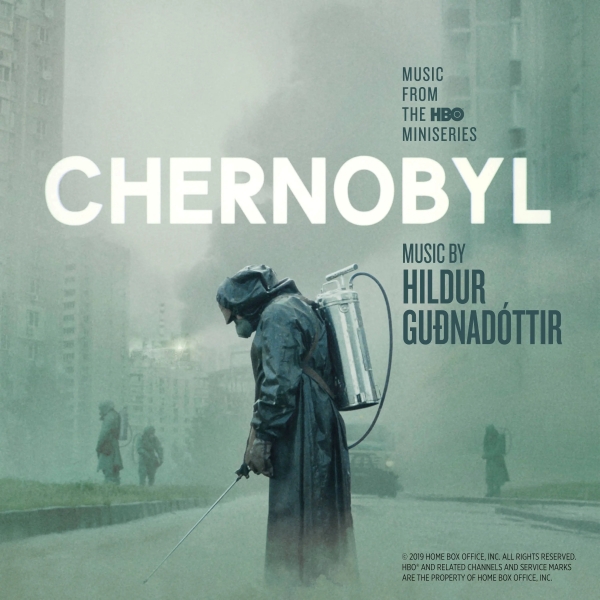
2019 was a year when Guðnadóttir’s music came to much wider attention with her compelling compositions for the HBO series Chernobyl and the movie soundtrack for Joker, starring Joaquin Phoenix, for which she received an Oscar for the Best Original Score at the 2020 Academy Awards ceremony.
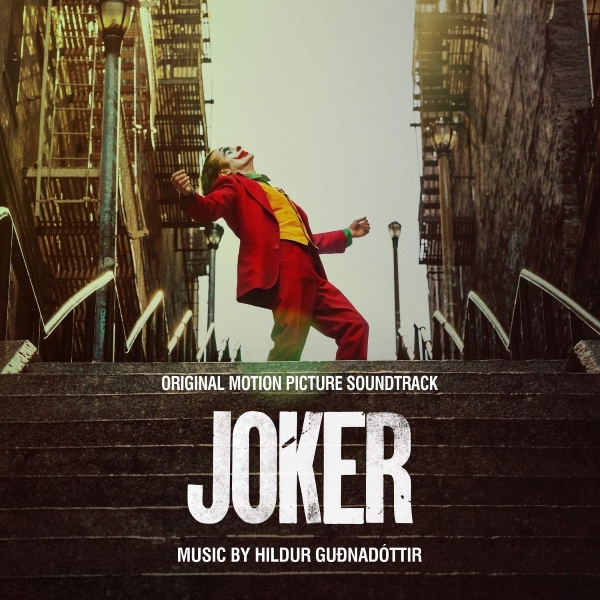
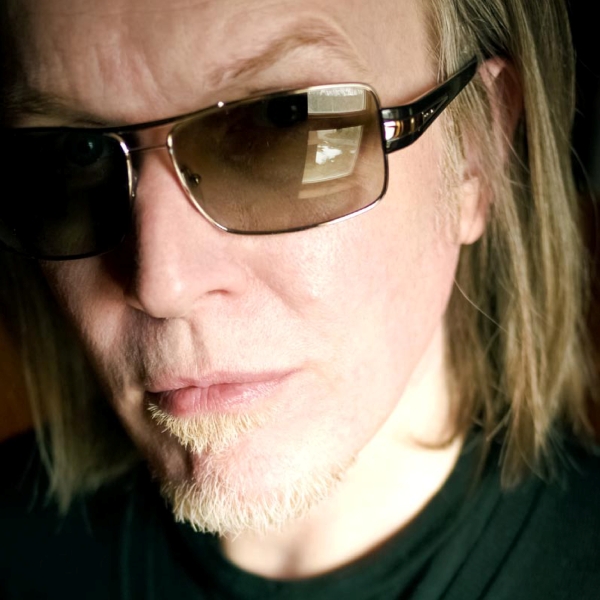
Guðnadóttir and Sylvian were both resident in Berlin during the mid-2010s and notwithstanding the aborted tour became firm friends and indeed collaborated as part of studio sessions that David held with a number of musicians across several Europeans cities during this time.
Hildur: ‘I remember vividly when I first heard David’s music and his voice. It was around 2003 and Blemish had just come out. And I just remember this feeling of being completely blown away by this record. I had never heard anything like it. Both the depth of David’s voice, his incredible lyrics and the sparse and exciting guitar arrangements. And how the voice and the guitar seemed to be simultaneously working together and against each other. It was just so beautiful and so striking and I just listened to that record pretty much on repeat for a long time.
‘Subsequently I got to know the rest of David’s work, became a big fan of his. In 2012, I think it was, we were planning to do a tour together and sadly that tour didn’t end up happening but David and I became friends and had a kind of long distance friendship for a few years, until we got to meet in person and make a bit of music together in Berlin, which maybe will see the light of day someday. But until then I, probably like the rest of us, continue to rejoice and marvel at David’s wonderful music and his beautiful artistry, and what a joy it is to get to listen to David Sylvian.’ (2022)
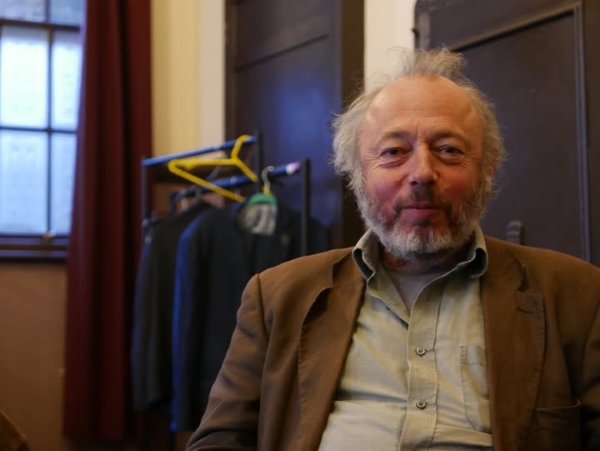
In March 2022, David Sylvian posted on facebook: ‘I want to share a brief message I received yesterday from Mike and Jon at Touch. Philip Jeck hadn’t been well for a short spell and now he’s left us. He was a lovely, affable, humorous chap with a supremely unique vision. He shall be sorely missed.
“We are deeply saddened that Philip Jeck died peacefully on Friday after a short illness. A remarkable man and a wonderful artist, he has been one of the kingpins of our work for 30 years. But with Philip it was never just the work, more the love, the spirit and the dedication. He touched so many with his wit, his zest for life and his wisdom. We will miss him terribly”.’
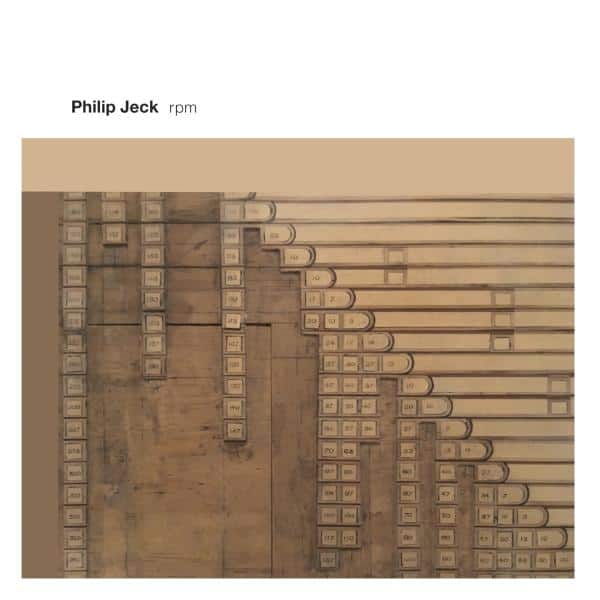
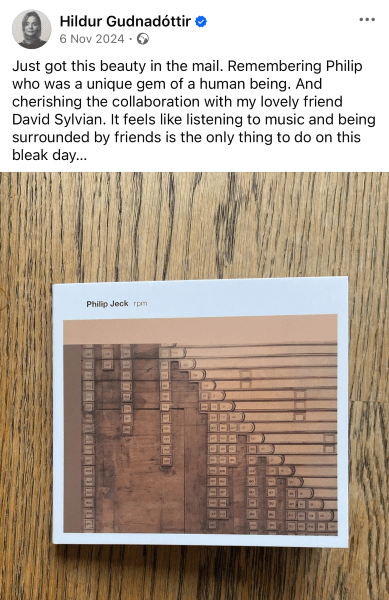
In 2024, Touch issued a double cd, rpm, featuring unreleased work by Jeck and other artists. ‘We wanted to join some of the dots of Philip’s life and involve many other collaborators, early and more recent,’ read the label announcement. Included was a track entitled ‘I Measure Every Grief I Meet’ performed by David Sylvian and Hildur Guðnadóttir. A mournful cello lament accompanies Sylvian’s recitation of Emily Dickinson’s poem. ‘Dickinson was one of Philip’s favourite writers,’ the liner notes inform us, and in featuring Emily’s words, Sylvian picks up a thread begun with ‘A Certain Slant of Light’ and ‘I Should Not Dare’ from Died in the Wool.
Both Hildur’s music and David’s voice were recorded specifically for this release, rather than dating back to their recordings together the previous decade. The piece was mixed by Francesco Donadello, a recording and mastering engineer based in Berlin, who has worked extensively with Hildur and was involved in Sylvian’s recordings in the city in the mid-2010s.
Dickinson’s poem was written in 1862 and is a study of grief, articulating how she compares the burden borne by those she encounters with that she herself carries, somehow seeking to quantify an emotion that one would expect to defy such quantification:
I measure every Grief I meet
With narrow, probing, eyes –
I wonder if It weighs like Mine –
Or has an Easier size.
I wonder if They bore it long –
Or did it just begin –
I could not tell the Date of Mine –
It feels so old a pain –
I wonder if it hurts to live –
And if They have to try –
And whether – could They choose between –
It would not be – to die –
There is a sincere fascination with the effects of sadness carried over many years, and whether there can be consolation, or at the least some easing of the pain:
I note that Some – gone patient long –
At length, renew their smile –
An imitation of a Light
That has so little Oil –
I wonder if when Years have piled –
Some Thousands – on the Harm –
That hurt them early – such a lapse
Could give them any Balm –
Or would they go on aching still
Through Centuries of Nerve –
Enlightened to a larger Pain –
In Contrast with the Love –
The causes of such grief are manifold, including ‘despair’, but the poet does find comfort in observing how others bear the crosses that they must carry:
The Grieved – are many – I am told –
There is the various Cause –
Death – is but one – and comes but once –
And only nails the eyes –
There’s Grief of Want – and grief of Cold –
A sort they call “Despair” –
There’s Banishment from native Eyes –
In sight of Native Air –
And though I may not guess the kind –
Correctly – yet to me
A piercing Comfort it affords
In passing Calvary –
To note the fashions – of the Cross –
And how they’re mostly worn –
Still fascinated to presume
That Some – are like my own –
In 2026, both David Sylvian and Hildur Guðnadóttir were listed as founding donors to The Philip Jeck Foundation, whose primary function is ‘to support artists who produce work rooted in (the traditions of) experimental and creative arts.’
‘I Measure Every Grief I Meet’
David Sylvian and Hildur Guðnadóttir, voice and instrumentation
Words by Emily Dickinson
Mixed by Francesco Donadello, December 2023
From rpm, Touch, 2024. Compiled and edited by Mary Prestidge, Mike Harding and Jon Wozencroft.
Emily Dickinson’s words © copyright The President and Fellows of Harvard College.
‘I Measure Every Grief I Meet’ – official YouTube link. It is highly recommended to listen to this music via physical media or lossless digital file. If you are able to, please support the artists by purchasing rather than streaming music.
The featured image for this article is the cover artwork for rpm, photography and design by Jon Wozencroft.
The following Touch releases are relevant to this article:
Without Sinking by Hildur Guðnadóttir TO:70
Englabörn by Jóhann Jóhannsson TO:52
An Ark for the Listener by Philip Jeck TO:81
rpm by Philip Jeck Tone 86
Hildur Guðnadóttir’s discography of film soundtracks can be found at her website here.
More information about The Philip Jeck Foundation can be found at its website, including how you can support its work by taking out an Audio Subscription.
Hildur speaks about Ryuichi Sakamoto, courtesy of Deutsche Grammophon, 2025
Full sources and acknowledgments for this article can be found here.
Download links: ‘The All of Water’ (bandcamp); ‘Chime, Chime (Re-rung)’ (bandcamp); ‘Elevation’ (Apple); ‘Overcast’ (Apple); ‘Killing Hawk’ (Apple); ‘A Bad Comedian’ (Apple); ‘Penny Taken to the Hospital’ (Apple); ‘I Measure Every Grief I Meet’ (bandcamp)
Physical media links: An Ark for the Listener (discogs); Without Sinking (discogs); The Revenant (Amazon); Joker (Amazon); rpm (bandcamp)
‘Music has always been the art form that moves me and interests me the most, but if I had any natural talent it was in visual art. I only finally came to working with sound/music through DJing, then on to using records and record players outside the dance club. Maybe the way I construct soundscapes comes from the visual training.’ Philip Jeck, 2009

I just found your blog and it is brilliant. So much detailed info. I’ve been a DS fan for over 40 years, so it’s wonderful to see others who are so affected by his art.
I met David at the Wiltern show in LA in the 90s and would love to see him one more time in this life.
Thank You
LikeLiked by 1 person
Glad you found the site, Gregge, and you find the articles of value. It’s a labour of love. This music and these musicians have made such an impact on my life. Such power in the creative arts!
LikeLike
My, what a long and fascinating road David has walked. Full of interesting turns and twists. We have all made the journey too. Educational, to say the least. Mr D N’s writings are spot on. Fergy fae Freuchie Fife Scotland. ❤️👌
LikeLiked by 1 person