
Gone to Earth draws to a close with its most musically up-beat track. Probably the first radio play of ‘Silver Moon’ was on London’s Capital Radio at the close of a disappointingly brief interview with David ‘Kid’ Jensen, who had indulged in much more in-depth discussions with David Sylvian during his prior stint as evening host on BBC Radio One. Speaking a few weeks before the release of the album, Sylvian introduced the track saying, ‘I think it’s quite a romantic piece. It’s almost a love song… It’s the nearest I’ve got to writing one for a while anyway…’
The opening bars are gently seductive, drawing the listener in as a scene is sketched out in the opening verse:
‘Out upon the open fields
The rain is pouring down
We’re pulling up the sheets again
Against the passing tides of love
Every doubt that holds you here
Will find their own way out’
So much is conveyed in those six lines – a vast rural location, the unsettled and unsettling weather, a couple taking refuge, clinging to one another amidst uncertainty and doubt.
‘I want to put things over lyrically in music which other people can relate to on a very human level,’ Sylvian told another journalist on his press tour to promote the album. ‘So…I don’t write about my own experiences but about the emotions and the thoughts, so that other people, when they listen to the music, they don’t think, “ah, that’s what David Sylvian thinks,” they share it, they feel it for themselves…
‘If I’m successful then hopefully I manage to raise it above just the purely physical materialist level, if you like. It should… it can do, I think, it can help, if people can find it in the music, there may be something there that can be rewarding for them. That’s what I hope for, but I might not be successful. And it really is up to the individual to find it, if they can, for themselves within the music.’
‘I will build a shelter if you call
Just take my hand and walk
Over mountains high and wide
Bridging rivers deep inside
With a will to guide you on
The heart will need no one
Those days are gone’
It’s imagery of a love that knows no bounds, of magnetism and devotion between two individuals. However, Sylvian’s contemporaneous comment also seems relevant: ‘People always have an idea that one day they’d like to live somewhere, they’d like to have a house somewhere. I think that’s a longing for something inside; there’s a place inside where that serenity exists. Safe and sound with yourself. I don’t say I have it, it’s something I long for. But I know it exists and I’m working towards it in the most practical way possible.’
‘Baby I can tell you there’s no easy way out
Lost inside of dreams that guide you on
Baby I can tell you there’s no easy way out
Soon the guiding moonlight will be gone’
For the chorus of a romantic pop song there is a great deal of uncertainty expressed, recalling the doubt in those opening lines and with the disconcerting absence of a guiding light looming. Nevertheless, the refrain is an uplifting one; the sharing of this experience with another and the reassurance of one’s dreams triumph over the challenges.
‘I go through periods when I’m very in control of the anxieties and pressures inside,’ confided the singer. ‘But there’s other times when it’s just a jumble, just confusion, and I’m totally lost. But I have a joy of life which goes beyond my own circumstances, so therefore if I’m suffering in some way, whether it’s health or work problems or relationships, whatever – I love the life which goes beyond all that, beyond surroundings. This is new for me. It was quite a revelation…
‘There’s no easy way out. You have to really apply yourself. And it can be frustrating… nobody can make changes in themself before it’s their time.’
From fields, mountains and rivers, we are then transported to the enormity and power of the open seas:
‘Out upon the ocean waves subside
From the weakness of the tide
That punishes in kind
When the heavens open wide
Every shore the moon shines on
Every word her sirens sung
“Believe in no one”’
The scene is one where a boat and its occupants are at the mercy of the elements, where the sirens, as in Homer’s Odyssey, tempt the sailors off course with their misleading incantation.
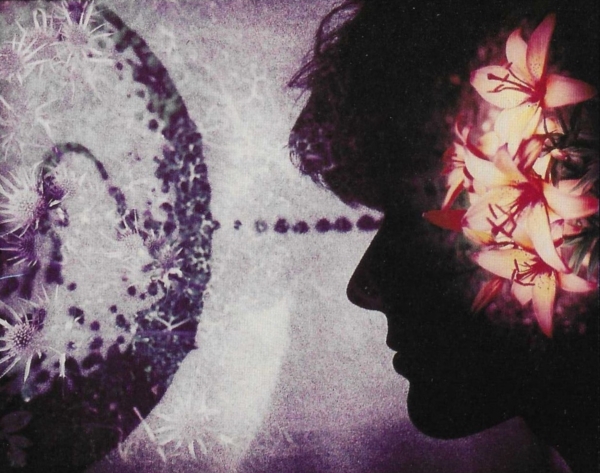
‘Some of your songs do seem to be quite naked love songs,’ asserted an interviewer reflecting on Gone to Earth. ‘Yes, they operate on two levels,’ came the response, ‘on a one-to-one level, a man-to-woman level, and then on a higher level too. Both are relevant and both are intentional.’
‘They are based on the romantic ballad but the idea is they should work on a much higher level. Most of the lyrics have double meanings. It’s easy to get obscure when you’re writing about things on a… spiritual level… or whatever. I’ve tried to keep it basic. I persevere with ballads or love songs because that’s the most classic form in pop music.’
Sylvian later expanded upon the deeper significance of the lyrics for ‘Silver Moon’: ‘There’s not a lot I can say about it, it’s a love song of sorts, but it’s also relating to my interest in the spiritual and the elements, and the female nature of creative work and energy, obviously relating to the moon, that was definitely playing around in my mind during that period of time.’ (2003)
‘Gone To Earth is a very optimistic record,’ its creator insisted. ‘For me it has a lightness, an exuberance… To build up a feeling/emotion/atmosphere through the lyrics and chord changes and really just let the tail end of the music … allow the listener to find themselves somewhere in it… Yes, that’s something I enjoy doing.’
Sylvian stated on several occasions that the album was a conscious move away from synthesisers towards guitar-based music. The closing track seemed to crown the approach and remained a favourite. ‘‘Silver Moon’, I like this piece very much,’ he reflected, some years after the release. ‘It’s got some very good guitarists on it, you know, an interesting mix of guitarists. It’s got B.J. Cole on pedal steel, Robert Fripp, Bill Nelson on guitar, as well as myself.’ (2003)
Jennifer Maidman plays bass on the track and recalls its development. ‘As I remember it, ‘Silver Moon’ was recorded around the same time as other Gone to Earth tracks, at The Manor studio, with Steve Nye producing. B.J. Cole, Robert Fripp, Bill Nelson and Mel Collins were added later, but the basic track was laid by David, Steve Jansen and myself playing together at the Manor, David on rhythm guitar and I think a guide vocal.’
It’s easy to associate Jennifer’s part on the record most especially with ‘Taking the Veil’ where the bass takes such a lead role, but listening again to ‘Silver Moon’, her part is beautifully constructed. I love the way the bass serves the song with some lovely little signatures, without anything being too showy. Whilst musicians were recorded at different times, it’s almost like Jennifer takes a step back as Mel Collins takes that wonderful soprano sax solo, with a little bass flourish around the 3-minute mark as the solo winds up. And those two harmonic notes at the end of the track are perfect.
‘I love the song and the way it came together,’ says Jennifer. ‘The bass by the way, as you can probably tell, is the same Wal custom fretless as featured on ‘Taking the Veil’. One can’t underestimate the impact Wal basses had around that time, with their unique sound, particularly the fretless – Mick Karn, of course, also Percy Jones and I think John Giblin. Alan Spenner was another user. A very influential instrument designed by Ian Waller and Pete Stevens.’
B.J. Cole’s pedal steel guitar was a surprise ingredient, the instrument’s laments rarely heard in a pop context. ‘I came across it by accident really,’ said Sylvian. ‘One of the pieces I was going to do had a kind of keyboard solo, and it just didn’t work out. And at the same time for the last track on the vocal album I was thinking about steel guitar. I was thinking it was maybe a bit too obvious. But Steve Nye had worked with B.J. Cole before, and he said that B.J. has said that it would be great to do something where people don’t expect him to play the norm. And if he could just come along and improvise in a way, and just see what happens, he would really enjoy it. Steve told me this, so I said, “Great, let’s see what happens.”
‘I was really impressed. I didn’t know that you could get that kind of sound, because it always tends to be the classical sound, that you always hear the same kind of sound out of that instrument. I don’t think anyone’s really used it to its full capabilities. I think even B.J. is a bit – I mean he did produce some wonderful sounds – but in a way he still related too strongly to the Country music world and he still falls back into that.’
Interviewed by Anthony Reynolds when researching for his book Cries and Whispers, B.J. Cole looked back on his session at The Manor and his interaction with Sylvian. ‘He was very specific about what he wanted me to do. I don’t know whether you know much about the pedal steel guitar but it’s very easy to play it in a cliched sort of Country way and he was very very dismissive when I started to play [in a way] that had any sort of twang to it, that might indicate that style of playing… Whatever brought him to use steel guitar on that track, obviously it worked and it sounded fantastic, and I managed to do it without it bringing to his music any hint of Country… That’s something that I’ve developed as a style over the years because quite a lot of people, although they might be intrigued by the potential of the pedal steel guitar, they don’t want me to bring the colour of Country music to it, understandably.’ (2018)
It’s both enjoyable and instructive to listen to such a familiar song tracing each of the parts, distinguishing B.J.’s playing from the guitars of Fripp, Nelson and Sylvian.
‘Improvisation and the vocals can give a life to the well structured form,’ explained Sylvian. ‘I often think it’s a danger with my style of music that it can become dead because it’s so well structured. I like to leave room for that improvising. I leave room also in the studio for arrangements. I mean the songs can be taken in any direction, so when I go to the studio anything can happen in a way. I have this form, the basic form but I leave it quite open for the musicians to interpret.’
Mel Collins’ soprano saxophone solo is a case in point, its exuberance adding so much to the buoyant vibe of ‘Silver Moon’. Collins had been part of the King Crimson line-up with Robert Fripp in the early ’70s and would subsequently return for a second spell over 40 years later. Around the time of recording Gone to Earth he was busy with many sessions, notably appearing on the Tears for Fears albums The Hurting (1983) and Songs from the Big Chair (1985).
Jennifer Maidman: ‘Having played with Mel in different contexts over the years, I think he’s particularly good, in his soloing, at responding in the moment to wherever the music is going. It’s something that goes far beyond just knowing chords and harmonic information etc., and is more in the realm of intuition and magic.’
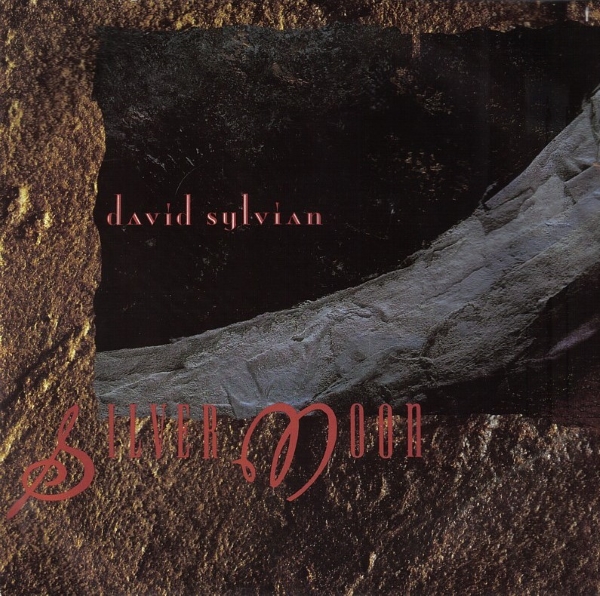
No doubt owing to the accessible nature of the track, ‘Silver Moon’ was chosen as the follow-up single to ‘Taking the Veil’. The main sleeve artwork was contributed by Russell Mills, its textures and uniquely designed font reminiscent of his work on the album gatefold. The 7″ was accompanied by a limited-edition multi-panel fold out sleeve revealing more of the original painting and with a Yuka Fujii photo montage on the reverse.
In these days of advanced computer packages for graphic design, it’s easy to forget that the process of preparing album sleeve art was a far more laborious and drawn out process in the mid-1980’s. Recalling his work on Gone to Earth and ‘Silver Moon’, Russell Mills told me that that first stage was for his painting to be ‘photographed (5” x 4” colour transparencies) – all time-consuming and the photography itself usually took about half a day. Typography and layout had to be designed by hand and then the type was specified – fonts and their weights and sizes chosen, character and line spacing decided – and sent to a typesetter. Then one waited for the finished typesetting to be returned. It had to be proofread, and if any amendments were required, was sent back, marked up using typesetters’ instructions, which are a series of codes and symbols. Another period of waiting.
‘Once the typesetting had been finalised the artwork was ready to be prepared. Artwork, at album size, was constructed on boards, with as many transparent tracing sheet overlays as necessary to carry and convey all the instructions for a printer; Pantone colours and tints for type and other graphic elements, inlays, positional guides, instructions for areas to be reversed out of the background image, etc. It’s a fiddly process that requires precision so as to ensure that the position of every element on each overlay corresponds to those on other layers and the baseboard. Imagining what one’s decisions might produce is all informed guesswork in which one has to try to determine what all these disparate components will look like.’
Curiously, given the lead single ‘Taking the Veil’ was not given the same treatment, a promo video was produced for ‘Silver Moon’, the work of ‘a young director called Nicholas Brandt.’ Sylvian’s hands obscure the camera’s lens when the song starts, then backing away he gestures to the hills which are transformed from monochrome to colour once the singer exits the frame.
The images ‘felt like the title – Gone to Earth,’ observed an interviewer on Japanese TV. ‘Is it something you were looking for?’ Sylvian: ‘I suppose so. I don’t like appearing in videos. If I could I would just use images rather than appear myself in videos. And I was basically trying to get to as close to that idea as possible. So the video is based on really the visual images of landscape and so on, rather than myself.’ His host was keen to understand whether the scenes were representative of his ‘real life’? ‘I live in the centre of London, quite far away from the countryside. I think that’s why I need it. Because I live in the middle of London I tend to have this relationship with the natural environment.’
‘Silver Moon’ promotional video
Linking back to his explanation of the title of ‘Brilliant Trees’, Sylvian evidently continued to be moved by the natural world. He was asked about beauty and the aesthetics of successful work. ‘Something needs to be provoked inside…it must go deeper than just a visual or a physical thing. It has to become an emotional experience. An example would be to be in a beautiful landscape. If you just see the landscape and you see, “oh, that’s beautiful,” that’s just one aspect. But if you feel the power, or you feel a unity, that’s a much higher level of experience, I think. And that’s what I try to put over. It’s not just painting a landscape, it’s painting an emotional experience.’
As the camera brushes through undergrowth and bracken before soaring into the sky, the invitation is clearly to come and ‘touch the grass’ for yourself, to feel that power from nature.
Nick Brandt would go on to direct Michael Jackson’s spectacular ‘Earth Song’ video and the subsequent ‘Stranger in Moscow’ before moving into other media. I caught up with him to ask about memories of working on David Sylvian’s project. ‘1986. I was fairly fresh out of college, my first year directing. ‘Silver Moon’ was one of the most beautiful songs I ever made a music video for. (I switched to photography full time in 2003). It was filmed on 35mm film – unusual for a music video in those days which were normally 16mm. I still listen to the song to this day. Just glorious. Transporting. Mesmerising.’
In sympathy with Sylvian’s paean to the female creative spirit inherent in the natural world, the curves of a reclining female mirror the rolling hills beyond, the silver moon is presented with a female visage, and a wild-haired nymph-like woman is abandoned in the enjoyment and adoration of the earth and sun.
‘The concept, for better or worse, was mine,’ says Nick. ‘We shot for one day in the Lake District. The girl – that was Chloe, my first girlfriend! Shot on Super 8 somewhere in Wales, I think?’
Sylvian recently recalled, ‘I was wheeled out of a hospital, unceremoniously dumped into the back of a car and driven god knows where, my guess is the Lake District but… “Can someone slap some make up on him he looks like death.” Certain events pass in a blur of activity in which one barely feels part.’ (2023)
Brandt: ‘I remember David having just come out of hospital and unsurprisingly being low energy as a result, poor thing.’ There was another memorable brush with nature during shooting en plein air. ‘For me, the star other than David was the barn owl – sitting placidly on a perch in front of the steadicam.’
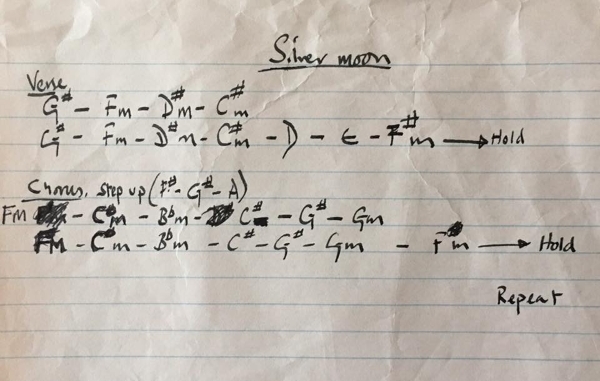
The songwriter retained an affection for the song. ‘Funnily enough I take out and brush off ‘Silver Moon’ during most tour rehearsals. It’s simply a case of finding a suitable home with the right band, arrangement, and set list. I haven’t given up on it yet!’ he declared in 2002. Alas, a suitable live context would never be found.
Sylvian insisted that the instrumental disc of Gone to Earth belonged with the vocal disc. Whilst disc 1 benefitted from intent listening and the pieces on disc 2 were conceived as environmental music, the tracks across both instalments had ‘some form of continuity.’ In the case of ‘Silver Moon over Sleeping Steeples’ there were some direct parallels. The moon no doubt carried the significance conveyed in the vocal track with which it shared the image. Maybe ‘sleeping steeples’ is just evocative imagery, or maybe it hints at Sylvian’s shift away from organised religion towards other belief systems, with Buddhism, Rosicrucianism and an appreciation for the spiritual significance of the elements all referenced on the record. B.J. Cole appears too for this instrumental, giving another well measured performance.
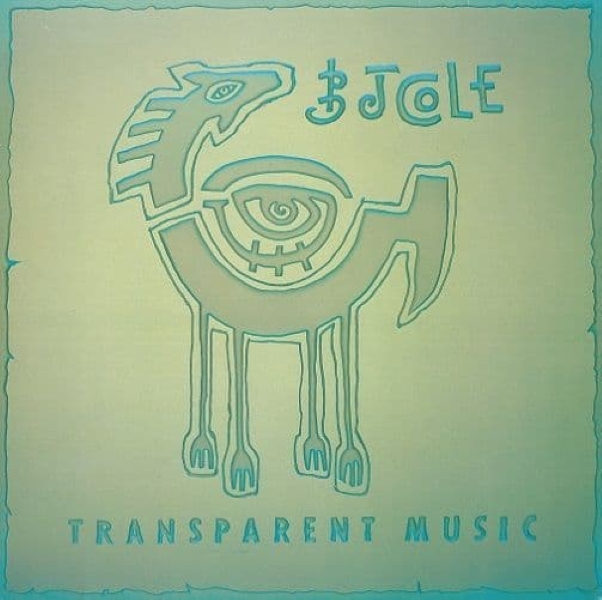
In 1989 B.J. released a solo album, Transparent Music. No doubt on some of the tracks there is something of the ‘twang’ with which Sylvian was not smitten. However, the numbers ‘Slight Rhapsody’ and ‘Ely Cathedral’ appear on my playlist of tracks with a similar heart to the Gone to Earth instrumentals. The former is graced by the double bass of Danny Thompson who performs so beautifully alongside Sylvian on both Brilliant Trees and Secrets of the Beehive.
‘Silver Moon’
B.J. Cole – pedal steel guitar; Mel Collins – soprano sax; Robert Fripp – solo guitar, frippertronics; Steve Jansen – drums; Ian (now Jennifer) Maidman – bass; Bill Nelson – guitars; David Sylvian – vocals, keyboards, guitars
Music and lyrics by David Sylvian
Lyrics © samadhisound publishing
‘Silver Moon over Sleeping Steeples’
B.J. Cole – pedal steel guitar; David Sylvian – all other instruments
Music by David Sylvian
Produced by David Sylvian and Steve Nye, from Gone to Earth, Virgin, 1986
Recorded in London and Oxfordshire 1985-6
‘Silver Moon over Sleeping Steeples’ – official YouTube link. It is highly recommended to listen to this music via physical media or lossless digital file. If you are able to, please support the artists by purchasing rather than streaming music.
All David Sylvian quotes are from 1986 unless otherwise stated. My thanks to Nick Brandt, Jennifer Maidman and Russell Mills for sharing their insights. Full sources and acknowledgments for this article can be found here.
Download links: ‘Silver Moon’ (Apple); ‘Silver Moon over Sleeping Steeples’ (Apple)
Physical media links: Gone to Earth (burningshed – cd) (Amazon – cd) (Amazon – vinyl re-issue); Transparent Music (discogs)
‘The more I’ve become more spiritually self aware, I feel I’ve had stronger experiences in the world around me. Before I was the kind of person who would stand in a landscape and just see the beauty and not feel the power or the unity. And now I feel it. It’s a big, big difference.’ David Sylvian, 1986


Thank you for this. One of my long-standing favourites. I have always been drawn to the lines:
”With a will to guide you on
The heart will need no one
Those days are gone’’
They show a confidence and inner strength previously missing from David’s lyrics. The idea that self-belief is the major guiding force in a life; that another’s input is not always required. Could this refer back to breaking away from Japan and starting a solo career? A gorgeous track.
LikeLiked by 1 person
Thank you for all these wonderful in-depth articles!
LikeLiked by 1 person
Whilst this is not directly about the article above, I just wanted to wish you all the best for 2025 the VB / David N and thanks for all the interesting reading, since I picked up on your site, about five years ago.
Just prior to writing this I just had ‘Some Kind of Fool’ on my headset and I think it is my favourite opening plethora of sounds on any record – it’s absolutely rich with little riffs, sonic sounds, strings (whether synth or actual and) piano and when the top line melody comes in with the David Sylvian voice, it’s just fantastic. The first three minutes is right up there for me (atmosphere and heightened feeling) with the Mick Ronson (as originally recorded) guitar solo, on Ian Hunter’s ‘Once Bitten Twice Shy’ single.
Keep up the good work. Cheers for now…
LikeLiked by 1 person
Thank you for the kind comments and wishes. All are much appreciated.
LikeLike