Eight Days a Week was an arts review programme broadcast on BBC2 on which host Robin Denselow discussed the latest music, movies and books with a small invited panel. The show had a relatively short run in 1983 and 1984, but that timing allowed for the release of David Sylvian’s debut solo LP, Brilliant Trees, to be a subject of discussion. Among the guests that evening was former Be-Bop Deluxe front-man and guitarist, Bill Nelson.
A little provocatively, Denslow proposed to Nelson that Sylvian was ‘trying to be taken very very seriously after being a pop singer with Japan?’ ‘I think perhaps David’s always wanted to be taken very seriously,’ Nelson responded. ‘There is evidence on the Tin Drum album particularly the direction this album would go.
‘I was a bit worried when I first heard it. I thought, how can I say something about this without being a little bit unsure? Because on first hearing things sounded very drab, very grey to me. And I thought, “Oh no, not another melancholic teenage angst album of sat in my room, suffering as an artist”… Third listening actually revealed for me a lot of depth there, much more than I first suspected, and I actually do like the album very much, particularly the slower tracks. It’s more the ambient things. Jon Hassell plays some tremendous trumpet, there’s some beautiful sounds in there. It’s not got a glossy production, it’s not your Trevor Horn poppy radio production, it’s very very simple, very dry. And I must admit the more I hear it, the more I like it… It does need time…’
The programme was also memorable for Sandie Shaw’s effusive response to Sylvian’s record: ‘I think it’s the most beautiful album. It’s wonderful. It’s got this wonderful sort of Piscean quality to it. Very enigmatic. I love it, I’ve played it again and again. I haven’t stopped playing it. ‘Nostalgia’! [head rolling back as if swooning] I love ‘Nostalgia’, it’s great. I could definitely turn into a fan. I think I am.’
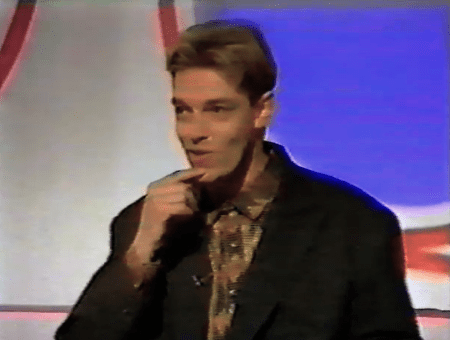
Sylvian would pinpoint the BBC programme as a catalyst leading towards his invitation to Bill Nelson to participate in the recordings for Gone to Earth. ‘I met Bill a couple of months after I finished Brilliant Trees,’ he said in a 1986 interview. ‘He appeared on TV – he had to actually review Brilliant Trees on TV…He was one of a panel that had to review the albums that week and my album happened to be on there and he happened to give it a really nice review…My exhibition, the Polaroid exhibition, was following a couple of days later so I invited him down. I mean we had loads of mutual friends but we’d never met and I thought this was a good chance to actually meet. And we got on well. We have lots of things in common, lots of interests in common. And it was in the back of my mind it would be really nice to work with him at some point. And when I decided to make the album a guitar-oriented album, Bill was one of the people on the top of the list to choose from.’

Among Sylvian and Nelson’s shared interests was a common fascination for the work of Jean Cocteau. There were nods to Cocteau in the lyrics on Brilliant Trees and in some of the artwork of the associated releases, notably the ‘Pulling Punches’ single (read more here), and his voice was heard on ‘Steel Cathedrals’. Bill had named his own music label after Cocteau and the imprint’s aesthetic was heavily influenced by the Frenchman’s work. It was an interest ‘that started way back in the late ‘60s,’ Nelson explained on a 2019 podcast. ‘I was at art college when I was a teenager and I came across a book of his screenplays in the art college library. And the images that were reproduced in this, I immediately took a shine to. And I then started investigating further and found out that he was an artist in terms of painting and drawing, he was a filmmaker, he was a poet and a writer, he collaborated with musicians, a set-designer. And I just got really fascinated with the kind of thing he did, so he was an inspiration… Some of his films are quite amazing… One of his first ones is called Blood of a Poet, it’s very surreal, very strange. I mean it’s the kind of thing that you would imagine David Lynch would do today. He was doing this back in the ‘30s. Incredible.’
In 1982 Nelson had recorded and released music for a stage play of Cocteau’s classic film, Beauty and the Beast (La Belle et la Bête), a movie Bill described as ‘the big “hit single” in Cocteau’s film canon…An absolutely magical telling of a magical fairy tale. It’s stunningly beautiful to look at and the scenes in the Beast’s castle have a dreamlike quality that, once seen, will haunt you forever…These days it seems as if there’s a reluctance to open up to beauty and wonder, an element of dumbing everything down to the lowest common denominator. It’s as if cynicism and pessimism has triumphed over good faith and optimism. Cocteau’s work celebrates the artistic vision and the inner life and does so without shame, irony or embarrassment. Beauty is the brave hero and the Beast is subdued by her power. A lovely metaphor for the civilising influence of Art.’
Another common quest was a yearning for spiritual revelation. Asked about the subject on the release of Gone to Earth, Sylvian said, ‘It’s become more and more a fascination of mine. Well, maybe more than a fascination. I suppose for many years I’d been questioning my own religious beliefs, which I’d never really done before. I had for many years a kind of childlike belief in God and I never questioned it. And then there came a point where I began to question it and I just started searching for something, values that I could live by or guide my life or something like that. I’ve found something that I think is a good foundation from which to build and it’s creeping into the music because it’s so important to me in my life.’
Was it something he’d worked out on his own or through an established religion? ‘Mainly worked out on my own but obviously from reading a great deal of literature. I guess I’m interested in both ends of the scale, the more practical approach to spiritual awareness and also the mystical side. I’m really not sure where my heart lies, which one I would choose to follow if I had to make a decision, I find them both fascinating at the moment. I mean, you’re trying to reach the same aim ultimately, it’s really what’s best suited for me as an individual.’
Nelson’s own 1986 releases, Getting the Holy Ghost Across and the subsequent mini-album Living for the Spangled Moment are rich with the imagery of his own esoteric religious interests which have some parallels with the activities of his inspiration, Jean Cocteau. Interviewed by music journalist Mark Prendergast for The Independent newspaper in 1995, Nelson said, ‘There was a time in the ’80s when I was a member of three different secret orders. Magic was a very narrow part of what I did. Rosicrucianism, alchemy or the word gnostic would be more apt because they cover a multitude of sins.’
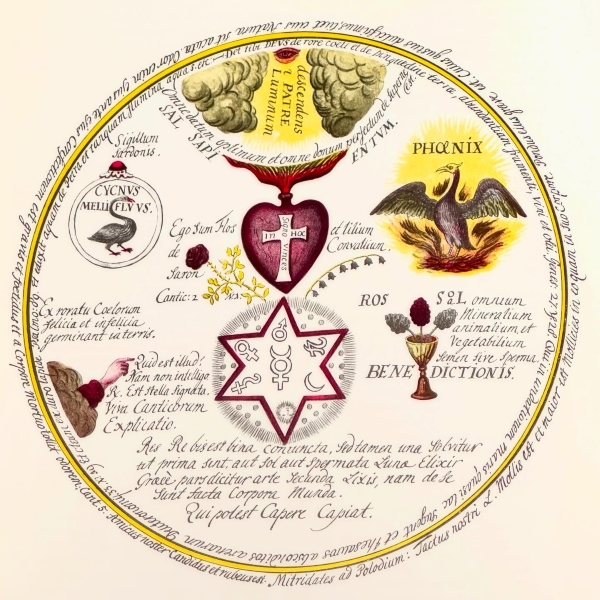
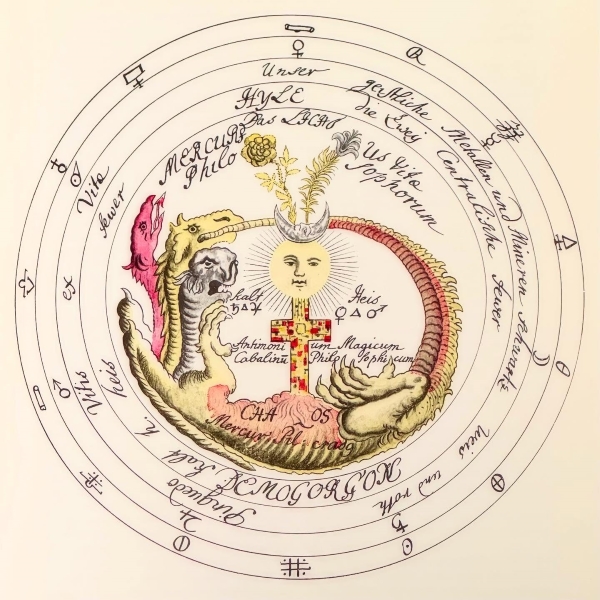
Given Sylvian’s earnest pursuit of insight around the time that the pair first collaborated, there can be little doubt that they would have discussed such matters. Gone to Earth bears witness to a shared interest between Robert Fripp and Sylvian in the philosophies of J.G. Bennett, the latter’s voice being heard on the title track. Similarly, the album’s artwork was influenced by the imagery of Rosicrucianism. Robert Fludd’s diagrammatic presentations of the relationship between the temporal and the spiritual were one of the sources of inspiration for Russell Mills’ painting for the cover (read more here). Sylvian also mentioned that Codex Rosae Crucis was another volume that he and Mills discussed in preparatory discussions regarding the album art. In recent social media posts Sylvian has drawn attention to two specific panels from the Rosicrucian manuscript which he described as ‘original references’ for the cover, encapsulating for him the light that exuded from the music.
Nelson worked with Sylvian on ‘Before the Bullfight’, one of the early trilogy of pieces to emerge for the album, and with Robert Fripp for another, ‘Wave’. The thought was then seeded of two distinct but complementary guitar ‘voices’ to be featured across the album. ‘Once I started working with Bill and Robert, first of all there was the contrast of styles, musical styles, that I thought would be interesting to play with throughout the album. There’s a contrast in characters. There’s a contrast in methods, in ways of working in the studio. Robert’s a very spontaneous player. You tend to have to catch what he plays first take, otherwise it’s different next time around. Whereas Bill is a more contemplative kind of player. He will think about what he wants to do. We would talk about it more and there would be a lot more suggestions, a lot more give and take working with Bill. And I like the contrast of working that way with people.’
The respect was mutual, borne not only out of musical creativity but also artistic intent, with Nelson highlighting the experience when asked in a contemporaneous magazine interview whether ‘there are still craftsmen among the present generation of musicians?’
‘Yes, there are people like David Sylvian who I’ve been working with recently. He does take the craftsman’s approach in that he cares very deeply about the quality of his work. Not just in the technical sense, i.e. that it’s recorded well or played in time, but that he cares about what he is saying. You can get away with shoddy technical performances and a rough recording provided something is being said and communicated through the music. And for me, David’s example of the dedication he puts into the meaning of his work – the content side of it – shines more than anything he might do on a technical level with studio techniques or expensive keyboards. In fact, I’m sure that if David sat down with just an acoustic guitar and recorded his songs on a simple cassette recorder, he’d still communicate more than bands like Sigue Sigue Sputnik could in a million years!’
An exemplar of Bill’s playing for me is his sensitive acoustic guitar work on the sublime ‘Answered Prayers’ from the instrumental disc of Gone to Earth. Sylvian has said that ‘all the instrumental tracks were demoed in their entirety (rare for me) including the main lines… Where this wasn’t the case, musicians were given co-writing credits, e.g. ‘Answered Prayers’ for Bill, ‘Upon this Earth’ for Robert’ (2023). So, for this piece we hear something flowing from the guitarist’s creative imagination to complement Sylvian’s own guitar and synth treatments.
Bill reflected: ‘Working with David wasn’t hard in itself. The hardest part for me, in any collaboration or session with someone else, is getting past my own inherent shyness and lack of confidence. I suffer tremendous agonies before embarking on these things, for all kinds of reasons. I have no formal musical training and rely on a kind of intuition in these circumstances.
‘Some people may interpret this as some kind of spiritual thing, a nebulous gift or whatever. What it boils down to is reaching a state of mind where the ego is too enraptured by the creative moment to raise doubts about what is going on. The best way to describe it, for me, is in Zen terms. It’s a state of “no-mind” or “beginner’s mind”. If you are 100% in the moment, the moment will take care of itself. Achieving this state isn’t as hard as it might seem…learning to trust it is far more difficult.’ (2002)
It’s notable that the title chosen for this piece is not that of a physical scene we can picture, such as ‘Where the Railroad Meets the Sea’ or ‘Sunlight Seen Through Towering Trees’, but is rather an intangible – something we feel in our heart rather than see with our eyes. Nelson’s guitar expresses a moment of clarity, a specific instant we are assured in the depths of our being that there is more to life than our flesh and blood existence: an epiphany. At least, that’s what those bright-as-crystal ascending guitar lines have expressed to me across all these years of listening. ‘It’s very important for me that people personalise my music,’ said Sylvian. ‘That it becomes involved in their lives, that it doesn’t remain an external thing and a kind of entertainment. It’s very important that music be personalised because only in that way will it be of value, will it have a long life, and will it take on a life of its own.’
‘Answered Prayers’ was used to accompany a moment of revelation in the film River of Love (1999) which tells the life story of Mata Amritanandamayi (see ‘All of My Mother’s Names (Summers with Amma)’).
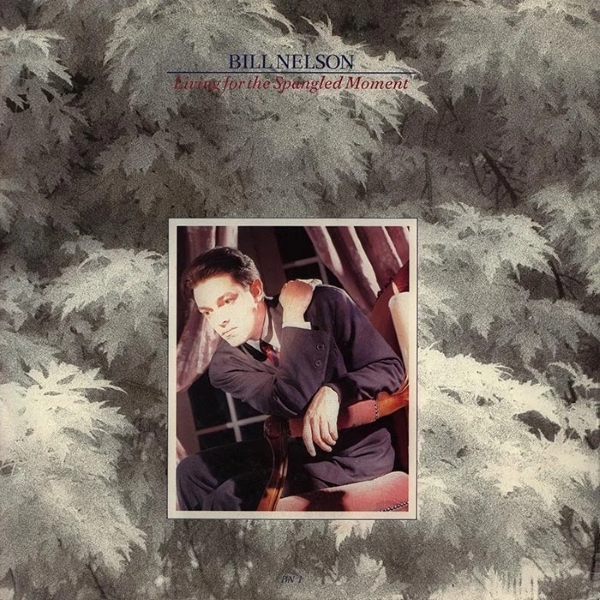
Having admired Bill’s playing on ‘Answered Prayers’ for decades, I have avidly listened out for tracks within his own catalogue that show the same creative touch, the same restraint of expression. The sound-world that Nelson enjoys on many of his instrumental pieces tends towards a more synthetic palette of rhythms and synths when compared with the organic textures prevalent in Sylvian’s work. However, there are some gems that sit on my expanded playlist by the Gone to Earth contributors.
‘Feast of Lanterns’ from Living for the Spangled Moment is one, which can also be found on the expanded double-cd re-release of Getting the Holy Ghost Across (2013). Interestingly, following his experience in the studio recording Gone to Earth, Nelson turned to Sylvian’s co-producer to help put the finishing touches to his own album.

‘I had so many options available that the decision-making at the end was almost impossible for me to do alone, which is why I worked on it with producer Steve Nye,’ said Nelson of Getting the Holy Ghost Across. ‘I felt I needed somebody to come in who hadn’t heard any of the tracks before and who could perhaps add a little more objectivity.
‘I have respected Steve’s work for a long time. He produced Japan’s Tin Drum album which I enjoyed tremendously. He’s also a member of the Penguin Cafe Orchestra – a very accomplished and sensitive keyboard player.
‘Actually, I had worked with him way back on the very first Be-Bop Deluxe album, Axe Victim…I got on very well with him then and liked the fact that he was also working as a musician in areas of music that weren’t the obvious. I met him again when I worked last year with David Sylvian on his forthcoming solo album. Steve Nye worked on that, as he had done on David’s previous album Brilliant Trees, and I thought the tonality and textural side to Brilliant Trees was very refreshing because it was the opposite of the excessive Trevor Horn kind of approach to record production that was so prevalent at that time.
‘So, when it got to the stage on my own album where I felt I needed to bounce the work I had done so far off an objective mind and ear, then Steve Nye was the first choice.’
Another ethereal guitar-based track from Nelson is ‘The Angel at the Western Window’ from his 1987 double-cd collection Chance Encounters in the Garden of Lights, which was very much influenced by his fascination with esoteric texts and philosophies, gnosticism and mysticism.
‘Looking back on it now,’ Bill later reflected, ‘I’d become deeply passionate about that kind of subject matter, but now it’s simply been absorbed into the unconscious fabric of things that have inspired me over the years, along with lots of other stuff. It certainly helped shape my sensibilities in one way or another, but it’s only one aspect of who I am…
‘Chance Encounters… it doesn’t try to seduce the listener with technical flummery. It has quite a stripped back, minimalist approach. The tracks are all relatively short, single thoughts simply stated, lasting just long enough for the main idea to be conveyed without fuss. You could say that they’re like haikus in musical form.’ (2018)
‘Answered Prayers’
Bill Nelson – acoustic guitar; David Sylvian – all other instruments
Music by David Sylvian and Bill Nelson
Produced by David Sylvian and Steve Nye, from Gone to Earth, Virgin, 1986
Recorded in London and Oxfordshire 1985-6
‘Answered Prayers’ – official YouTube link. It is highly recommended to listen to this music via physical media or lossless digital file. If you are able to, please support the artists by purchasing rather than streaming music.
All artist quotes in this article are from 1986 unless otherwise indicated. Full sources and acknowledgments for this article can be found here.
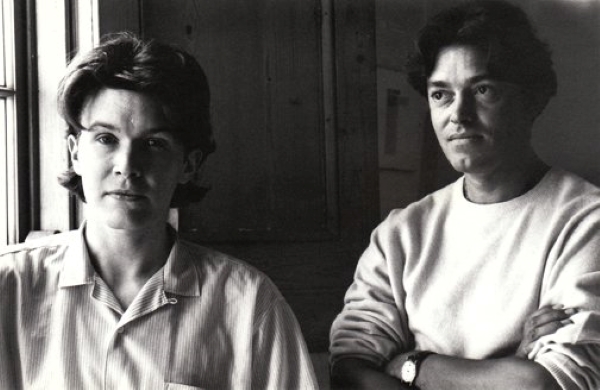
The featured image is a photograph of David Sylvian and Bill Nelson from a series taken at the Gone to Earth recording sessions by Yuka Fujii, from Bill’s official website, © Yuka Fujii
Bill Nelson’s website is Dreamsville. He has many albums released via bandcamp here and an official store at Burning Shed here.
Download links: ‘Answered Prayers’ (Apple); ‘The Angel in the Western Window’ (bandcamp)
Physical media links: Gone to Earth (burningshed – cd) (Amazon – cd) (Amazon – vinyl re-issue); Living for the Spangled Moment (as part of the Getting the Holy Ghost Across 2 cd re-issue discogs); Chance Encounters in the Garden of Light (Amazon).
‘I could use the word faith, but it might be misleading. But faith is definitely something I have. Almost like a science of the spirit which it is possible to learn about. When I was younger I remember saying in total ignorance, “The next evolution of man will be the spiritual evolution.” I always felt I wanted to know more. I read a lot about how one can control one’s own spirit and therefore gain control of ourselves.’ David Sylvian, 1986

Thank you for another wonderful article. I’ve always struggled slightly with Gone To Earth as an album. Although there are many beautiful moments, I find it too dense, too much going on and no room to breathe. This may be construed as blasphemy by many but there you have it! Thanks again for your excellent articles.
LikeLiked by 1 person
Of Sylvian’s three early albums, Gone to Earth has always been my least favorite. This is mainly due to how incredible Brilliant Trees and Secrets of the Beehive are. I think most Sylvian fans consider the latter his best album. I certainly do. That said, Gone to Earth does have it’s moments. For me, Before the Bullfight is the standout track. I also quite enjoy the ambient pieces. I think the aspect of the album that has always bothered me is the seeming attempt to sound more conventional and/or mainstream. While the track, “Gone to Earth” does have some fairly jarring guitar-work, most of the songs come off as well-mannered New Age easy listening.
LikeLike
Gone to Earth has always been my favourite Sylvian album. The combination of Robert Fripp and Bill Nelson was another inspired musical choice. I wish Sylvian had further explored what he and Bill Nelson could have achieved together by making a complete collaborative album like he did with Holger Czukay.
LikeLiked by 1 person
Thank you for a fascinating article about an album that means so much to me. It’s David’s best work IMO.
LikeLiked by 1 person