
The US leg of the Everything and Nothing tour wound to a close with a show at the Wiltern Theatre in Los Angeles on 14 May 2002. It wasn’t long before David Sylvian’s attention turned towards new work after an extended period compiling and completing material from the preceding 20 years, firstly for the excellent vocal cd set which gave the tour its name and then for its instrumental companion, Camphor, which came out a couple of weeks after the LA gig.
Immediately following the tour, Sylvian’s brother, Steve Jansen, who had performed as drummer and percussionist in the stage band, took up residence at the New Hampshire property that was home to Sylvian, his wife Ingrid Chavez and their young family. ‘God, it gets increasingly difficult to place events firmly in time,’ wrote Sylvian later when the Nine Horses record – a trio with Jansen and Burnt Friedman – was released in 2005. ‘I’m trying to recall how this project got started. I’m not entirely convinced of the dates nor of the intervals between, but it seems that Steve and I started writing together in the late summer or fall of 2002, at least that’s what the dates on the digital photographs appear to tell me.’
Sylvian’s new studio facility, housed in a barn at the remote property to which the family had relocated in 2000, was at this time newly completed. ‘At first we were using the writing as a means of exploring some of the newer technology in the samadhisound studio,’ he recalled. ‘The writing took off in all kinds of directions whilst we searched for common ground, passions, interests. Progress was slow as the tools were still new to us but other than that the writing came relatively easy.’
At first the pair were ‘just kicking around ideas,’ uncertain how their joint endeavours might come together. Sylvian: ‘We hadn’t written together for about a decade and I had all this new technology and we were kind of studying the technology and writing simultaneously. So it was a slow process but some interesting work surfaced.’
‘Initially David and I explored our renewed relationship through composition,’ said Jansen, ‘trying many possibilities, writing off the cuff with improvisation techniques as well as composition through sound design. Much time had lapsed since we’d last collaborated together on a recording, so it seemed there were many paths to wander.’
‘We’ve been trying to map out a new sonic territory that is unique to this collaboration,’ said Sylvian as the work was developing. ‘I think right now we are heavily relying on electronics. That seems to be the area of interest and where we are moving with the project. In a sense we are always on a long learning curve…as we’re constantly acquiring new technology and seeing how we can incorporate this technology in the work.’
‘I remember heavy snow,’ said Sylvian of the final months of 2002, ‘shovelling heaps of the stuff from the short walk to the studio every few days or so. Around Christmas Keith Lowe came to spend time with us, working in the studio on electric and acoustic bass, bringing his unique brand of seasonal cheer and the best ginger cookies in the world to share with our families.’
Lowe’s bass and Jansen’s drums had formed the rhythmic spine of the Everything and Nothing tour band (see here for a conversation with Keith about the experience). The chemistry had been good, and both the versatility and sensitivity displayed by Lowe in handling Sylvian’s past catalogue qualified him as an eminently suitable collaborator for the new material that now was forming up.
Samadhisound subsequently posted a brief video online from Keith’s visit to the snow-bound studio. The warmth of spirit that he brought to proceedings is self-evident.
As time moved on, in Steve’s words, Sylvian and Jansen ‘felt that our more considered works were a truer representation of our combined sensibilities and interests. Almost without word it became understood that the more laborious path would, as usual, yield the best fruit.’ It being clear that work on the joint project would entail painstakingly detailed sound design and programming, Sylvian felt a need to break away for a period.
‘About two months after [Keith] left us for his home in Seattle, I felt compelled to get to work on a project that seemed pressing and asked Steve if it would be ok to take time out from our project for about 6 weeks or so. It was during that time that I wrote and recorded Blemish. The work took off at a creative tangent, it lit a fire under me…Steve returned to the studio to work on some ideas of his own.’ At least one of those ideas would later be absorbed back into the Nine Horses project as the core component of the title track (read more here). Others would surface on Jansen’s debut solo album, Slope, in 2007.
The Blemish project ‘led to the formation of the label, which led to a tour, and so on and so forth. So, there was a point when I thought the Nine Horses project would never reach completion,’ said Sylvian. ‘It was so far behind me at one point, I just thought I can’t turn back and really re-evaluate what we’ve been working on. I’d moved too far past it.’
Thankfully, though, inspiration was found to return to the compositions formulated with Steve. The unexpected success of the self-released Blemish played its part, Jansen observing that ‘the opportunity to take our time and find our footing was never more afforded and prevalent than now, with samadhisound up and running.’ A potential complicating factor was the brothers’ meeting with Burnt Friedman whilst on the Fire in the Forest tour in 2003, triggering parallel collaborative work with Sylvian. As it turned out, however, this proved a catalyst for bringing the earlier work-in-progress to completion, Sylvian realising that ‘there was something compatible in this material that I was working on with Burnt with some of the material that I’d written with Steve, and I could pull these two projects together.’
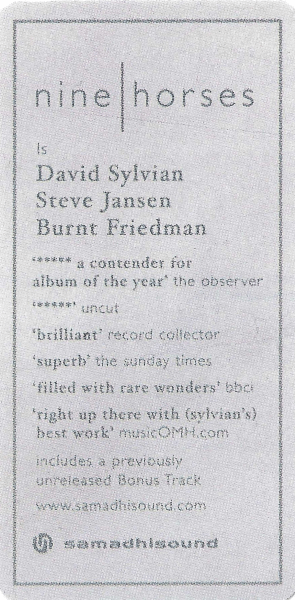
When the Nine Horses album Snow Borne Sorrow surfaced in October 2005, the opening track was musically driven by the trio of Jansen, Sylvian and Lowe. Keith’s contribution was front and centre. Performed on stand-up bass, the deep timbres of his playing – alongside Steve’s shimmering cymbal-taps – demonstrated from the opening bars that the computer-generated sounds on this record would be counterbalanced by acoustic instrumentation, to include double bass, trumpet, clarinet, saxophone and piano.
‘It’s a wonderful world
And you take and you give
And the sun fills the sky
In the space where you live
It’s a day full of dreams
It’s a dream of a day
And the joy that it brings
Nearly sweeps her away’
Sylvian conducted an illuminating interview with Jim Lange for his show on West Virginia Public Radio. ‘‘Wonderful World’ opens the album and immediately we get the sense of the mood,’ observed Lange. ‘I mean you set this mood – you have this title ‘Wonderful World’, but there’s this unsettling kind of feeling that we get from the music. And then you sing ‘It’s a wonderful world as the buildings fall down’, and then we immediately know where we are. Can you talk about those lines?’
‘Well, I think ‘Wonderful World’ was the first piece that I wrote post 9/11,’ responded Sylvian. ‘I was in New York the night before the attack took place and was… I don’t know… I guess I don’t think I could have written about it directly at that point in time… I can’t recall how long the duration was between experiencing that event and then writing about it for the first time, but there was a fair break in the writing process before I felt comfortable addressing the subject.’
‘It’s a wonderful world
As the buildings fall down
And you quicken your step
‘til your feet leave the ground
And you’re soaring above
All the sorrow below
And you’re falling in love
With those you don’t know’
‘I guess what I’m saying is that no matter how difficult life becomes, or how intense the suffering, there are also other levels of experience in life, that you are able to engage with life on other levels, other dimensions which repeatedly confirm how beautiful life is. So that even in the midst of the suffering, even in the intense experience of pain and loss and grief, there is a part of your consciousness that doesn’t let go of that knowledge.
‘And sometimes it strengthens it, sometimes these difficult times strengthen one’s belief in life. Not necessarily one’s faith, I don’t think you necessarily need to have a religious faith to carry you through these times, but an idea of one’s spiritual worth, spiritual self, and it’s kind of focussing on that element.
‘It’s documenting the negatives in the world and the struggles that we go through. There’s another line in the song and it says:
‘It’s a wonderful world
And she doesn’t know why
She wakes up each day
And continues to cry’
‘I think it’s possible to live with that dichotomy. I think it’s possible to exist on both of those levels simultaneously, if you will. That it’s possible to be suffering, to be in a dark place in one’s life, but at the same point still have the knowledge and experience of life as a divine gift.’

Other interviewers enquired as to whether the title was ironic, but Sylvian was clear: ‘I’m not a very ironic person, not in my character to be one. So the title of the song expresses exactly what I think: despite the tormented period we are going through, it is possible to look at reality with different eyes. I find that beauty and the sacred are everywhere, you just need to know how to see them and this depends a lot on the perspective of our gaze.’
The lyric contains reference to unidentified female and male characters whose circumstances are portrayed in sketched portraits:
‘It’s a wonderful world
It’s a real crying shame
‘Cause she’s hurting herself
In a violent way
And there’s people she knows
That won’t even try
And they’re trapped in their lives
Feeling terrified’
‘He’s sleeping his troubles away
He’s finding it too hard to bear
I’m with him every step of the way
I weep for him, I weep for him now’
As Sylvian sings of the agonised female, another voice was required to reciprocate for the male. Sylvian: ‘The choice of collaborators was, as is usually the case, governed by the requirements of the individual compositions. Stina Nordenstam was our first choice for the “answer” lead vocal on ‘Wonderful World’. I have great respect for Stina. I’d often thought of working with her in some capacity and when I’d completed the lyric for this piece she immediately sprang to mind. She can simultaneously invoke feelings of vulnerability and strength which works well in the context of this piece as it isn’t always obvious as to whom is commenting on whom.’
‘It must’ve been around late May ’03 that we went to Stockholm to record Stina’s contribution for ‘Wonderful World’,’ recalled Sylvian, the timing being between the recording of Blemish in February/March and its release in June. Whilst there, Stina also wrote and recorded the vocal for ‘Birds Sing for Their Lives’ which would be a bonus track on the Japanese edition of Snow Borne Sorrow and then reach a wider audience on the subsequent Money for All release. (That song and Stina’s work will be explored in more detail in a later post on this site.)
Sylvian was certain that they had identified the right foil for his lead. ‘I’d been aware of Stina’s work for years and the thought had occasionally crossed my mind of singing a duet of sorts with her. Once I’d completed the lyric for ‘Wonderful World’ I knew I’d found the opportunity for us to work together. We corresponded via email at first then Steve and I flew to Stockholm to record her vocal.’
By Sylvian’s own admission, the challenge of bringing together the nascent work with both his brother and Burnt Friedman ‘was to create this sense of continuity where there really was only a minimal amount of continuity at that point in time [laughs]…It really involved bringing Steve into Burnt’s material, elaborating it further and further, and then developing the material that Steve and I had been working on to a greater extent.’ Jansen replaced the drum patterns performed by Jaki Liebezeit on the original takes of Burnt’s compositions (see ‘The Librarian’ for more background and Burnt’s perspectives) and then musicians including Keith Lowe were invited to add their touch to tracks such as ‘A History of Holes’ and ‘The Day the Earth Stole Heaven’, lending added consistency across the record.
For Nine Horses’ follow up EP, Money for All (2007), we got to experience this process in reverse, with Burnt taking the Sylvian/Jansen composition ‘Wonderful World’ and remixing it in his own style. For this he recorded additional contributions: cello by Claudio Bohorquez, building on the string samples in the original; clarinet by Hayden Chisholm, which is gloriously consistent with his playing across Snow Borne Sorrow; electric E-bow guitar from Thomas Elbern, and timpani recorded in Cologne by Norbert Krämer to complement the skittering rhythms constructed by Friedman for his reinvention of the song’s setting. Burnt also added other treatments and dub effects himself.
Whereas the final instrumental passage of the original is dominated by a simple resounding keyboard melody accompanying Stina Nordenstam’s enigmatic siren calls, Friedman’s coda builds to a crescendo with manic cello bowing from Bohorquez. Keith Lowe’s double bass is high in this mix as it was in the album version, and in that ending his part anchors the expanded virtual ensemble concocted by Burnt. We can imagine that the Money for All version gives a view of what the Nine Horses album might have sounded like had the Sylvian/Jansen numbers been developed towards the style of the Friedman originals, rather than vice-versa.
On David Sylvian’s The World is Everything tour in 2007, the evening opened with ‘Wonderful World’ and we got to witness the core trio from the 2002 session of Sylvian, Jansen and Lowe performing the piece, alongside Takuma Watanabe on grand piano and either Theo Travis or Hayden Chisholm on woodwind, the pair sharing the dates. Yuka Fujii’s film of the Brussels performance on 20 September, posted on samadhisound’s official channels, features Theo Travis as Sylvian picks up both the male and female vocal parts for the live rendition.
‘Wonderful World’
Steve Jansen – sample programming, drums, keyboards; Keith Lowe – double bass; Stina Nordenstam – vocals; David Sylvian – keyboards, guitar, vocals
Music by Steve Jansen & David Sylvian. Lyrics by David Sylvian.
Produced and arranged by Steve Jansen & David Sylvian. From Snow Borne Sorrow by Nine Horses, Samadhisound, 2005.
Mixed by David Sylvian with Steve Jansen at samadhisound
‘Wonderful World (Burnt Friedman remix)’
Claudio Bohorquez – cello; Hayden Chisholm – clarinet; Thomas Elbern – electric guitar, E-bow; Burnt Friedman – drum programming, instrument treatments, dub effects; Steve Jansen – sample programming, drums, keyboards; Norbert Krämer – timpani; Keith Lowe – double bass; Stina Nordenstam – vocals; David Sylvian – keyboards, vocals
Music by Steve Jansen & David Sylvian. Lyrics by David Sylvian.
Produced and arranged by Steve Jansen & David Sylvian. Remix by Burnt Friedman. From Money for All by Nine Horses, Samadhisound, 2007.
‘Wonderful World – live’
Steve Jansen – drums and electronics; Keith Lowe – bass; David Sylvian – guitar, vocals; Theo Travis – woodwind; Takuma Watanabe – piano
Music and lyrics by David Sylvian.
Played live on The World is Everything tour, 2007
lyrics © copyright samadhisound publishing
All quotes from David Sylvian and Steve Jansen are from interviews in 2003-5 unless indicated. Full sources and acknowledgements for this article can be found here.
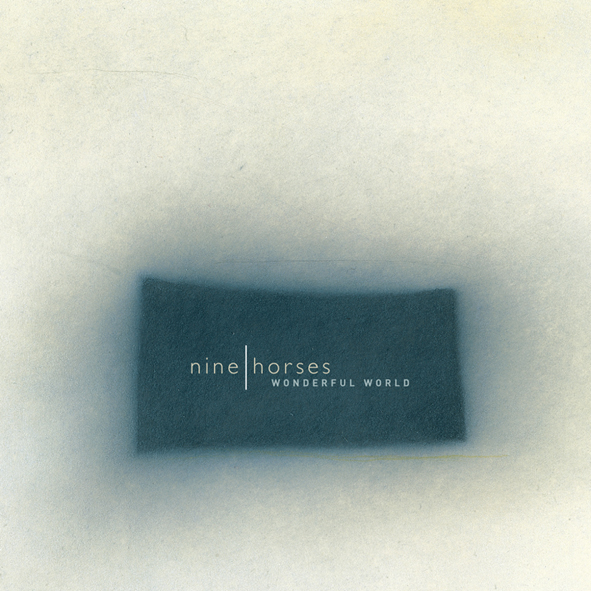
The featured image is from the 2006 cd single release of ‘Wonderful World’ which includes a radio edit of the song. The artwork is ‘Duchamp’ by Wes Mills (1999).
Download links: ‘Wonderful World’ (Apple); ‘Wonderful World (Burnt Friedman remix)’ (Apple)
Physical media links: Snow Borne Sorrow (Amazon) (vinyl re-issue); Money for All (discogs)
‘There were many moments on the Nine Horses project where things really came together beautifully, notably writing the tracks ‘Wonderful World’ and ‘Atom and Cell’ with my brother.’ David Sylvian, 2010

More about Snow Borne Sorrow:
The Banality of Evil
Atom and Cell
A History of Holes
Snow Borne Sorrow
The Day the Earth Stole Heaven
Related:
The Librarian

Thank you for you wonderful in depth articles!
LikeLiked by 1 person
And thank you for visiting the site and reading them!
LikeLike