
The story of the ‘reformation’ of Japan (or to be accurate, of the four members who created the band’s final studio album, Tin Drum) was something that I followed in real time through the pages of the fanzine Bamboo. The first hint of such momentous news was contained in the Summer 1989 edition and almost comically understated, undoubtedly because the situation developed whilst the print publication was being finalised.
Rather than being heralded in the opening editorial comments from the magazine’s dedicated volunteer production team led by Debi Zornes, the surprise announcement was shared in the regular ‘Latest News’ feature, nestled on page 29. Under the heading Japan, it read: ‘If any of you have seen the July 12-25 issue of Smash Hits, you would have seen a small piece in their “Fancy that” column that Japan are getting back together. This news also appeared in a French magazine called Best, in their June issue. Apparently they are talking about recording together but nothing is definite. If they do go back into the studio together it will probably be for only one track/single.’
Then, appended immediately below, is: ‘Late Additon: We understand that they are definitely getting back together though not under the name Japan.’
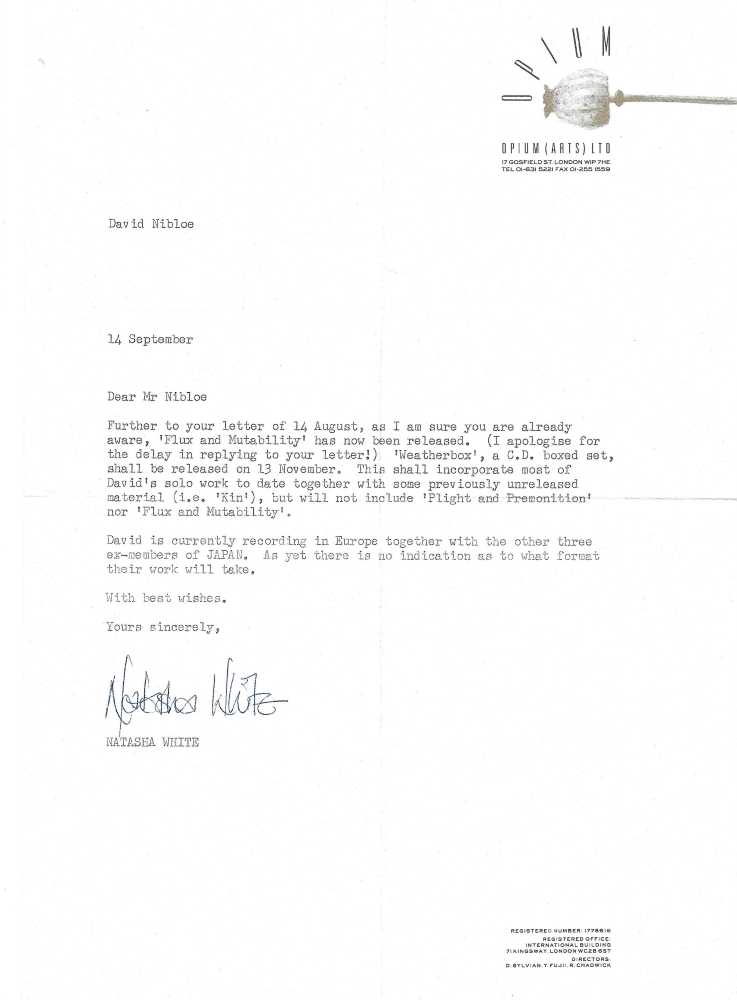
During this period I was in the habit of writing occasional letters to Sylvian’s management company, Opium (Arts) Ltd, at their London offices of 17 Gosfield Street, eager for news of present and future projects. It would sometimes take a considerable time for a response to be received, but there was always excitement in receiving a type-written update on smart Opium letterhead (‘Directors: D. Sylvian, Y. Fujii, R. Chadwick’) from the ever-patient Natasha White. My letter of August ’89 was rewarded with an update on the release of Flux and Mutability and the forthcoming Weatherbox 5-cd collection, followed by confirmation that ‘David is currently recording in Europe together with the other three ex-members of Japan. As yet there is no indication as to what format their work will take.’
Each subsequent edition of Bamboo was eagerly awaited for the latest developments, which unrolled in agonising slow motion. Reading them back now, I’m struck by the detail of the story of this record that the Bamboo team were able to glean during its evolution, drawn from press, industry contacts and the fan community:
Autumn 1989: ‘At present, David, Steve, Richard and Mick are in the studio, rumoured to be one in Marseilles, recording experimental tracks. A spokesman told the Melody Maker, “If it works, it works. If it doesn’t, it doesn’t. But it’s going very well. When they finish in a month they may talk about reforming Japan”.’
Winter 1989/1990: ‘In a February edition of No.1, they said of the Japan get together in France that apparently seven songs have been recorded but no plans for release. In Melody Maker (10 Feb 1990), they report that 8 or 9 tracks have been completed in the studio where the recording sessions are reported to have gone “jolly well”. There is no date set for the album, which will be a Virgin release.
‘Virgin would only say that they were still in the studio and the management company the same, but added that if anything was released (it’s not known yet), it would definitely not be under the name Japan, which should not cause people problems as they were sure enough references to Japan would be made in the press.’
Spring 1990: ‘The record company said they are still working on their album and they could not be more informative than that. It’s understood that they have recently been working in a studio just outside London.’
Summer 1990: ‘There is still no release date for the album. Richard was asked in March at the Sakamoto show when it would be out and he said June. David has mentioned July/August to some but Virgin say the album is still in the process of being done. A radio broadcast in Japan stated that either the working title for the band or the working title for the LP will be “Testing the Water” and is environmental music. It is rumoured that Virgin want the LP released under the name Japan.’
Autumn 1990: ‘Last year, the ex-members apparently recorded from 15 November to 5 December at studios near Venice in Italy (the same studio that Steve and Richard recorded with Alice). Reader Paul Parkinson put a few questions to Bill Nelson after his gig in Wakefield re the Japan album. Nelson said that he played on several tracks and it was a Sylvian type album, and very good. He also said that they were given £250,000 to make the album but this had been spent before the album was mixed and no more money would be forthcoming from Virgin.
‘Other news on the subject is that the album has been recorded and will be released sometime next year. Steve Nye will be working on it when it’s mixed. About ten studios were used for the recording. Michael Brook is also said to have worked on the album, contributing guitar. The name of the band will not be a problem as Virgin have said they will release it under any name they choose.’
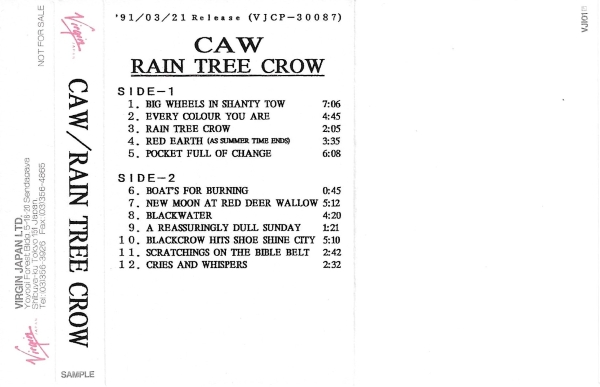
Finally, definitive news came in the Winter 1990/1991 edition. ‘David said that although he has recorded an album with the ex-members of Japan, it doesn’t mean that Japan have got back together. They got back together only for the album but not as Japan. They will re-appear under the name Rain Tree Crow and the album will be called Caw and is scheduled for release on 18 April with a single ‘Blackwater’ preceding it sometime towards the end of March. Bill Nelson, Michael Brook and Phil Palmer guest.’
The title Caw was included on promotional cassettes issued in Japan ahead of release, but was evidently dropped before the album materialised in favour of a release simply under the new band name. Mick Karn indicates in his biography that “Caw” had also been considered for the name of the band itself, alongside “Jean the Birdman” which soon surfaced as a track name on the Sylvian/Fripp project that followed closely on.
First, though, there was the single, ‘Blackwater’, and what a tremendous introduction to the album it was. Throughout the months of waiting there had been a doubt in my mind as to whether this music would ever see the light of day, and if it did, I had no idea how to form an expectation of what its sound might be. ‘Blackwater’ bears the touch of each of the contributing musicians whilst also taking them well beyond the boundaries of their previous work as a band. The entire track is buoyed along on a gentle tide of beautifully judged brushed drumming from Steve Jansen, heralding a new maturity in the quartet’s output. It’s worth playing the song on a decent sound system to hear the richness of Mick Karn’s simple bass part which can be lost completely when listening on the move in a less powerful format. Certainly not as showy as his lead parts on Tin Drum, but nevertheless at the forefront. (Steve once described it as ‘fairly dull by Mick’s standards’, but did this ballad call for anything more?) Richard Barbieri’s atmospheric synthesisers had last been heard behind Sylvian’s vocals on Gone to Earth, and his propensity for devising sounds that are unique and yet organic is once again on display, such that we believe that we are hearing something reflective of the real world and not mere artifice.
Steve’s accomplished drum part did not come naturally. ‘I was experimenting quite a lot of the time,’ he said, ‘I changed my set-up and had a whole new variety of drums, snares and cymbals to play with. Sometimes I was using two snares, moving drums around, so that I wasn’t forcing myself to play in a standard way. That was fun for me, but also made [engineer] Pat [McCarthy]’s job more demanding.’
‘Blackwater’ was ‘the hardest track to work on. We started it in Italy – the song was there and we were playing around with different rhythmic approaches including a conga feel, which I gradually grew to hate. We then had a break from recording, following which we went to Wool Hall Studios in Bath where I tried different approaches with ethnic percussion, a full kit, and then brushes.’
‘I spent quite a while whittling the role down to brushes and dropping the swing element it had started out with. The kit was so exposed and close-mic’d against the gentle timbre of the song that I found it impossible to get an entire take that I was happy with. The band were getting increasingly agitated with me spending what little remained of the recording budget on a drum track.’ (2015)
Mick recalled the stay at ‘Wool Hall in Bath for two weeks, where Steve began working with a kettle drum for ‘Blackwater’ on the Monday. Come Thursday, we were still listening to the one solitary kettle drum which just couldn’t be made to sound perfect enough and, thankfully, we moved on to something else on the Friday, until the following Thursday and another four days of the kettle drum that drove Steve to the edge of insanity. Try and imagine 7 days filled with listening to one drum continually from morning till night and perhaps you’ll understand how torturous improvisation can be!’ (2009)
Jansen: ‘The studio time had finished, so I had time to go away and think about it and I really didn’t like what I’d done. I had taken samples of the sounds at the time so I took a SMPTE mix of the track home to our E16 [Fostex Multitrack recorder, which had been purchased to record Stories Across Borders] and started to duplicate what I’d played on the Akai S1000 and the Macintosh. I used a variety of samples and literally compiled them on top of the original – slowing down where it slowed down and so on.’
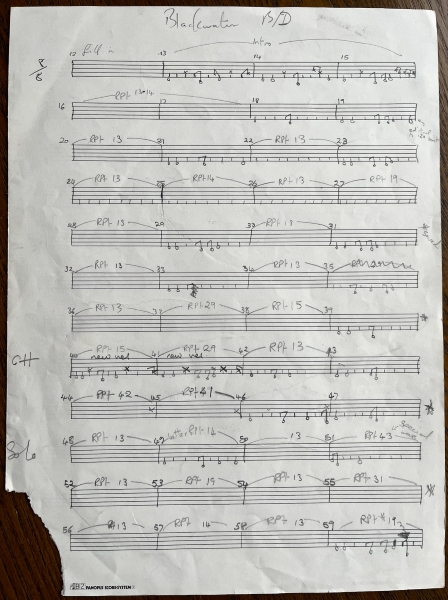
‘I think I had seven or eight brush snare hit samples of differing velocities and strengths. Then I had two or three toms and one full velocity bass drum – so there was a wide variety with a lot of possibilities. I have quite a collection of drum samples, but it’s never enough. Whenever I’m working on sessions I always like to get a sample of the day and of the different set-ups that I’ve used.’
Given the part was put together piecemeal, it’s impressive that it flows so naturally. ‘Hopefully it doesn’t sound too bad. I was surprised at the quality of the Akai; it was the first time I’d used one.’
‘Blackwater’ was the only track on the album to be constructed with such an extensive use of samples. Computers were used to capture performances rather than to ‘correct’ them. ‘We never use quantisation,’ explained Richard Barbieri, ‘it’s purely to change notation here or there, taking bits and pieces out. Because we had the computer running while we were all playing live, if we liked something we could lift it and shift it, but keep the actual performance.’
Richard’s keyboard parts were concocted using a mixture of old tools and new. ‘For a long time Sequential Circuits’ Prophet 5 has been my forte. I’ve used it with a number of effects and I’ve always been able to do a lot of what I’ve wanted on that particular keyboard. But lately I like the Ensoniq VFX and I’ve used that extensively on the new album. It’s the one digital keyboard that seems to suit me quite well and I like the way it works – it’s very much a performance type of keyboard. The actual presets on the VFX are awful, they’re disgusting, but I could tell that there was something in the way that you go about programming it that was nice and would suit me.
‘In terms of effects, I’ve always used an SPX90 [Yamaha], mainly through lack of funds more than anything else… One of the best things I did was to have the Prophet fitted for MIDI – mine’s one of the last to be made so it has a few extra functions and is fairly reliable. A lot of things on the album that may sound a bit guitar-ish are in fact the Prophet, like the solo in ‘Blackwater’. I’ve also found a way of distorting it without using any external effects which is quite interesting, I’m not sure if it’s a fault or whether I’ve just got better at a certain area of programming!

‘I always find something new, especially with my old System 700, which is one of the first modular synths that Roland built. There must be so much dust inside it that it’s causing all these kind of quick changes where the sound doesn’t quite come through. But things like that sound good – a lot of what I do is accidental and it just works.’
In addition to Barbieri’s guitar-like synth, ‘Blackwater’ boasts one of the solos from Bill Nelson that had been mentioned in Bamboo. Bill was also returning for the first time since his stand-out playing on Gone to Earth, his sound again both clean and crisp.
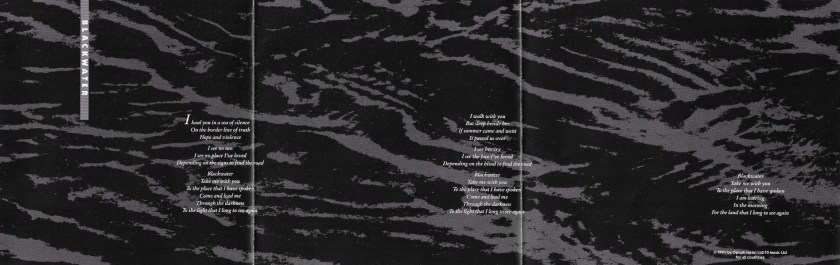
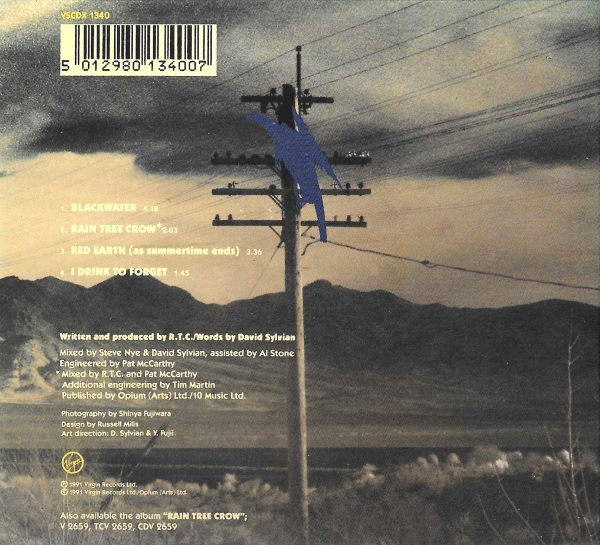
The single came in two formats, one with a fold-out lyric sheet and another a limited-edition digipack ‘folio’ with cruciform artwork. Both gave us our first glimpse of Shinya Fujiwara’s desertscape photographs which seemed quite a contrast to a song themed around water. The images had been contained in the photographer’s book American Roulette which was published the previous year.
Given the imagery, Sylvian was asked whether the music was based on experiences in the US? ‘No, it isn’t really a reference to America, although the place referred to is in a sense a mid-West desert – it’s more a place of the mind,’ he responded. ‘I found early on that with the kind of tracks we were choosing to use, there was this imagery in my mind of a desert landscape. I do tend to work with these images anyway when working on my own projects, and I thought that if all these pieces could somehow relate to this desertscape then there would be continuity, which there was a danger of there not being otherwise.
‘Perhaps I should first say that the image of the desertscape is for me symbolic of a kind of ending, a kind of death you could say. The aridity of that kind of landscape does not encourage new life to take root… But images of ‘Rain Tree Crow’ and ‘Blackwater’ are more positive images. The images of water, and its regenerative power, are about the possibility of new life, and to me these two images are complementary in that respect.

‘The concerns of the lyrics are ongoing and the content is something that’s been developing in my own work for a long time. I tried not to use lyrics which were overtly personal because it was a group project and I didn’t want to shift the focus at all. But I didn’t want to be dishonest to my own nature – so I tried to write them in such a way that they were universally applicable.’
Various images come together in the promotional video for Rain Tree Crow’s lead (and only) single. It was directed by Nigel Grierson who had previously created the film for Sylvian’s ‘Orpheus’, bathed in Mediterranean warmth. The scenes are drained of colour for the ‘Blackwater’ promo. We see the force of water in the strong current of a river in full flow, its power to shape rocks into stalagmites and stalactites, and then the calm of a pool. Sylvian sings a couple of key lines as he sinks into a reverie.
‘I haul you in a sea of silence’
‘Blackwater
Take me with you
To the place that I have spoken
Come and lead me
Through the darkness
To the light that I long to see again’
There are two unidentified characters in the short film. A boy is seen walking carefree through the woods, then engulfed in water but radiating wonder rather than fear, and finally exposed to the elements in a desert sandstorm. And we see the statuesque figure of a woman:
‘I walk with you
But sleep beside her
If summer came and went
It passed us over’
Perhaps the youngster represents the protagonist in his formative years, and the woman a lost love or muse. As we reach the final scenes, we see the singer as if in a releasing death. I’m left with the impression of the waters carrying someone over into the next life, like traversing the Styx in Greek legend.
‘I am leaving
In the morning
For the land that I long to see again’
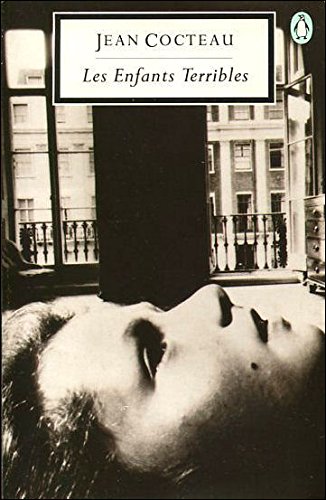
The setting is reminiscent of a photograph by Bill Brandt (Portrait of a Young Girl, Eaton Place, 1955) which featured on the cover of Penguin’s 1980s edition of Jean Cocteau’s Les Enfants Terribles, a volume with which Sylvian was likely to be familiar given his fascination with the French artist, writer and poet (read more here).
Seen throughout the video is the figure of the crow, which dramatically flies out through the open window of the room in which the singer lies in the closing moments. It’s an image repeated in the band’s name as well as ‘Black Crow Hits Shoe Shine City’ (and explored further here). ‘I was going through, and still am to some degree, a rather negative emotional period in my life,’ said Sylvian when asked about its significance. ‘I found that the symbol of the crow became very relevant for me and by being able to objectify this emotional experience, with this symbol, with the image of the crow, it became part of the healing process. It’s something I could only touch on with this album, but at the moment I have the idea to continue the story of crow for a while and see where it leads me.’
By the time the video was produced, relationships within the band had splintered. Running out of studio time – brought on by difficulties such as finalising the drums for ‘Blackwater’ – the budget had been exhausted and this led to disagreements about how to complete the work that had taken so many months in so many studios to lay down. Sylvian stuck to his precondition that the name Japan should not be associated with the record, this being a different context in which the four were working. The others had become willing to concede the point in order to unlock a further advance from Virgin, it now being clear that the reformation would go no further than a single album.
The record company saw commercial potential in the music but felt they could only effectively market it with the benefit of the familiar band name. Interviewed for Anthony Reynolds’ book, Cries and Whispers, Declan Colgan – a key figure at Virgin at the time – said, ‘I can still remember when ‘Blackwater’ came in. Willie Richardson, who was head of A&R, had received a DAT with ‘Blackwater’ and two other songs on it, all rough mixes. It got played at an A&R meeting and everyone there was blown away. It was: “Oh, Wow.” The hope for it was huge. Everyone in the sales and marketing department was saying, “This is a top ten single and a top three album – if we can call it Japan”.’ (2018)
For Sylvian it was a point of principle. The band had all agreed not to use their former identity from the start of the new incarnation. In the end, Sylvian funded and completed the mixes with Steve Nye. Jansen, Karn and Barbieri felt excluded and betrayed.
Returning to the subject of Rain Tree Crow’s arid landscape imagery and its appropriateness for the project, Sylvian said, ‘I think that what eventually happened with the relationship within the group itself and also maybe some of our personal relationships outside the group had something of that nature anyway.’
This desert theme may have created the connective tissue between the tracks for Sylvian, but it wasn’t something that resonated for Mick Karn. ‘One of the main influences during the recording was our engineer Pat McCarthy. Pat came over from Dublin; our original producer, Michael Brook, brought over a lot of Irish books with him, lots of Joyce and stuff… David read a lot of the books. ‘Blackwater’ means Dublin in Gaelic, doesn’t it? The recording sessions felt very Irish, so to hear all this talk about desertscapes you’re thinking, “When did all this happen?”’
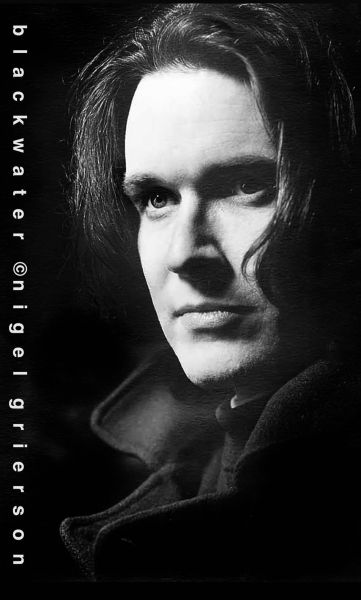
A version of the video was first completed including only Sylvian, with the other band-members only discovering that it had being shot after the event (the original edit can be seen below). Jansen: ‘Virgin phoned me up…and said, “You know, we’re really unhappy that the band aren’t in the video!” and I said, “What video?”’ It was subsequently resolved that takes of Steve, Mick and Richard playing their instruments would be retrospectively edited in. These sequences were all individually recorded, Karn sharing that his filming was delayed a week following a fight (unrelated to band matters), his appearance being obscured by shadows because of lingering bruising.
One of the sequences removed to make way for the new footage shows glass as shattered as the original multi-album aspirations for the project, and a striking sequence of Sylvian and the crow in silhouette.
Original edit of the ‘Blackwater’ video, before shots of Jansen, Barbieri and Karn were edited in. Apologies for the imperfect picture quality.
The music transcended all the difficulties. Even in an interview that laid bare how badly things had fallen apart, Richard Barbieri was at pains to point out: ‘We’re very, very proud of the album. We were all very happy when we were recording it, and it shows. Let’s just say it’s the Japan album nobody thought would come about.’
It’s intriguing to contemplate how a track like ‘Blackwater’ emerged from the original sessions and was developed into such an impressive piece. Sylvian: ‘Although much of the finished work incorporates seeds of the original improvisations from which it grew, there was a lot of re-recording and polishing of the material. I don’t remember there being too much of a struggle regarding the different directions the material took, although I do remember I’d frequently be forced to justify my decisions whereby one piece or approach might be deemed out of context and another not. ‘Blackwater’ might be the exception here. I think I fought harder for that track than any other. Not because it was of the greatest interest, but it was a strong piece that worked well in the body of the remainder of the album.’ (2010)

Steve Jansen would put his drum samples for ‘Blackwater’ to alternative use for a song that reached No 5 in the UK singles chart, No 1 in Italy and achieved Billboard chart success in the US: the debut solo single by Annie Lennox of Eurythmics. The introduction came through Steve Lipson, Jansen having got to know the producer years earlier when performing live with Propaganda. Jansen: ‘Annie invited me to listen to a new track she was working on at her home studio in her attic space which I believe wasn’t really set-up to record drums [‘that explains why there are no drummers performing on it’]. She sang a guide vocal on it and we discussed what sort of thing was required.
‘Since programming had become a fairly common practice by that time, I took the track away and programmed something up in my own recording space. I actually used some of the same samples that I’d made for ‘Blackwater’…I think I drove my neighbours a bit nuts at the time as my place was being refurbished and there was no sound insulation. The track was called ‘Why’.’
Steve’s drum arrangement for the song was developed further during the production process before it was released and took its place on Annie’s 1992 Platinum-selling album, Diva. Jansen: ‘My “version” had a closer feel to ‘Blackwater’ in terms of presence and intimacy but the final mix is kind of more rhythmically bland, but maybe that’s what it takes to create a global hit.’ (2017/18)
Video for ‘Why’ by Annie Lennox, 1992, drum programming by Steve Jansen
‘Blackwater’
Richard Barbieri – synthesisers; Steve Jansen – drums, percussion; Mick Karn – bass; Bill Nelson – guitar; David Sylvian – guitars, additional synthesiser, vocal
Music by Rain Tree Crow. Lyrics by David Sylvian
Produced by Rain Tree Crow. From Rain Tree Crow by Rain Tree Crow, Virgin, 1991.
Engineered by Pat McCarthy. Mixed by David Sylvian and Steve Nye at Olympic Studios, London.
Computer programming by Steve Jansen. Keyboard programming by Richard Barbieri and David Sylvian.
Recorded between September 1989 and April 1990 at Miraval Studios, Le Val, France; Condulmer Studio, Zerman di Mogliano, Italy; Marcus Studios, London; Air Studios, London; The Wool Hall, Bath; Ropewalk Studio, Dublin; Mega Studios, Paris, France; Eel Pie Studios, London.
All artist quotes are from interviews in 1991 unless otherwise indicated. Full sources and acknowledgments for this article can be found here.
Download link: ‘Blackwater’ (Apple)
Physical media: Rain Tree Crow (Amazon)
‘‘Blackwater’ started out very different musically and I wasn’t comfortable with the feel of it. At the time I felt it would have worked better without drums at all (still do in fact… something less busy for sure), since it was a very delicate song built upon ambient sounds and vague crescendos.’ Steve Jansen, 2015

More about Rain Tree Crow:
Red Earth (as summertime ends)
New Moon at Red Deer Wallow
Blackcrow Hits Shoe Shine City

After reading this (I’ll read it again tomorrow, when I’m brighter – perhaps not the right word), I feel I need to check whether we downloaded this – with a few other Japan songs, a few years back – where my vinyl and CDs were not including some of the work I liked.
Listening a short time ago it struck me that Blackwater was a change in direction from eight or nine years before, a haunting or spiritual melody, but nothing like Ghosts.
I remembered that I’d also responded to one of your associated links, getting on for three years ago, so I read that again too.
During lockdown, I in fact had two experiences with jackdaws, within a fairly short time frame, of course, besides the crow, another ember of the corvid family.
The first was when I was cycling, to keep fit during the inactivity, and I noticed a bird, just off the road, this was only about 150m into my cycle. It looked like a youngster, possibly fallen from a next, but looking up and around, it could have been from one of a few. It was at the front of a period stone residence. I went back to our property and got some water in a bowl. The jackdaw looked me right in the eye as I put the water down to it and then it drank eagerly. I went back home and after a quarter of an hour, I went back with a cat box and brought it back to ours. It couldn’t fly but immediately started calling for (presumably) one of its parents. I put it back in the box and carried it back to the property I’d found it but released it into the back garden, which had plenty of trees and foliage, figuring it would have a better chance, if it’s parents found it.
Not much time later (I’m doubtful that it was the same bird, but who knows?) A jackdaw appeared in our front garden with an injured wing). We had a tallish rowan tree in the front with a bush and a couple of pints at lower staggered levels and, for the next 33 days, it came up and down the tree, when I fed it. It was getting stronger and the wing was either getting better, or the bird was fully fledged. On the 33rd evening we both watched it fly off! Wonderful.
I agree with David Sylvian, they are special birds. There is also a very big crow that comes to the yard we share with immediate neighbours. Five years later, we get one or two regular visitors!
Thanks again David (Nibloe).
LikeLiked by 1 person
First thought: what a difference between the subtlety and rarefaction of this track in the original version and the more “country rock” cut heard on the Everything and Nothing Tour (there’s a bad quality bootleg of London Hammersmith shows, both of which I was lucky enough to attend).
The album itself, albeit divisive for the band members, stands as a timeless masterpiece in the post-rock genre. Thank you for spotting the original video mix and the connection between Steve and “Why”.
Amazing retrospective, David… goosebumps, as usual!
LikeLiked by 1 person
Thanks for the kind words. The emotions of the band members when the album was released were certainly raw. I think all have expressed the view that the work is strong. Looking back on the fall out, Richard Barbieri told Anil Prasad in an excellent interview on the Innerviews site, ‘In retrospect, one could make an argument for both points of view, but the important thing in the end is the work itself and I have to say that David and Steve Nye did a really good job with the mixes.’ (2017)
LikeLike
David N,
After reading this thread again, I wondered whether the Bamboo fanzine was a conscious (or unconscious) catalyst for your creation of this (excellent) fan-site of yours (it’s held my interest as a reader, for the last five years, so thanks again)?
I was also interested to find through searching for the Bamboo fanzine, that there were, during the band’s existence, around four separate fanzines for Japan – Bamboo as ‘the principal’, Japan Fanzine – apparently an early fanzine from October 1978; Japan Fan Library (at least an issue in 1982) and of course the Official Fan Club Magazine.
Obiter dicta –
Yes, I have Blackwater! – Sasha did get it for me. She handles all our hard drive/electronic collection. It will go back on my Walkman ‘stick’ the next time it is charged. Besides my (limited) vinyl and CDs, I listen to Sylvian/Japan at least sometime every week – on the stick. On our hard drive, I have downloads from Gentlemen Take Polaroids, Tin Drum, The Collection (part duplicating hard collection), Brilliant Trees (ditto last), Rain Tree Crow, Everything & Nothing and Secrets Of The Beehive. Sasha’s favourite by Japan is their cover of Smokey Robinson’s and Al Cleveland’s, ‘I Second That Emotion’. I like it too.
Best Wishes,
Jeremy
LikeLiked by 1 person
Thanks for reading, Jeremy. I wouldn’t say that Bamboo was a conscious inspiration for the creation of this site. The inspiration was the music itself. I’ve always enjoyed reading insights from the musicians involved and it’s fascinating to me that this music reaches me like no other. Maybe there was an unconscious inspiration in the fact that, back in the day, I so valued the efforts of those behind Bamboo and others who contributed to the fan community. I believe that amateur efforts have a place in the ‘ecosystem’ that surrounds music that people hold dear, but I make no grandiose claims for this site. It’s a blog, no more than that. If it prompts anyone to listen again to the tracks, or explore the recordings of some of the contributors, then that would be wonderful. Everything leads back to the music.
LikeLike
P.S. The fanzine thing has rekindled an old memory of my own, from 1970. My parents bought me a Brother typewriter from The Ideal Homes Exhibition of that year and it’s ten feet away from me, still. My imagination started a newspaper called ‘The Enterprise’ and I gained pleasure from duplicating say, a dozen copies of it. It was entirely fanciful, I was too shy to do anything with it (and too young).
I can’t remember exactly the subject matters, but probably news, definitely nature, probably history…
Rain Tree Crow is a name, for me, that epitomises everything brilliant about the natural world – from water, our world, brilliant trees and one of the most intelligent descendants of dinosaurs!!!
LikeLiked by 1 person
Thanks for responding David, noted and I like 👍
To oldgondolier, I enjoyed your response too. The live experience must have been special…
LikeLiked by 1 person
Hi. Really interesting read. Thanks. I used to work at Opium (Arts) for around 6 months in 1988 with Natasha at the Gosfield Street offices. She was lovely. I was 19 and it was only my second ever job, essentially as Natasha’s assistant. I used to respond to answer the phones and fan mail, welcome fans who popped by the office, and also show people around the basement gallery for some of David’s photos. I only met David once. Richard (Chadwick) was a lovely boss, really friendly. I remember him giving me a compilation tape of songs he liked that he thought I might like, including Nina Simone and Tom Waits. Can’t remember the others. The tape has sadly been lost over time. It was an exciting building for someone having their first job in London. Connie Filipello’s (PR for David, Japan, Wham, George Michael, Duran Duran amion others) office was upstairs. She was fun and a force to be reckoned with. George Michael’s PA Siobhan Bailey was also upsatirs with Richard’s office at the top of the building. Family circumstances meant that I couldn’t stay longer than six months but it was a happy time, my first job in London and an incredible experience for a Sylvian/Japan fan. Thanks for the Blackwater article. Really interesting.
LikeLiked by 1 person
What a brilliant story. Thanks so much for sharing it!
LikeLike
Yes, thanks Jason, I enjoyed your response too. You’ve reminded me how excited I was in 1995, when I started working at London Bridge SE1.
You were involved in the bridge between Japan and Rain Tree Crow, whilst the feeling for Japan was still dynamic and fans were excited what would happen next.
It’s always great to work with a team you really get on with, especially early on in a career.
Plus, you got to meet the man himself!
My partner and I got to meet Neneh Cherry in 1996 (I was slightly bowled over) and I sat opposite Glen Matlock on the tube in 1998. For we music fans, such meetings tend to remain…BW
LikeLike
…in the memory…(at the risk of overkill on my part) – after reading Jason’s post again, I hadn’t realised that David (Sylvian’s) career had already expanded to photography – by 1988 (or before) – I recall looking at [his] official site, some years ago, and thinking at that time, that this was part of his thing upon relocating to the States…I guess I thought ‘Gentlemen Take Polaroids’ – which has been on my stick for at least eight years, was written at least partly, tongue-in-cheek. I listen to it at least every other week! This has been, for me, the most informative, enjoyable, thread.
Yesterday, ‘Blackwater’, was loaded to my stick and finally, I agree 👍 strongly with Steve Jansen about the quality of the mix and the song is as good as anything from the earlier tracks – no wonder that people at Virgin, thought it was so good…x
LikeLiked by 1 person
Erratum: Richard Barbieri referred to mixes.
LikeLike