‘This short film was shot in two days of November 1984 in and around the outskirts of Tokyo, Japan. A large part of the music was completed during that same month and recorded over a period of three days. I later updated the material in London, in an attempt to elaborate on the theme started earlier in Japan, and to further improve the quality of the soundtrack.’
David Sylvian, August 1985
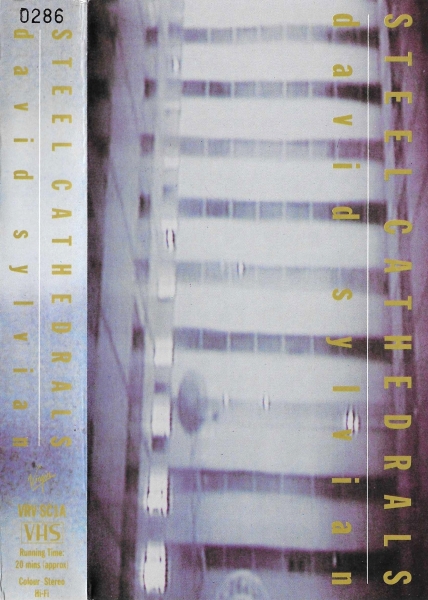
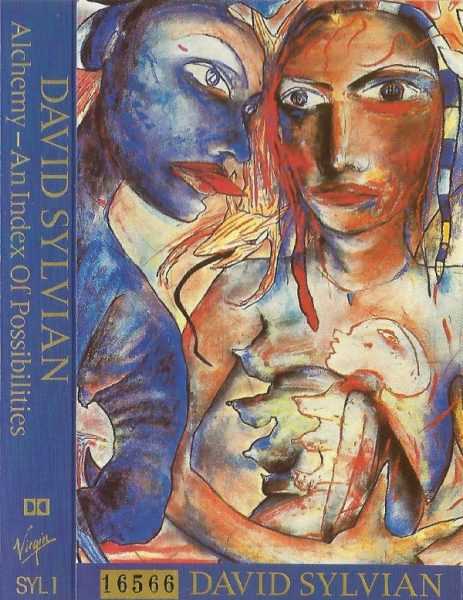
Such was the artist’s inscription on the reverse of the Steel Cathedrals video cassette released in the UK at the end of 1985, coinciding with the issue of an audio cassette, Alchemy – An Index of Possibilities. Essentially an instrumental follow-up to Brilliant Trees, the cassette contained ‘Preparations for a Journey’, the three ‘movements’ of Words with the Shaman, and the soundtrack to the Steel Cathedrals film. Both the video and audio cassettes were numbered limited editions, with the video limited to 2,000 copies (mine being #0286, as pictured).
Having been drawn in by Tin Drum and then blown away by ‘Forbidden Colours’ and then the entirety of Brilliant Trees, I was eager to experience whatever Sylvian produced and, in what would be a recurring theme over the years to come, it would often take time to understand and appreciate each successive step in his artistic journey. Steel Cathedrals was certainly unlike anything I had encountered to that date.
‘Both ‘Steel Cathedrals’ and ‘Preparations for a Journey’ come from the soundtrack of a video I worked on in Japan at the end of 1984,’ Sylvian explained. He was in Japan at that time for the exhibition of his Polaroid montages, Perspectives, and was commissioned by a local TV company to make a documentary about his life and art. ‘The idea didn’t appeal to me particularly, but I was extremely short of money,’ he would reflect. ‘I was supposed to write and direct everything, which I thought was really strange.’ So he ‘stretched the idea’ to enable a wider focus. ‘There was only one section that I wrote which was documentary – the rest I tried to make up with more interesting things, things that would interest me. The most successful part was what appeared in Steel Cathedrals.’
‘The film itself was directed by Yasuyuki Yamaguchi and he showed me some shots, just some experimental things he wanted to work on, and it kind of fell in with an idea that I had of shooting the industrial areas outside Tokyo and giving it a sense of life through a pulsing sound.’ The inspiration had been sights encountered on a journey through unfamiliar surroundings. ‘I clearly remember being in a car on the road from Yokohama to Tokyo speeding past all of these factories that were beautifully lit up at night, looking quite otherworldly, like some colonial outpost on a distant planet, and thinking to myself, “These resemble something like steel cathedrals, inspiring a similar kind of devotion perhaps amongst those that work within their walls.” As I happened to be working on both the music and the film at the time, the title stayed with me.’ (2010)
Director Yamaguchi ‘went out shooting and I stayed in the recording studio. I only had eight days to do it and it was awkward because I was ill for two of those days.’ Sylvian’s vision was to ‘create visuals that worked the same way as music does, in that they don’t dictate to the viewer, but allow a starting point for the imagination. They could spark off something in the viewer’s… memory? It could be to do with colours, anything. Even if it bores them into thinking about something else…’
The video opens with an image of three buildings that have a symmetry that reminds me of the arrangement of triple arches on the front elevation of an imposing church building. Through a shimmer like the haze of intense heat on a summer’s day, we see chimneys pointing upward, industrial processing plants glinting in the sunlight, waste gases rising into a clear blue sky. Not a single person is seen through the eighteen-minute duration, but the camera lingers on walkways around these vast facilities, as if to emphasise that it is the absent humans who both construct and operate them. Elevators are seen ascending and descending, like blood passing through the veins of the architecture, first by day and then illuminated at night in an environment that never sleeps.
The music for the original Japanese documentary was recorded with Seigen Ono, with whom Sylvian and Sakamoto had worked on ‘Forbidden Colours’, at the Victor Aoyama studio in Tokyo. The ensemble was a small one – David and Ryuichi being joined by Steve Jansen and erstwhile Japan guest-guitarist Masami Tsuchiya. ‘I really just improvised in the studio with some basic ideas that I had done in London. I put down this “pulse” and then I built up an ambient atmosphere behind it, bringing in musicians to improvise over it.’
Jansen recalls choosing to deploy traditional instrumentation. ‘I played the Taiko drum on the Tokyo session of the recording ‘Steel Cathedrals’. I’ve seen a few Taiko drum performances, usually in drumming groups such as The Kodo Drummers’ (2018). In particular, he utilised the odaiko, a wooden barrel-shaped instrument with taut skins stretched across both ends. It can be heard being struck by hand in percussion which dances around the predominant pulse of the piece. The odaiko ‘starts after about eight minutes,’ says Steve, ‘recorded at JVC Aoyama Studios which is where Richard [Barbieri] and I recorded Worlds in a Small Room‘ (2021). The latter was also a video soundtrack, this time for NASA footage of the Space Shuttle, and was recorded in November 1984, very close in time to the sessions with Sylvian.
‘I like to work with the element of chance,’ said Sylvian, ‘like Masami Tsuchiya’s “guitar abstractions”, which was basically him laying a guitar on the surface of a table and hitting it with different objects like a tuning fork. What came out were very much like noises.’
The original version of the track contained on the Preparations for a Journey documentary video boasts lead synthesiser lines that pick up the theme of local instrumentation, recreating the sound of the Far East in a similar way to what had been achieved for Japan’s Tin Drum. This first iteration was named ‘Showing the Wound (A Will to Health)’. Both elements of the title are nods to Joseph Beuys whose influence on Sylvian would later become explicit through Gone to Earth’s ‘The Healing Place’ (read the background here).
Of Beuys’ installation Show Your Wound, the Tate museum commentary says, ‘The wound was a recurring theme for the artist. On a personal level it referred to injuries he received in the Second World War, his breakdown in the 1950s and his heart attack in 1975.’ In a wider context, the wound was a symbol of human frailty, and Beuys’ contention was that we must recognise our own hurt, display it rather than hide it, in order to progress towards wholeness. The artist saw creativity as essential for human health. ‘Art alone makes life possible – this is how radically I should like to formulate it. I would say that without art people are inconceivable in physiological terms… I would say man does not consist only of chemical processes, but also of metaphysical occurrences. The provocateur of the chemical processes is located outside the world. Man is only truly alive when he realises he is a creative, artistic being… Even the act of peeling a potato can be a work of art if it is a conscious act.’ (1969)
Everyday acts and objects as works of art, every person an artist. Sylvian was seemingly drawing a parallel with the lives of those ‘devoted’ to the operation and upkeep of those Tokyo industrial facilities. The potential for fulfilment and creativity existed, rather than lives lived out merely in subservience to commerce.
‘Showing the Wound (A Will to Health)’ from Preparations for a Journey, 1985. The original track that was developed into ‘Steel Cathedrals’.
Returning home, Sylvian was keen to develop the piece further. ‘We asked for the material to be sent over to the UK so I could continue working on it for my own project, and they sent rather bad copies over of the original masters. There was a high level of hiss on the main tracks.’ However, logistical problems did not dampen his enthusiasm. ‘It was enormously frustrating. I recognised it straight away when we got the copies sent over from Japan, but it didn’t prevent me from wanting to work on it because I was really curious about where I could take the piece. But there was nothing I could do to solve the problem at that time, now technology’s improved and you can actually deal with this kind of surface hiss and all the rest of it a lot better than you once could. So it’s possible to clean them up…
‘I went on to add a lot more instrumentally to these pieces,’ added Sylvian, who expanded the track ‘Preparations for Journey’ from the simpler version included on the video. (2010)
For the closing section of the original soundtrack in particular, he saw the potential for something new. ‘‘Steel Cathedrals’ was the first step in a new approach for me. There had been a fair amount of room for improvisation in the recording of Brilliant Trees but the pieces themselves had an existing, recognisable architecture, a clear framework that the participants had to be conscious of. With ‘Steel Cathedrals’ I loosened things up a bit. I drew out a road map of the dynamics of the piece but left the content open to the participants to decide. I created a backdrop to give the players something to work off of (I was still working one on one, not as a group), there was the ambience, the pulse etc. Then I invited players to respond to this. I did a considerable amount of editing after the fact, cutting and pasting, shifting information around, composing would be the simple word for it.’ (2004)
Sakamoto’s piano for ‘Showing the Wound…’ had been a case in point of a musician responding freely to the context presented, and in the subsequent London sessions a trio of improvised performances were added from Robert Fripp, Kenny Wheeler and Holger Czukay. Fripp’s guitar was recorded on the occasion of their first meeting, when Sylvian was looking for the musical voice to unlock his arrangement for a piece known at the time as ‘The Holy Blood of Saints and Sheep’ (read the story here). Sylvian: ‘At that initial meeting we worked alone on material for the Gone to Earth record and the ‘Steel Cathedrals’ soundtrack’ (2004). Robert reels off some strident solos which Sylvian places surprisingly low in the mix. This approach works beautifully in the context of the ambient piece, even if the listener can’t help but wonder what the effect might be of hearing Fripp’s work at blistering volume.
Kenny Wheeler’s flugelhorn is a welcome element wherever it appears in Sylvian’s work. Here he is not subject to the constraints of a ‘break’ within a ballad structure and that freedom is rewarded with some sumptuous flourishes that spiral heavenwards.
Another supplementary element was the inclusion of disembodied voices that provide another hint towards the humanity so absent from the video itself. ‘The French voice I recorded, the rest came mainly from Holger’s use of the dictaphone,’ explained Sylvian. It was an extension of the approach adopted on many of the tracks on Brilliant Trees, chanting voices heard on ‘Steel Cathedrals’ being particularly reminiscent of those on the title track of Sylvian’s debut LP. ‘He found this old IBM dictaphone in the dustbins outside a factory in Germany and he made it work for him. Basically, he records a variety of sounds onto dictaphone tapes which are very wide and he has altered the playback head of the machine so that he can move it across the tape, backwards and forwards across the tape so that he can improvise with pre-recorded sound.
‘It’s the first time I’ve ever seen anybody do this with tape and the first time Holger used it was on the end section of Brilliant Trees where you can hear monks’ and women’s voices from his dictaphone. The nice thing about it is that it has a deteriorated quality – it gives this unidentifiable sound that causes very particular emotions in people. It adds colour to the music, an atmospheric depth that sounds very organic. There are sounds that we hear all the time – while we are talking you can hear sounds out on the street and you don’t have to identify particularly what they are, but when they are used in a piece of music they conjure up certain feelings which are very difficult to create with a synthesiser. I mean you would have to plan so much to find that kind of sound, but it’s something you almost stumble over when you work with Holger.’
The ‘French voice’ belongs to Jean Cocteau, with whom Sylvian had developed a deep fascination despite the generations between them (read more in the article about ‘Pulling Punches’ here). The artist, poet and author can be heard musing firstly about the ‘mystérieux personnage’/‘mysterious character’ who ‘lives within us…and dictates works to us that we have meditated on for a long time…’ and then pondering the imagined desires of ‘Alexandre de Macédoine’/Alexander the Great. Whether included for their inference, the significance of their speaker, or merely as an indeterminate element among the weft and warp of the sounds being weaved, the presence of these spoken passages adds texture to the work. In overlaying Robert Fripp and Kenny Wheeler’s improvisations in a musical exchange with those from Ryuichi Sakamoto previously recorded in Japan, along with sound elements from Holger Czukay and those self-crafted, Sylvian fashioned an instrumental with far greater depth and complexity than the earlier rendering on the Japanese documentary.
A new name was given to the final version. From reports in the Bamboo fanzine at the time when Sylvian was struggling with how to package the triple elements of Words with the Shaman, ‘Steel Cathedrals’ and the first trilogy of songs produced for a second solo album, it seems that an interim working title had also existed. The plan then was for the follow-up to Brilliant Trees to present the track along with ‘Before the Bullfight’, ‘Laughter and Forgetting’ and what would ultimately become ‘Wave’. ‘Side One of the album is an instrumental piece entitled ‘Explosion of Faith in a Cathedral’,’ stated Bamboo’s issue 6, ‘Side Two consists of three or four songs.’
‘Steel Cathedrals’ perfectly encapsulates the environment that Sylvian had witnessed on that trip between Yokohama and Tokyo, but it seems that there was also something drawn from his subconscious. Sylvian: ‘I have a poor memory for such things to be honest…I wouldn’t have remembered an interest in [Dirk] Bogarde were it not for the fact that his biographer got in touch recently to ask about the obvious references. I was quite taken aback that ‘Steel Cathedrals’ was a poem by Bogarde, I simply wouldn’t have known that to be the case, but I must’ve read it and it lodged itself in the back of my mind…How does that work? I read the book in ’78, the composition was made in ’85. No matter how I personally feel about the source of the title, I have to believe there’s a debt to be acknowledged there. I become the unreliable narrator of my own story.’ (2010)
The notable previous allusion to Bogarde’s work was the naming of Japan’s ‘Nightporter’. ‘Steel Cathedrals’ is one of a small number of published poems by the actor. It too chronicles experiences encountered on a journey: in this case rail trips undertaken in the age of steam, another impressive feat of human ingenuity.
‘It seems to me, I spend my life in stations.
Going, coming, standing, waiting.’
‘Dawn stations, with a steel light, and waxen figures.
Dust, stone, and clanking sounds, hiss of weary steam.
Night stations, shaded light, fading pools of colour.
Shadows and the shuffling of a million feet.’
‘Grinding sound of trains, and rattle of the platform gates.
Running feet and sudden shouts, clink of glasses from the buffet.’
‘Iron pillars, cupulas of glass, girders messed by pigeons,
the lazy singing of a drunk.’
Lieut., Queen’s. D. VAN DEN BOGAERDE.
Sylvian’s ‘Steel Cathedrals’ found its home on the Alchemy… cassette, the format chosen because the flaws in the master recordings rendered the output unsuitable for vinyl. ‘There was just a concern that people would be upset with the sound quality of these pieces,’ he said. ‘So in the end we just put it out on cassette because it was more forgiving (laughs). In a sense you couldn’t really tell just how bad the sound quality was on cassette, whereas on vinyl it would be a lot more apparent.’ (2003)
The proposal to release the video in the UK – now shorn of the documentary but with the benefit of the evolved soundtrack – was actually refused by Virgin Video, the arm of the company charged with carrying music promo content. An 18-minute film with an ambient soundscape was hardly their stock-in-trade. ‘I’m very aware that the things I’ve done this year were for a very, very limited audience,’ Sylvian acknowledged. Instead, Virgin Records took the decision to release it themselves, a sign of the label’s belief in their artist’s work. Sylvian: ‘The best they can get out of it is a reputation for releasing more interesting videos.’
As Sylvian approached the end of his tenure with Virgin after the turn of the millennium, one of his final acts was to create an instrumental compilation, released later as Camphor. The process allowed him to consider past works and their context in the long arc of his back catalogue. ‘I have heard ‘Steel Cathedrals’ again after many years,’ he said whilst the compilation was being curated. ‘It’s an interesting piece, as it was a precursor to the work I was to do with Holger, and later again with Rain Tree Crow. I based the piece around a very simple structure and then improvised the work into shape…As a composition it has its moments, but as its composer I’m drawn to its weaknesses rather than to its strengths. But it’s an area of work which will likely go on intriguing me for many years to come. I daresay a detail of ‘…Cathedrals’ will surface on the final compilation.’ (2001)
In fact, this wouldn’t be the case. ‘I’d originally intended to create a somewhat more languorous collection composed of edits or details of the longer instrumental works that I’ve composed on and off for the past 18 years, interspersed with shorter pieces,’ explained Sylvian, ‘compositions such as ‘Steel Cathedrals’, Words with the Shaman, the collaborations with Holger Czukay, and the more recent installation “soundtracks”. I found the task of cutting these works down, lopping off tops and tails in search of a section that might reasonably encompass the whole in essence, dispiriting. I gave up after one or two attempts and returned to an impromptu compilation.
‘Virgin are in the process of re-mastering the solo catalogue and are including the Alchemy… cd previously only available as part of the limited edition Weatherbox set. Pieces that failed to find a home on the compilation (‘Steel Cathedrals’, Words with the Shaman) will once again be widely available’ (2002). The new mastering attempted to deal with the substandard sound quality. ‘It’s been cleaned up, but you can still hear there’s something to be desired,’ Sylvian concluded. (2003)


Disappointingly, the late Virgin-era compilations Everything and Nothing and Camphor were not accompanied by a digital format video release so that fans could upgrade their video-tape – or laser disc – originals. ‘We had a wonderful concept for an expansive DVD release but could not convince Virgin records of its relevance/significance’ (2002). Sylvian retained some hope of realising the project even after he had parted ways with the label and launched samadhisound. As late as 2004, he was on record as saying, ‘We may release Steel Cathedrals as part of a DVD package at some point,’ but it never came.

Where Steel Cathedrals depicted a scene like some ‘outpost on a distant planet’, Steve Jansen and Richard Barbieri’s Worlds in a Small Room literally took us beyond the earth’s atmosphere to life on the Space Shuttle, with scenes from the craft’s early missions. ‘In the surroundings of our choice we are able to see and hear of stories from afar,’ read Steve Jansen’s quote displayed at the end of the film, ‘…we can begin to feel we have witnessed a thousand different worlds. Yet we only experience these worlds in a small room.’
The music that plays as the credits roll is ‘Distant Fire’. Another piece with Eastern flavours, it demonstrates two other Japan members experimenting with ambient material in the next phase of their careers following the pop heights of Tin Drum and the demise of the band. Whether intended or not, the imagery in my mind’s eye is of the man-made fires that can be spotted from space, signs of human life evident even from orbit. The only co-written piece, Jansen declared it his favourite from the album. ‘It’s not that musically it’s better, it’s just that from a performance point of view – we just sort of improvised. It sounds hard to improvise and it just came together really.’ (1985)
‘Showing the Wound (A Will to Health)’
Steve Jansen – percussion; Ryuichi Sakamoto – piano, strings; Masami Tsuchiya – guitar ‘abstractions’; David Sylvian – all other instruments
Music by David Sylvian [as quoted on the video, albeit the later iteration – ‘Steel Cathedrals’ – is co-credited to Ryuichi Sakamoto]
Recorded in Tokyo, 1984
From Preparations for a Journey, David Sylvian, Victor Rock Video, 1985
‘Steel Cathedrals’
Holger Czukay – dictaphone; Robert Fripp – guitar, frippertronics; Steve Jansen – percussion; Ryuichi Sakamoto – piano, strings; David Sylvian – keyboards, tapes, digital percussion; Masami Tsuchiya – guitar ‘abstractions’; Kenny Wheeler – flugelhorn
Music by David Sylvian & Ryuichi Sakamoto
Soundtrack from the short film by David Sylvian & Yasuyuki Yamaguchi
Recorded in Tokyo/London 1984/85
Produced by David Sylvian, from Alchemy – An Index of Possibilities, Virgin, 1985
All David Sylvian quotes are from interviews in 1986-87, unless otherwise indicated. Full sources and acknowledgments for this article can be found here.
Thank you to Renaud Haslan for his assistance in research regarding Jean Cocteau’s recorded voice on ‘Steel Cathedrals’.
Download links: ‘Steel Cathedrals’ (Apple), ‘Distant Fire’ (bandcamp)
Physical media links: Alchemy (Amazon – vinyl re-issue); Other Worlds in a Small Room (a reimagined version of the original Worlds in a Small Room album) (discogs)
‘My first experience with improv came with the recording of a soundtrack by the name of Steel Cathedrals back in 1984.’ David Sylvian, 2010
More about Alchemy – An Index of Possibilities:
Words with the Shaman
Ancient Evening
Incantation
Awakening (Songs from the Tree Tops)
Preparations for a Journey
