
Ingrid Chavez’s 2010 album, A Flutter and Some Words, marked a return to music after a long break. Her only previous solo album, May 19, 1992 on Prince’s Paisley Park label had been released nearly twenty years earlier. The intervening years had been spent prioritising motherhood following her marriage to David Sylvian and the birth of their two daughters.
Each of Ameera Daya and Isobel have songs dedicated to them on the record. In Ameera’s case, though she was a teenager at the time A Flutter… came out, the song looks back to an early experience when she was not yet two years old:
‘Our world was in you
With your golden hair
Now brown
And wide eyes shy of two
Now lined in kohl
You had us to yourself then
Angel seed
Sown into the heartland’
Ingrid’s familiar spoken word which many of us first heard on ‘Heartbeat (Tainai Kaiki II)’, the beautiful collaboration with David Sylvian and Ryuichi Sakamoto that brought Sylvian and Chavez together, chronicles a road trip taken by the young family as they travel westwards from their Minneapolis home of the time:
‘The tarred road eternal
Slicing through the salt flats
Sparkling in the simmering sun
The country
Laid out before us
From the northern great plains,
To the camel coloured hills
Of San Ramon
We drove on through the night
Crossing state lines
Some unspoken promise
Calling us
Calling us west’
The compulsion for their journey came from the visit of Mata Amritanandamayi (known as Amma or Ammachi) from India. Each year since 1987 Amma had embarked on such a tour, travelling across the US and beyond. An ashram had been inaugurated in San Ramon, California in 1989, the first to be established by Amma in the US, and it was traditional for her visits to America to commence there.
Ingrid’s track, ‘The First Darshan (Song for Ameera)’, describes both the anticipation of the family’s first encounter with Amma and then the moment of embrace in the lap of the holy woman at darshan:
‘The long road led us to her door
The scent of jasmine filled the air
We laid beneath the slow sway of a willow tree
All colour faded to white
Waiting for the unknown
Waiting for her
And with the grace of god in her stride
She arrived…
When she pulled us into her lap
You were the first
And like a great house over you
We were in her arms
Halleluja!
Halleluja!’
‘I was hoping that somewhere along the way a song about Ameera would come without me having to force it,’ said Ingrid, ‘and it did. It’s the last song that was written. I really feel like the things you need come to you if you’re patient and don’t force them…I wanted her to know how special she is in my journey to where I am. I wanted her to understand that, when she was first put into Amma’s lap and David, my son Tinondre, and I were pulled over her, that we are a house for her. Not a physical home, a heart home.’ (2009)

This was the second in a trio of encounters with Indian saints that made an indelible impression on David and Ingrid. ‘Shortly after we met,’ Sylvian recalled, ‘we went to visit Mother Meera in Germany, and that increased our level of devotion, and we increased the amount of time we spent applying ourselves to practice. A while later we met an Indian avatar by the name of Mata Amritanandamayi, and she became my guru and is still my guru. And further down the road, Shree Maa actually came to our house in Minneapolis to stay for a period of time, and that was a tremendously transforming experience also.’
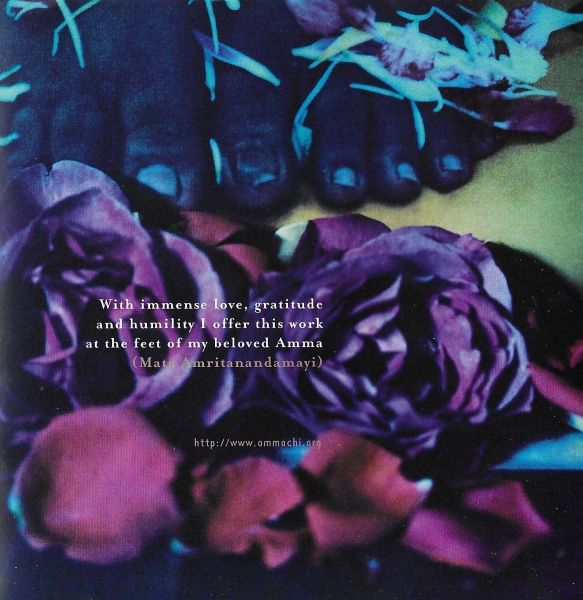
All three are celebrated on Sylvian’s album Dead Bees on a Cake, Mother Meera on ‘Thalheim’, Shree Maa appearing on ‘Praise (Pratah Smarami)’, and with the artist’s sleeve inscription reading: ‘With immense love, gratitude and humility I offer this work at the feet of my beloved Amma (Mata Amritanandamayi).’
As life continued in the ensuing years the pilgrimage to California would become an annual event and would be extended by travelling with Amma, taking in the destinations on her annual US ‘yatra’. Family and spiritual life was all-absorbing. ‘I stopped making music altogether, and I didn’t do a whole lot of writing during that period of my life, either,’ remembered Ingrid. ‘I put all of my creative energy into my children. We also had a guru at the time – we were following Ammachi around, and that was a big part of my life…we were on the road with her constantly during the summer. That was in the 1994 timeframe.’ (2016)
The memories created were good ones. In a recent interview Ingrid reflected: ‘That was a beautiful special time in my life because it was a good time in my marriage with David. Our family was young. Our three kids would miss the last week of school every year because we’d pack up and drive across America to visit Amma in California. We would travel around the country and meet up with her in different states.’ (2022)
Amma was born in 1953 to a lower-caste fishing family in Kerala, India. Her birthname was Sudhamani and as a young child she was often scolded by her mother for not attending to the family chores, preferring instead to spend time in meditation and easily distracted by her spiritual yearning, particularly a fascination for the Hindu god Krishna. A biography, Ammachi by Swami Amritaswarupananda, was published in 1994 and subsequently the story of her life was dramatised in a film called River of Love. This was released in 1999, the same year as Dead Bees on a Cake, the soundtrack containing multiple tracks from Sylvian’s earlier catalogue, including his collaborative work with Holger Czukay, which were added under David’s direction.
The excerpt below shows a young Sudhamani. The biography describes how she would call out to Krishna whilst ‘absorbed in a state of supreme devotion’, sometimes losing consciousness and falling to the ground. In these moments of bliss she would hear the sound of Krishna’s flute. This episode is soundtracked first by a fragment from Plight & Premonition by Sylvian and Czukay, and then, as revelation comes, by ‘Answered Prayers’ from Gone to Earth.
Sudhamani’s devotion grew and in time she was recognised to be a manifestation of the divine, firstly of Krishna himself and subsequently as an avatar of the Divine Mother. At some point, perhaps after her US tours began, she became known as the ‘hugging saint’. During darshan, when devotees come forward to share an intimate moment at the feet of the teacher, rather than remain at a distance or allow just a touch of her feet, she would embrace everyone who approached her.
‘People used to come and tell Amma their troubles,’ she once explained. ‘They would cry and I would wipe their tears. When they fell weeping into my lap, I used to hug them. Then the next person too wanted it… And so the habit picked up…
‘Today’s world is becoming more selfish in nature. Everyone wants to get. Not give. Only when you sow can you reap. Without giving, you cannot take. People need to understand that.
‘Embracing symbolises giving. It’s loving, and love is what there is a shortfall of in the world. Embracing also symbolises motherhood, the mother from whom you took birth.
‘My embraces are aimed at that, to waken the spirit of giving in people…It is not purely physical, but aimed to touch you inside.’ (2002)
Amma’s influence on Dead Bees on a Cake is explicit not only in the dedication of the album to her but also in the track ‘All of My Mother’s Names (Summers with Amma)’. It’s significant, I think, that amidst his celebration of ‘love, devotion and divine intoxication’, Sylvian’s expression of those summers the family spent moving from place to place in Amma’s footsteps is in the form of an instrumental. Perhaps words could not adequately express the intensity of the experience.
The opening tabla from Talvin Singh dances below exclamations of sound from other instruments including Sakamoto’s rhodes, the air heavy with anticipation. Then at around 2mins 10sec a threshold is breached and the track ascends into a near-delirious free-jazz tour-de-force reminiscent of Miles Davis’ Bitches Brew. The music is charged with electricity, particularly in the abandonment of Mark Ribot’s lead guitar soloing which is thrust into the foreground with the exquisite finger-plucked double bass of Chris Minh Doky and skittish drums from Scooter Warner.
‘I wasn’t listening to any particular artists or body of work during the making of the album,’ said Sylvian. ‘In fact, I’d moved to Minneapolis and it was something of a retreat from all of that for me. I felt I had this cultural overload living in London, and moving to Minneapolis sort of cleansed the system to some degree. I wasn’t listening to a whole lot of music. People have referred to the influence of Miles Davis’ electric period in ‘All of My Mother’s Names’ and it’s an obvious reference, but again I hadn’t listened to that body of music for a number of years. What I think happened was there was a period of digesting all of these influences over a period of time until it surfaced in my work quite naturally and unselfconsciously.’
In the final phase of ‘All of My Mother’s Names’ the frenzy subsides and the tabla returns in what seems to be a further ascent to a calmer plateau, the music perhaps embracing the range of emotions expressed at the feet of the guru, from the thrill to the bliss.
The track name refers to the practice of chanting a devotional hymn to a guru or god encompassing their many names or characteristics, often numbering 108 which is a sacred number in Hinduism. Amma’s ‘108 names’ was composed by a devotee in the late 1980s and would have been familiar to anyone who declared her to be their guru, it being chanted every day in each of her ashrams. ‘In Hinduism gods have many different attributes, so the Divine mother can have 108 names or 1000 names,’ explained Sylvian. The track ‘All of My Mother’s Names’, he said, ‘refers to that in relation to my own teacher, who also has 108 names and 1000 names, as attributes of all the different aspects of her character, her nature.’
The music has the energy of an ensemble live performance. ‘There is a lot of improvisation,’ Sylvian confirmed, ‘but it was all recorded piecemeal. None of the musicians were ever playing together in a room and there was a lot of sampling and re-sampling done, shifting of information around the track, but particularly Mark Ribot’s contribution and Ryuichi Sakamoto’s contribution is quite free in their improvisation on the piece.’
Part of Sylvian’s later reworking of the track involved the rhythm percussion and addition of parts by Talvin Singh. ‘I’d worked with a tabla player in New York, and the session hadn’t gone well. I’d moved to Real World Studios in England, and somebody suggested Talvin. It was wonderful. On the piece ‘All of My Mother’s Names’, for example, he was performing to a track that already had Sakamoto’s piano and Ribot’s guitar work, so that is quite a challenge. I would love to work with him in the future, if at all possible.’
Recently I was able to ask both drummer Scooter Warner (more commonly known these days as Skoota) and bass player Chris Minh Doky about their experiences of recording the piece. ‘Being a session musician in New York at that time. I got the call,’ Skoota told me, ‘but from whom I do not remember. The record was released in 1999 but my drum parts were recorded a few years before at Right Track Recording NYC.’ This was the studio where David recorded various musicians early in the gestation of the project, a trip to New York that kicked off with time with Ryuichi Sakamoto trying – unsuccessfully as it turned out – to establish an approach to co-producing the record. Sakamoto and Sylvian would subsequently return to Right Track to lay down ‘World Citizen’ and then ‘Zero Landmine’.
‘I don’t remember how many songs I recorded back then,’ admits Skoota, but his playing features on ‘God Man’ as well as ‘All of My Mother’s Names’. ‘It was just David and I in the studio with the engineer. David was very clear about the direction he wanted the song to go, but he also gave me artistic freedom to be creative with my performance. And, I never heard the music before arriving at the studio for the one-day session.’
Were there any reference points given musically, or was the inspiration for the music discussed? ‘Not at all. There were no reference points. At the time of the session. I was unaware of the title of the record and there was never a discussion about it.’ When he eventually heard the finished track, he was delighted. ‘I love it! It was a great productive day in the studio.’
For Chris Minh Doky, the link to the Dead Bees on a Cake project came through Ryuichi Sakamoto. I remember seeing them together on stage at London’s Hammersmith Odeon (or Apollo as it is now known) for Sakamoto’s Sweet Revenge tour of 1994. Chris was delighted to be invited to join the band for that outing. ‘It was unbelievable,’ he told me. ‘I remember when he called me, I was on tour in Europe. I was playing with George Benson with some jazz stuff. I was totally thrilled. I flew out to Tokyo to start the production rehearsals and we just hit it off right away and became great friends.
‘In terms of musicianship and how to orchestrate what you play when you play it with others, Ryuichi made a deep impact on me. I come from jazz and it’s not that I’m a traditionalist by any means, but we have a way of looking philosophically on how to approach your playing with others. And I always thought that was the holy grail of how to interplay with other people, until I met Ryuichi, because his whole thing was incredibly deep. He would say it’s almost like composing in real time, when what you contribute with your voice has to do something for the better amongst all the other notes happening in the moment. The way he did it and the way he explained it took it to a whole other deep level that will stay with me forever.’
When he was invited to Right Track, Minh Doky was living in New York. ‘Ryuichi called me and asked me if I would be interested in playing on a record he’s producing. I’ve worked so much with Ryuichi and he was such a great friend so whatever he asked me I just said, “Yes!” I didn’t ask who it was with or what it was, I just said, “Yes, let’s do it!”
‘Before going into the studio, Ryuichi of course told me who we were going to do it with.’ Chris was aware of Sylvian’s work, solo and with Japan, but little more than that. ‘I went straight down to Tower Records in Soho, NYC, and got some cds and LPs to check it out.’
He remembers both Sakamoto and Sylvian being present when he laid down bass for a number of songs, ‘All of My Mother’s Names’ being his credit on the final cut when the album was eventually released some three years later. ‘It was very clear with David and Ryuichi that they definitely had a very deep friendship. Witnessing and experiencing that, I just took a step back because the two friends are working on this: let me just be the bass player.’
His lasting impression was of the care and detail in the approach. ‘One thing I remember, we were laying down some bass tracks for these songs and it went pretty well and we were very thorough – as Ryuichi is – and happy with the outcome, and a couple of hours went by and I thought, “We’ve got it, we’ve got it! Let’s listen back: Great!” And then David was there at the end too and he said “Yeah, I like it. Now let’s work on it.” What! We just did it! But you know, those guys are very meticulous at what they do. So basically we found what the vibe was going to be for the bass lines, and then we started doing it section by section, and sometimes it would be two bars by two bars, and it was a long process because every note had to be thought about, debated and stuff. I remember it took quite some time.
‘There was something special in there and it definitely radiated from the two of them.’

Sylvian’s experience of the devotee/guru relationship went deeper than the darshan embraces, profound as they were. Today Amma’s tours are attended by many thousands of people and she leads a humanitarian organisation bringing relief to the most needy: the poor, the homeless, those in need of medical treatment, orphans, those struck by natural disaster. I understand from those with first-hand knowledge that the smaller groups of devotees and seekers visiting Amma during the mid-90’s US trips meant that those who did come could spend intimate time with her in a way that would now be impossible.
In Swami Amritaswarupananda’s biography, Ammachi, he says that in the beginning the teacher won’t give strict instructions to the disciple. Instead they will simply show unconditional love. ‘The strong impact created by the guru’s love will make the disciple fit for the guru to work on his “vasanas” or mental tendencies.’ He goes on to quote Amma: ‘I am like a gardener. The garden is full of colourful flowers. I was not asked to look after the beautiful flowers which are in no way defective but I have been asked to remove the insects and worms from the pest-ridden flowers and plants. To remove the insects I have to pinch the petals and leaves which is painful, but it is only to save the plants and flowers from destruction, In the same way, Mother will always work with the children’s weaknesses. The process of elimination is painful but it is for your good.’
‘The temptation when on a spiritual path with a guru is to speak only of the blissful aspect of the romance,’ said Sylvian. ‘This is a very important part of the relationship between guru and devotee. But the spiritual path isn’t an easy one. To quote Swami Paramatmananda:
“Most people think
That the spiritual path
Is some peaceful
Sweet thing
That only gets
More and more peaceful.
The Spiritual path is a
Bloody WAR!“
Swami Paramatmananda
–1st class on the Mahabharata’
(from DS interview published in 2008)

In a separate conversation, Sylvian spoke of ‘the element of ferocity in the proximity of the guru. People talk about the experience of bliss, but the level of ferocity, the fire that one has to walk through, live through – that is also very intense.
‘The degree of suffering increases as the experience of sadhana [spiritual discipline] deepens, for me, because at first there’s less attachment to who one believes one is and it’s easier to let go of all the things that need to be let go of. As you move through different stages, the degree of fear increases because ultimately you’re getting to the root foundations of the ego, which are unshakeable. And there is real fear because you see the death of the ego approaching, and if you let go of that, what is there?
‘As you have to face your fears in the presence of your guru, you witness other people going through their experiences. There’s often this perception, “Why do I have to live through this fear? I’ll take on anybody else’s obstacles, but not this one!” [laughs].
‘It’s so pin-point perfect, it’s precision-made, this laser-like intensity focusing on just what needs to be focused on. Once you move beyond a given level of fear, apprehension, there’s an enormous release and a whole new world of possibility seems to open up. You live and breathe that for a while until you come up against that next obstacle.’ (2004)
David and Ingrid would not only visit Amma in the US, but also travelled to spend time with her at her ashram in Kerala on the South Indian coast, sharing the challenges in their lives. By now they had moved home to California, drawn to be close to Shree Maa’s ashram in Napa, but were not feeling settled. ‘As a family we needed room to physically stretch out. We’d expanded since our move from Minneapolis with the birth of our second daughter Isobel plus I needed to build a studio from which to work as I have a general dislike of commercial studios.
‘Although my engineer Dave Kent and I have performed minor miracles working in all kinds of unlikely or unconventional places and set ups over the years I felt drawn to create a space of my own. A place of retreat and independence. This forced us to look further afield for a suitable place to live.
‘Failing to find a suitable location on our travels back and forth across America, while on a trip to India we asked our guru for guidance. It’s through her grace that we currently live where we do.’ (2001)
‘We bought one of her old ashrams in New Hampshire,’ said Ingrid Chavez, referring to the property on the opposite side of the States in Temple, New Hampshire, where the family would relocate and Sylvian establish his samadhisound studio.
Even though the move took them so far from San Ramon and Amma’s regular presence there, the guru was still a significant figure in their lives and practice. ‘Having bought that ashram,’ Ingrid added, ‘I became one of the organisers of the Boston-area programme. I did that for a couple of years.’ Even by now Amma’s popularity in the US, and indeed across the world, had grown exponentially. ‘That was a big challenge because I’d never organised anything like that before. It was a retreat for 1,200 people. It took a toll on my marriage with David with me getting so involved with that and not feeling as connected to it all. We were having programmes at our house.’ (2022)
On her website Ingrid published a poem, ‘3 Doors Down’, over 1,300 words reflecting on Amma’s visit to Bryant college, Rhode Island, for the conference she helped organise. It speaks of the thrill of her presence:
‘She who sleeps 3 doors down
in a college townhouse dorm on the floor,
is brown skinned and smells of roses.
Her hair is black as midnight
and her eyes sparkle like diamonds.
Upon her nose a jewel is set.
She wears beads around her ankles
and beads around her wrists
and her voice…
how to describe the sound of smoke
rising up from the core of the earth?’
…recalls intimate encounters:
‘When she whispers in my ear,
time stands still
and for a brief moment
nothing exists
but the scent of roses
and the sound of her voice.
I feel as if I am back in the womb.
Her voice is as familiar to me as my own
and to remember it
is to lose myself in thoughts of her.
She is my She,
my He,
my All in All.’
…being enchanted by her teaching:
‘And then she speaks.
My head is filled with the hum of a hundred honey bees
as I close my eyes
and move along the melodic landscape
of her words.’
‘As it takes me in
and stills this restless mind,
I am spellbound,
hanging by a fine gold thread.’
…and the loving embrace of darshan:
‘She will stay until sunrise
consoling,
hugging,
wiping away the tears
of those who have lost loved ones.
She will kiss the hands of couples
and shower them with rose petals.
She will stroke the cheek of one person
and rub the back of another.
She will sniff babies
and tousle the hair of older children
and each person will get just what they need from her,
leaving her lap exalted.’
…whilst acknowledging that she herself cannot fully commit to the experience. ‘As I tune out/everyone else tunes in’. The impediment seems not only to be her responsibility for the practicalities of the event, but also her circumstance in that moment:
‘When she sings to Devi,
she throws her head back
and stretches her arms towards heaven.
She cries…ma! ma! ma!
And I want more than anything in this world
to be where ever she is at that moment,
weightless…
suspended between heaven and earth.
But I am not made of feathers and down.
I am heavy and rooted to the earth,
anchored by my desire
to love and to be loved.’

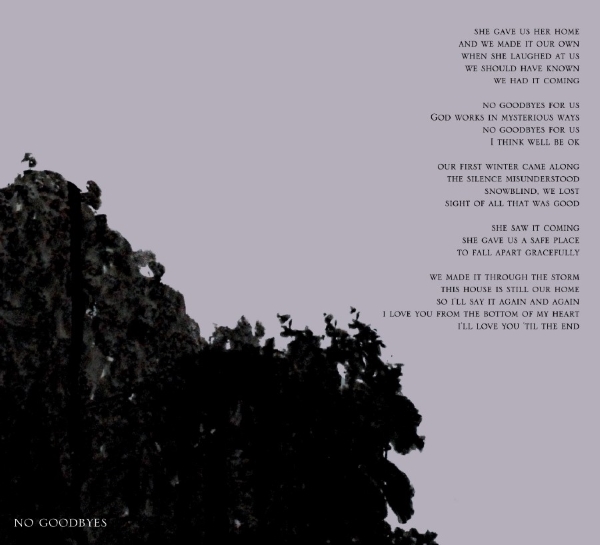
Turning back to A Flutter and Some Words, there is another track that reflects on Amma’s influence. ‘No Goodbyes’ reaches the conclusion that in leading the couple to their home in New Hampshire, Amma knew that they needed somewhere to ‘fall apart’:
‘She gave us her home
and we made it our own
when she laughed at us
we should have known
we had it coming’
The flute is high in the mix, a manifestation of Krishna’s presence.
‘Our first winter came
the silence misunderstood
snowblind, we lost
sight of all that was good
She saw it coming
she gave us a safe place
to fall apart gracefully’
Even after their marriage was over, the couple continued to find a refuge in the property which they now shared for several years in altered circumstances.
‘We made it through the storm
this house is still our home
so I’ll say it again
I’ll love you ’til the end’
‘All of My Mother’s Names (Summers with Amma)’
Chris Minh Doky – double bass; Marc Ribot – guitars; Ryuichi Sakamoto – rhodes; Talvin Singh – tabla, percussion; David Sylvian – guitar, keyboards; Scooter Warner – drums
Music by David Sylvian
Produced by David Sylvian. From Dead Bees on a Cake, Virgin, 1999.
‘All of My Mother’s Names (Summers with Amma)’ – official YouTube link. It is highly recommended to listen to this music via physical media or lossless digital file. If you are able to, please support the artists by purchasing rather than streaming music.
‘The First Darshan (Song for Ameera)’, ‘No Goodbyes’ and ‘3 Doors Down’ © Ingrid Chavez
‘The First Darshan (Song for Ameera) & ‘No Goodbyes’ – official YouTube links. It is highly recommended to listen to this music via physical media or lossless digital file. If you are able to, please support the artists by purchasing rather than streaming music.
All quotes by David Sylvian are from interviews conducted in 1999/2000 unless indicated. My sincere thanks to Skoota Warner and Chris Minh Doky for sharing their recollections of the recording sessions, all their quotes are from 2023. Full sources and acknowledgements for this article can be found here.
The featured image is a photograph of the feet of Mata Amritanandamayi, photographer unknown. Thank you to Paul Vincent Farrell for contributing the image of David Sylvian’s polaroid of Mata Amritanandamayi from his private collection.
Download links: ‘All of My Mother’s Names (Summers with Amma)’ (Apple); ‘The First Darshan (Song for Ameera)’ (bandcamp); ‘No Goodbyes’ (bandcamp)
Physical media links: Dead Bees on a Cake (Amazon); A Flutter and Some Words (bandcamp)
An extended vinyl version of Dead Bees on a Cake was released in 2018 (Amazon)
The documentary River of Love (1999) was directed by Michael Tobias. A later movie documentary, Darshan: the Embrace (2005), was directed by Jan Kounen and followed Amma on a tour across India. At the time of writing it can be viewed online here.
How does your relationship with your guru, Amma, influence your life on a day-to-day basis?
‘It underpins everything I do. It is the substratum upon which my life is built, it’s how I make sense of it. Nothing has meaning for me if it fails to acknowledge all that that relationship represents.’ David Sylvian, 2003

More about Dead Bees on a Cake:
I Surrender
Midnight Sun
Thalheim
Alphabet Angel
Pollen Path
Praise (Pratah Smarami)
Darkest Dreaming
The Scent of Magnolia

Hallo David, a note of thanks for another enlightning informative post. I do appreciate them, thank you. Diolch, Richard
LikeLiked by 1 person
Thank you so much Richard.
LikeLike