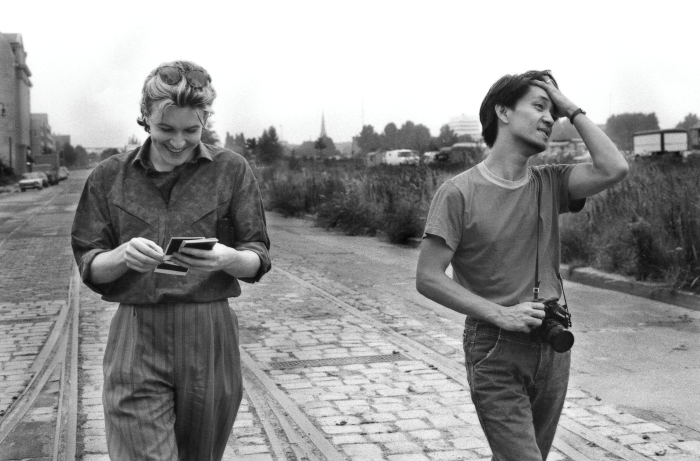
‘When I recorded Brilliant Trees, I started the album in Berlin, out of necessity, out of a low budget and it being the cheapest studio I could find, but I found that going to a strange place, meeting in a strange place — all these musicians for the first time, some of them I’d never even spoken to prior to meeting them — created a sense of adventure about the whole project,’ recalled David Sylvian. ‘I didn’t just feel it, I noticed it in the other musicians, and that they would give more of themselves in that environment rather than in their natural environment, their home town or whatever.’ (1991)
It was mid-August 1983 when the sessions began, with Steve Jansen present at the outset and then successively attending were Ryuichi Sakamoto, Wayne Braithwaite, Ronny Drayton, Richard Barbieri, Holger Czukay and Jon Hassell – an impressive line-up comprising both well-established musical counterparts and brand-new invitations. It seems to me that it would have been a daunting prospect, knowing the plans for the coming month in this first foray into working outside the context of a band. But that’s not how Sylvian looks back on it. ‘A wealth of talent passed through. The material was strong. There was a conscious departure from past work. This was far more personal. Those first steps weren’t intimidating. I felt completely at home. Outside of coming up for air, we made a cocoon of the studio where the walled city was an alien presence… possibly mood setting.’ (2022)
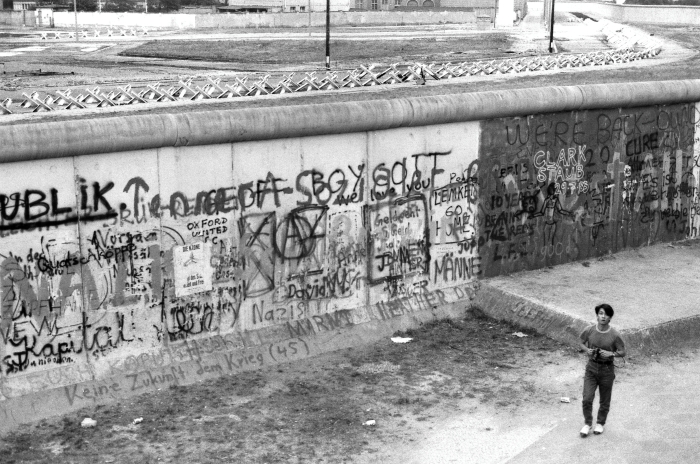
This was still West Germany and Berlin a city dissected by a wall that separated East from West, the former under the control of the German Democratic Republic – effectively a communist state. It would be six more years before the Iron Curtain fell and the world watched on TV screens as the structure which had divided people and ideologies was swarmed upon and assaulted by civilian might from both sides. Hansa Tonstudio was just 150 yards from the wall, hence its nickname, Hansa by the Wall. And it was only six years previously that David Bowie had recorded his album Heroes there, singing of ‘standing by the wall’ as ‘the guns shot above our heads’, following on from the Low sessions that gave us ‘Weeping Wall’, an instrumental that Bowie explained was ‘about the Berlin Wall – the misery of it.’ That Bowie had recorded there was significant given the appreciation that Sylvian and his Japan bandmates had for those albums, with their influence on the sound of ‘Burning Bridges’ barely veiled.
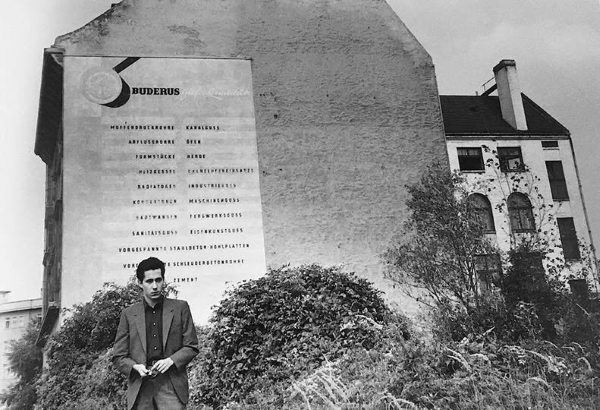
‘The area in which the studio was located was fairly bleak,’ was Sylvian’s memory. ‘There was a stretch of land across the road which was barren but occasionally occupied by a travelling fairground’ (2022). Hansa was situated on Köthener Straβe and a kilometre away, the walk following the line of the wall along Zimmerstraβe, was Checkpoint Charlie, the infamous border crossing between East and West.
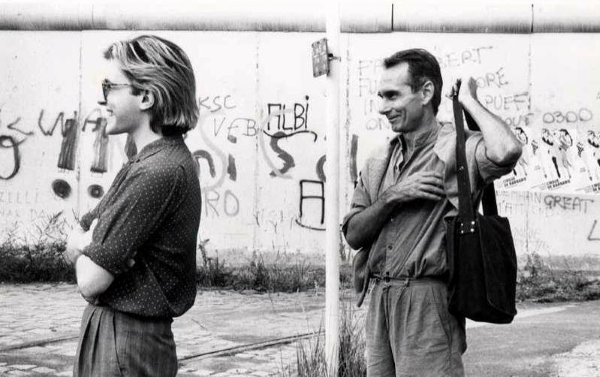
Thanks to the photographers amongst those who gathered for the Brilliant Trees sessions, we have pictures showing the neighbourhood at that time, many including the main participants as they took breaks from recording in the basement studio. Sylvian’s book of Polaroid montages, Perspectives, published soon after Brilliant Trees, opens with images of the Berlin Wall and Sakamoto close to the border.
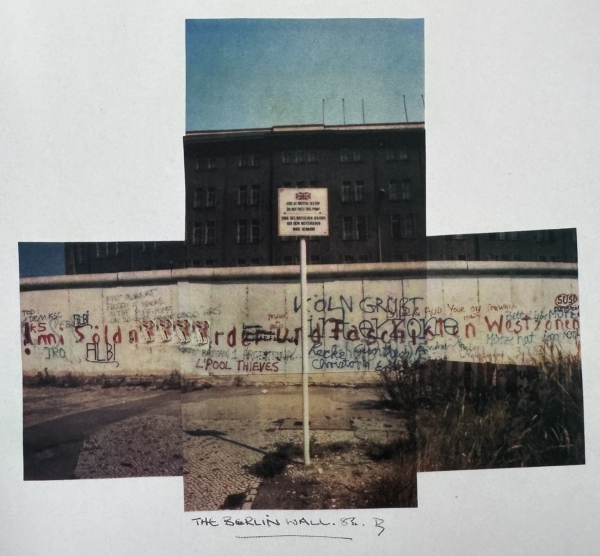
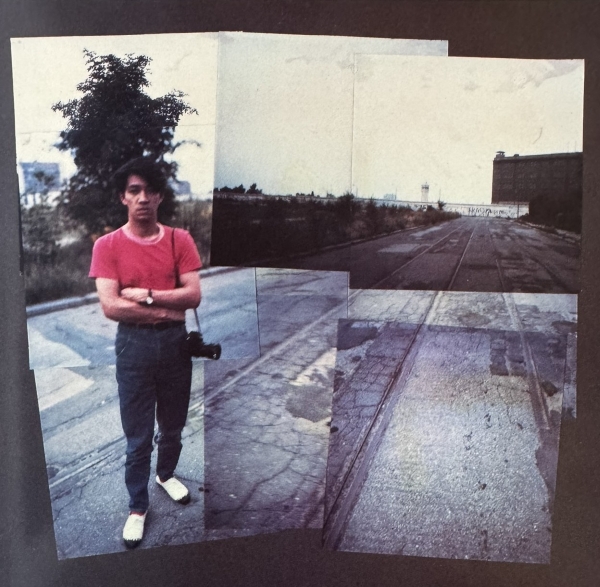

The stories of Sylvian’s studio interactions with Holger Czukay, formerly of Can, are familiar from interviews, and latterly from the video shot by Yuka Fujii and uploaded by Sylvian to the samadhisound vimeo channel. Given the productive nature of their time together in Berlin, it’s astounding that this was the pair’s first meeting. Sylvian: ‘I met Holger the day he arrived at Hansa. Many of the photos and the film of our time there were taken the day of our meeting. I believe we recorded Holger for maybe 2½ days. We hit it off on day one.’ (2023)
Later in the ’80s, David and Holger would be interviewed together on a couple of occasions for Alan Bangs’ radio show on BFBS, during which there would be much laughter and the easy conversation that is shared by firm friends. You can tell when viewing Yuka’s precious footage of the pair, thrust immediately into the studio environment after only introductions, that they are still working one another out as they seek to find exactly the right sounds for ‘Weathered Wall’, searching for the appropriate words to express their thoughts to one another. ‘Holger’s English remained consistent throughout the years I knew him,’ Sylvian would later reflect,’…subtleties could be lost so the dialogue was relatively basic.’ (2021)
Having read about Holger’s adaptation of the dictaphone to his own purpose, it really comes to life when you witness the process in action. Sylvian: ‘He brought with him two large, antiquated IBM machines that he’d discovered dumped outside an office building in Köln. He recognised their potential and, back at the studio, started to explore the possibilities they presented. As he said, “I’ve so much more flexibility with these machines than any sampler on the market,” and, in general, this was the case.
‘He’d improvise with samples, running the playback head of the dictaphone over a broad expanse of tape which he’d prepared with all manner of samples and sounds, many taken from his own studio environment, incorporating the use of the varispeed function which, as far as I’m aware, was the only other speed that the dictaphones had. It proved to be enough, in terms of flexibility, to produce sounds from which one frequently couldn’t determine the original source.
‘On my material you can hear this approach employed on tracks such as ‘Weathered Wall’ and the coda to ‘Brilliant Trees’. On these songs, time was spent placing and occasionally repeating these unique elements to create motifs or meld together raw material into something that made sense within the context of the composition, but it was the beauty of the raw material that made this possible. After all, Holger himself would edit and rework his own material for extremely long periods.’ (2018)
The results handsomely rewarded their efforts and stood the test of time. ‘I really travelled a long way with a piece called ‘Weathered Wall’,’ Sylvian reflected in a 2003 interview with The Wire. ‘The arrangement of the piece was very open, very sparse. I found that the elements that Holger brought to the table – little samples from the dictaphone that he was using at the time – were so much more profound in terms of accentuating the emotional content of the piece than any power chord you could come up with. Anger in pop music is often stereotypical. It’s the stamping of the foot, the childlike response to that emotion. But to be able to allude to these frustrations, anger, and more destructive emotions that one feels in a far more suppressed manner in the work, as in life, was fascinating to me. It’s the suppression that’s fascinating. Once we suppress something as powerful as, say, desire or anger, it will manifest itself in so many other ways in one’s life. Somehow, music in its formlessness can allude to it so much more readily than any of the other arts. Cinema comes close, and so does poetry. But music still has the upper hand.’
For all Holger’s reputation as a ‘madcap’, his earnest approach in service of the music is what transmits to me in the video clips. ‘I’ve never liked the “mad genius” tags attached to him,’ insisted Sylvian. ‘He played up the buffoonish image for reasons of entertainment and self-amusement but there was an acute sensibility at work as sober as any I’ve witnessed… The degree of insightfulness, musical knowledge, and hours of labour that went into creating the material was downplayed.’ (2018)
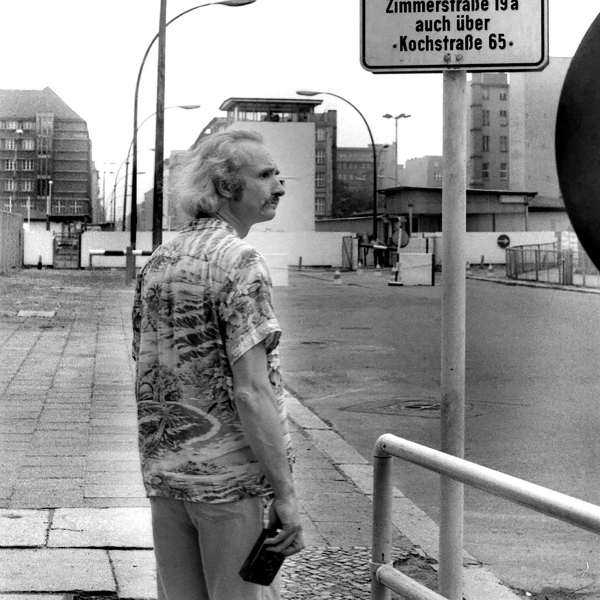
Holger was the one person for whom Berlin was not an unfamiliar environment. He’d ‘once lived in Berlin,’ Sylvian shared, ‘he maintained he lived in no man’s land just the other side of the checkpoint… [you] could never be 100% certain with Holger. He was a formidable teller of tall tales. Embellished perhaps. I loved them regardless’ (2022). Czukay had met up with Ryuichi Sakamoto in Tokyo the previous year on the occasion of the Japanese release of his album On the Way to the Peak of Normal. Ryuichi had likely already left the Brilliant Trees sessions by the time Holger arrived, but another acquaintance was re-established there.
Jon Hassell was another first-time meeting for Sylvian at Hansa. Not so for Czukay. ‘Jon and Holger knew one another from their time spent studying with Stockhausen but hadn’t met since. There was a brief catch up, social interaction between them though no musical performance. Jon’s intensity was refreshing. There was thoroughness, a rigour, that didn’t allow for compromise but instead demanded a clarity of purpose, of intent. Holger’s approach was the antithesis of Jon’s. Joyful enthusiasm, wild invention, much paint thrown at the canvas to see what sticks, manipulation of the results.’ (2004)
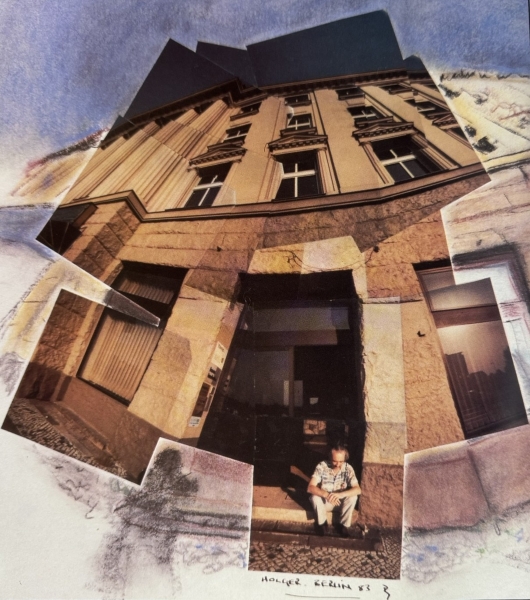
Holger’s openness and sense of fun is reflected in his posing for a couple of Sylvian’s Polaroid collages, later exhibited and published in the Perspectives volume, including the cover image (below). ‘This is when we were recording the album…the entrance to Hansa Tonstudios,’ said Sylvian, who enhanced the photographs he took using pastels. ‘A lot of the Polaroids I took around this picture didn’t work out, I couldn’t get the perspective right. It wouldn’t fit, so I tried actually filling it in with the drawing. I tried it once before actually with a picture of Yuka and it worked so well, I thought I’d try it again and it worked even better on this one.’
The ensemble for ‘Weathered Wall’ is a glorious amalgam of three quarters of the final Japan line-up – Sylvian, Jansen, Barbieri – and the never-heard-before trio of Hassell, Czukay and Sakamoto. The acoustic range of Jansen’s drums and percussion is beautifully recorded and it’s notable that writing in 2021, Sylvian identified the track (along with Gone to Earth’s ‘Before the Bullfight’) as one where he would still keep the drums ‘foregrounded’ were he mixing it to modern sensibilities. Speaking back in 1986, he explained how ‘Weathered Wall’ had been his first attempt at anchoring a composition with drums so that the music didn’t just drift by as the listener is ‘lulled into that false sense of security’ (read the full quote in the article on ‘…Bullfight’ here).
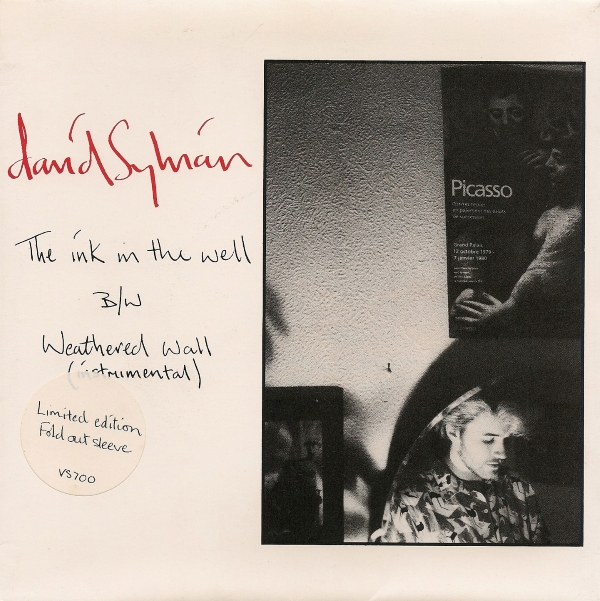
‘Weathered Wall’ showcases the contributions of all the participating musicians, albeit we can’t decipher the individual synthesiser parts of Barbieri, Sakamoto and Sylvian. The soundscape can be particularly enjoyed on the instrumental version of the track which was released on vinyl as b-side to ‘Pulling Punches’, but not yet made available in digital format. Listening to this vocal-less version only enhances my appreciation of the alchemy that was achieved in Berlin back in August and September 1983.
‘I’ve admired Jon Hassell for a while now,’ said Sylvian in an interview to mark the album’s release. ‘He’s someone who always brings more than just his avant-garde trumpet. He instantly fills such a cold studio with his personality.’
As for Hassell, he appreciated Sylvian being bold enough to connect with people whose work he admired, rather than merely trying to imitate their style. Sylvian felt that some other artists were reticent to make such invitations, based on an ungrounded fear of being rejected. ‘I know that to be true of people like Jon and Holger, often these people have enormous respect from other musicians, [and] can find themselves isolated somewhat because they’re not invited to participate in projects, I think, just on the premise that it’s just not a possibility, it would never happen.’ (2004)
Very recently I have been able to speak to Peter Williams, who was engineer at the subsequent sessions for Brilliant Trees in London (more insights about that in a forthcoming article). Peter also contributed to the mixing of the album, along with co-producer Steve Nye and Sylvian himself, including both ‘Weathered Wall’ and the title track. So what was the key to achieving the exquisite sound of Hassell’s trumpet that we hear on the finished album?
‘You are trying to get a sense of breath there,’ Peter told me. ‘So you mic it very close (probably a U87) and then compress the sound so that all the “breathiness” is accentuated, and the sound becomes very close. Then you get that sort of intimacy with the sound. Within the three-dimensional sound stage of the recording, you can position that up close because it’s got no ambience, so there’s no depth, and it’s squished up a bit so it’s a very focused sound.
‘I’d have used either a compressor on the mic input (DBX 160/Neve 2254 probably) to get that, set on 4 to 1, though with attack delayed, so that the breath comes through, so it’s nice and squished up. And then because when you squish it up, it tends to accentuate both top and bottom, you want to trim those out a bit, with the desk EQ, so you are just left with this kind of ethereal sound.’
Reflecting on his work with Sylvian, Hassell commented: ‘To the extent he is incorporating my vocabulary into his vocabulary, the experience is not so revelatory for me as it perhaps might have been, if I may be so bold to say, for him’ (1990). However, this did not imply that he wasn’t enamoured with the results. ‘Of all my collaborations,’ he said, ‘David’s work is the closest to my temperature.’ (1991)
It’s likely that, as ever, Jon chose his words carefully. Temperature, in the literal sense, was something that he saw as highly relevant to music making. Of his 1983 release Aka-Dabari-Java/Magic Realism, he wrote, ‘This is the story of my ongoing cultivation of the imaginary intersection where everything is shimmering and warm, jungle and city, sexy and funny and gracefully “spiritual” all at the same time…
‘My days and nights in India – with Pran Nath showing me the holy caves and rivers and palaces where the art of raga unfolded – allowed me to time-travel back to an age of flickering candlelight, splashing water and laughter, with serpentine melodies unfurling in perfumed air.
‘This pushed me further to think in terms of the imaginary world of beauty and sensuality that might have developed in our time if the “classical” model had been musics from warm climates instead of grey and cold northern Europe.’
Hassell’s ‘intensity…really brought the pieces alive for me,’ said Sylvian. ‘It was wonderful to get that affirmation, to be able to make that connection between a certain voice and a composition, that it was going to work.’ (2000)
The pair seemed to inhabit common ground. ‘I really enjoyed listening to Jon’s music…I’m interested in the idea of music as a sense of place that doesn’t exactly exist in the world but it exists in the imagination of the listener or the writer. I know that Ryuichi was talking about this when we were recording ‘Forbidden Colours’ and we agreed that the soundtrack of Merry Christmas… had that sense of place to it, but you couldn’t quite pinpoint where or what it reminded you of. Yet the place exists in the imagination of people and that’s something I wanted to bring into my work, especially on the B side of Brilliant Trees – this sense of place, this landscape.’ (1987)
The sequencing of ‘Weathered Wall’ was significant in opening the second side of the LP. ‘I had to keep re-writing things and going back in the studio until I got an album that went well in the continuity sense. It didn’t flow before. I had lots of problems with continuity,’ Sylvian said. ‘The A side and the B side are quite different in atmosphere. That’s what I meant by continuity, trying to find how to place the tracks, the running order and so on. I didn’t actually plan to do an album with two totally separate sides, which is really how it’s turned out…The B side, you couldn’t really call them songs, they are pieces of music and the influence is more of an ethnic influence. And the A side are songs and they are very simple songs with very simple structures, and the instrumentation is a little jazz orientated.’
Side one comprising of songs with side two being ‘pieces of music’ invites a parallel with Bowie’s Low. His Steve Reich influenced ‘Weeping Wall’ contemplated the Berlin Wall outside the Hansa studio, but the allusion to Jerusalem’s Wailing Wall is explicit in the title. Sylvian’s track calls on the same reference point, the ‘Weathered Wall’ of the title never appearing in the lyric, which instead refers to ‘the wailing wall’.
Whether Sylvian’s piece was influenced in any way by the studio’s location is a matter of conjecture but the Jerusalem site is certainly summoned up, where the prayers of the faithful are verbalised in mournful cries of sorrow at the Temple’s destruction and exaltations for its restoration.
‘I have never visited Jerusalem,’ said Sylvian, when asked about the LP’s lyrics. ‘The album Brilliant Trees was written in a period when my belief system, my faith, came under attack. I wanted to see what remained when all pillars of support were removed. The pieces you mention [‘Brilliant Trees’ and ‘Weathered Wall’] are explorations along those lines.’ (2003)
‘You were someone to believe in
A place for hope in a changing world
Feeling every moment
Every one of the years spent in your arms
After a lifetime of living
These soiled hands show no life at all
Working at all hours
Never facing the fears here in my heart’
‘I wondered who the “you” is being addressed in that song?’ enquired another interviewer. ‘I wouldn’t like to pin that down,’ Sylvian responded, ‘because I think it can be interpreted in a number of different ways. For me the person or the thing in question changes all the time. I like that ambiguity, I like that a song can move between being a love song to someone that’s close to you, or a God, some greater higher power, so I purposefully allow the pieces to have that ambiguity so that people can still find something of themselves in the work and work it into relevant situations in their own lives.’ (2001)
Sylvian’s exclamations at the face of the wall are those of one bereft. The song, he said, ‘is based on an idea of religion, like the Catholic religion, seen by many as a moral support. What interested me was those who lose that faith and try to live without this support.’
‘Grieving for the loss of heaven
Weeping for the loss of heaven
By the wailing wall
You were someone to believe in
Giving life were there was a will to learn
But it’s the nature of living
To count only the years left in your heart’
Asked for a favourite track from his debut solo album in later years, Sylvian declared, ‘I stood close to a track called ‘Weathered Wall’ from that record. Yeah, it felt like it came someways with the arrangement of the pieces to quite an unusual arrangement. It also incorporates performances by Jon Hassell. It’s really quite something in that context.’ (2004)
‘Weathered Wall’
Richard Barbieri – synthesisers; Holger Czukay – dictaphone; Jon Hassell – trumpet; Steve Jansen – drums, percussion; Ryuichi Sakamoto – piano, synthesiser; David Sylvian – vocals, synthesisers
Music by David Sylvian and Jon Hassell. Lyrics by David Sylvian.
Produced by David Sylvian and Steve Nye. From Brilliant Trees, Virgin, 1984
Recorded in London and Berlin, 1983/1984
Mixed by Steve Nye, assisted by David Sylvian and Peter Williams
Lyrics © copyright samadhisound publishing
‘Weathered Wall’ – official YouTube link. It is highly recommended to listen to this music via physical media or lossless digital file. If you are able to, please support the artists by purchasing rather than streaming music.
Download links: ‘Weathered Wall’ (Apple)
Physical media links: Brilliant Trees (Amazon – cd) (official store – coloured vinyl reissue)
The featured image of David Sylvian and Ryuichi Sakamoto was taken in Köthener Straβe, Berlin, 1983, during the Brilliant Trees sessions by Yuka Fujii and is featured on the inner gatefold of the recently re-issued coloured vinyl pressing of the LP (order link above).
David Sylvian quotes are from 1984 unless otherwise indicated. Sources and acknowledgements for artist quotes in this article can be found here. The full 40-minute film of the Hansa sessions can be seen on the samadhisound Vimeo channel here.
‘These sessions in Berlin were my first step in creating what would become Brilliant Trees and my initial move away from the structure of the band. It was one of the happiest recording experiences I can recall while signed with a major label. Because of the success of having everyone meet in Berlin, a city native to no one involved, it felt like an adventure. People arrived with a spirit of openness and receptivity.’ David Sylvian, 2021
More about Brilliant Trees:
Pulling Punches
The Ink in the Well
Nostalgia
Red Guitar
Brilliant Trees

Before I reached the final quote, not far above, (I promise), the phrase, ‘spirit of adventure’, entered my mind.
After the VB’s previous offering, I was left in no doubt about the influence of David Bowie, on the four quarters of the final incarnation of Japan (I also loved the way Rob Dean played guitar, I would add). This came as a surprise, to a certain extent, but I could also see it, in ‘the first phase’ of Japan’s career, thinking about it…
Another influence, my view, expressed before (I know), was Bryan Ferry. We have to remember that Bowie and Ferry both established themselves (and their bands), with a similar spirit of adventure – only about a decade before this solo album of David Sylvian’s, which I have on CD.
Returning to the final quote, I think as well as moving away from the initial structure of the band, the two sides of the album evoke a fondness (and self-respect) for a place the composer already knew, rich in excitement and melody (Red Guitar is amazing!) and the exploration of new directions and places, respectively.
Returning to influences, Germany, Bowie, and Can (and Eno with Heroes). Unconsciously maybe, some of the second side of Roxy Music’s Country Life…Brilliant Trees…Constanz Karoli, the sister of Michael Karoli, I believe, making another Can connection…
…Steve Nye…
I may come back to this again or, a treat I’m looking forward to in the next week or so, I may comment further on one of the final three associated links, which were written before 2020 – since I’ve been following David Nibloe’s excellent blog – and I’m looking forward to catching up on these…
LikeLiked by 1 person
I don’t think it’s an accident that ‘Weathered Wall’, is the opening track of the second side of the album to which it belongs.
It’s the interface for changes to come, not only in ideology, but in a career.
LikeLiked by 1 person