
English artist Phil Collins was a nominee for the prestigious Turner Prize in 2006. The Tate Gallery website offers an insight into his work in the supporting text for his exhibit: ‘Phil Collins often operates within forms of low-budget television and reportage-style documentary to address the discrepancy between reality and its representations. In his projects, Collins creates unpredictable situations and his irreverent and intimate engagement with his subjects – a process he describes as “a cycle of no redemption” – is as important for his practice as the final presentation in the gallery.’
Creating an unpredictable situation as a catalyst for intimate engagement was at the core of a later project by the artist, one in which David Sylvian would be invited to participate. ‘Earlier this year,’ read an announcement on davidsylvian.com in August 2013, ‘David was invited to participate in an installation by the visual artist Phil Collins, entitled My heart’s in my hand, and my hand is pierced, and my hand’s in the bag, and the bag is shut, and my heart is caught (after Genet).
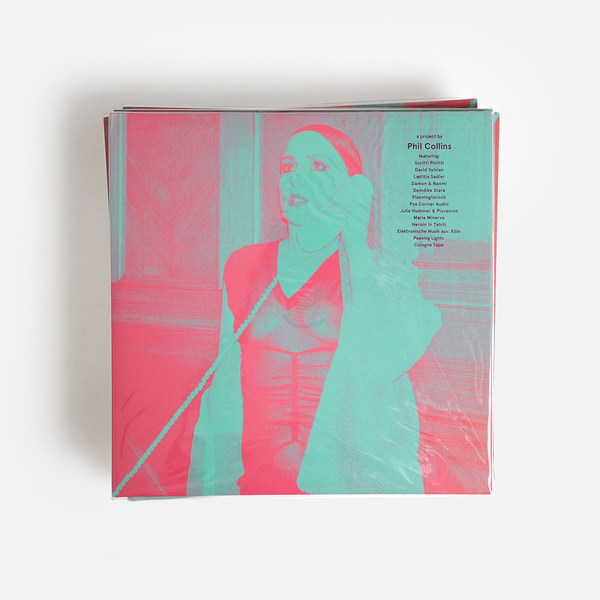
‘A number of musicians were given, with the consent of those using the phone, anonymously recorded telephone conversations from a booth housed in a homeless centre in the centre of Cologne, from which to construct a composition of their choosing incorporating the text either directly or indirectly as each participant saw fit.
‘The resulting work was played back in specially designed listening booths in the museum itself. The conversations that David received resulted in the song ‘Do You Know Me Now?’, released for the first time on the samadhisound label on 10” vinyl and as digital files…
‘The installation was successfully housed in the Museum Ludwig, Cologne, from April 18 through to July 21 2013, and will travel further afield later in the year.’

A subsequent essay by Siniša Mitrović provided more detail of the installation and its concept. ‘In 2013 Collins collaborated with guests of GULLIVER survival centre for the homeless, located under the railway arches at Cologne’s central station. Opened on the 5th of January 2001 as the first institution of its kind in Germany, GULLIVER stands out for the comprehensive service it offers and its extended opening times, from early in the morning to late at night.
‘To safeguard the survival of people living on the streets, GULLIVER provides a range of physical and psychological assistance: breakfast and evening meals, refreshments, an info centre and job exchange, showers and toilets, washing machine and dryer, wardrobe facilities, hairdressing, a day dormitory, battery-charging station, postal address service, internet use, and regular art exhibitions and cultural events.
‘Though only a stone’s throw from the banks of the Rhine, and in close proximity to the cathedral, museums, the old town, and other cultural attractions, the survival station is in some way its own world, all but invisible to the hordes of tourists, business people and commuters who pass by it every day.
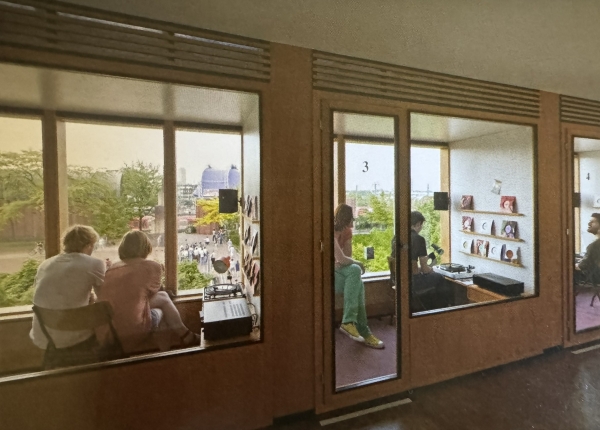
‘At GULLIVER, Collins installed a phone booth with a free line which anyone could use for unlimited local and international calls, on the agreement that the conversations would be recorded and anonymised. Selected from more than a thousand calls made over a four-week period, the material was posted to a group of musicians, serving as the starting point for original new songs. These were pressed as 7″ vinyl records and presented in an exhibition at Museum Ludwig in specially designed listening booths, each equipped with a turntable and high quality sound system, installed so as to overlook a busy public square and the railway bridge.
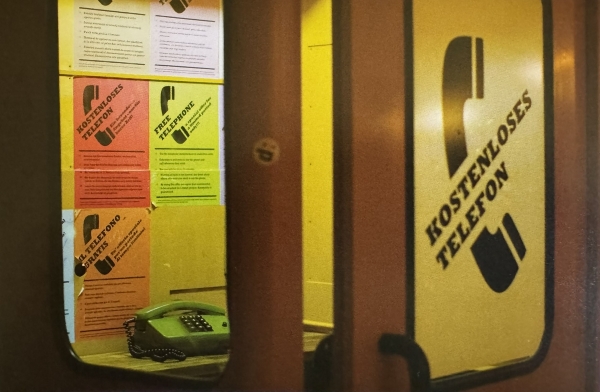
‘After the installation in Cologne, the work, entitled my heart’s in my hand, and my hand is pierced, and my hand’s in the bag, and the bag is shut, and my heart is caught, was presented in adapted configurations in New York and Berlin.
‘my heart’s in my hand, and my hand is pierced, and my hand’s in the bag, and the bag is shut, and my heart is caught is a headfirst dive into a city, tuning in to its many unheard stories. Having worked for a homeless magazine in the ’90s, Collins has a long-standing interest in issues relating to these routinely ignored communities. Here he looks at the intimate relationship we have with the telephone, specifically the decline of landline technology.
‘If text messaging, social media and the undisputed rule of digital capitalism epitomise the present hyper-accelerated moment, the project throws into sharp relief the almost forgotten aspects of a telephone conversation: its physicality and romance; its protracted and performative nature; its ability to create and counter distance, and to conjure up the poetry of the spoken word. Bringing to the fore the expressive potential of the human voice in an age of total surveillance, Collins dramatises the moment of communication as an emotional, unpredictable, and ambivalent exchange.’ (2015)
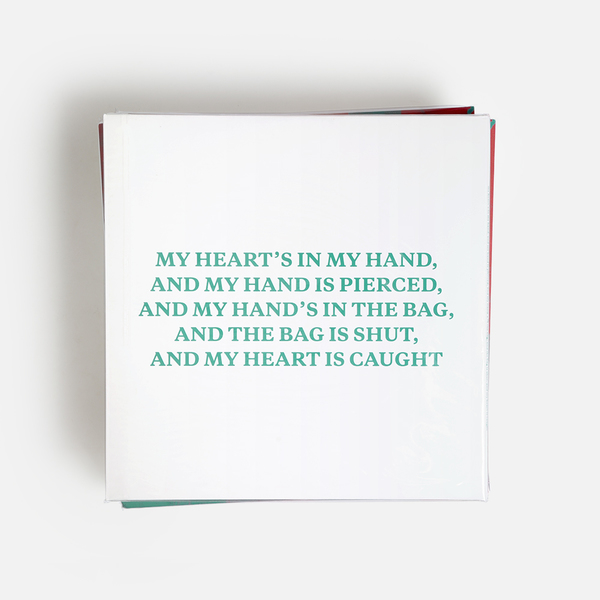
The exhibition’s title was taken from Jean Genet’s novel Our Lady of the Flowers (first published in 1943) expressing both vulnerability (‘my heart’s in my hand, and my hand is pierced’) and being confined by circumstance (‘my hand’s in the bag, and the bag is shut, and my heart is caught’).
‘The people who ran the shelter saw that art should play a role in the lives of their guests and that those people think about culture as much as everyone else does,’ explained Collins as the installation moved on to New York’s Tanya Bonakdar Gallery in October 2013. ‘The shelter is a place where people can go in the extreme cold or when they’re tired or also to listen to music and for tea. It was also a very friendly, pleasant and social place. Those disjunctures exist anywhere, and I don’t know if art is the place to solve those things but it is one place to meditate on them.
‘In the ’90s, I was a secretary at a magazine for the homeless in London called The Big Issue. I came into contact with a lot of people who exhibit a very precise political subjectivity and got to know the conditions of their day-to-day existence, how they live. It’s a group that I find interesting, because in a recession, people quite often confuse homelessness with the presence of street drinkers or other types of homelessness which actually don’t cover the wider demographic.
‘The visual image of homelessness is much stronger than hearing people in very intimate situations. And that’s where the intersection with the phone call came.’
Collins’ project consciously disassociated the voices of the individuals from stereotypical images that we might have in our minds of those living on the streets. The way the listening booths were presented at Cologne played with the intersection of the public and the private. The clear-paned listening stations allowed for an intimacy in the listening experience of words derived from the conversations from the shelter, but this was in the context of a public exhibition space, one with views over the busy square towards the railway station where the shelter is situated – a reminder of the myriad unknown stories of the people milling the streets below.
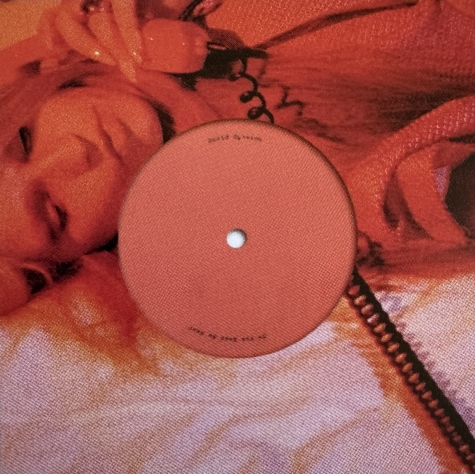
Below: David Sylvian ‘Do You Know Me Now?’ 7″ vinyl from the installation listening booths
Collins: ‘You have an experience which is maybe solitary, maybe social. But you’re also aware of people having similar experiences which you don’t necessarily share. That feeling of distance or reflection, to me, becomes acute. The emotional tenor of the conversations is heightened in a way. I wanted the experience to be physical, and it was concrete when pressed onto vinyl.’
The artist was asked whether he gave the musicians participating in the project any sort of guidelines as he passed them the anonymised conversations from the telephone booth? ‘Largely not, actually. The thing that I tried to underline was that they just needed to do their job, that they didn’t need to approach this in an artistic manner. Because I was trying to find this kind of effective terrain, which could mean pop music and pop culture and the economy and politics, I suppose. In the ’80s, political pop, which spoke about everyday experience, was very present. This was another way of using source material which was already very loaded, but to find a way to make pop songs from it.’
The announcement on Sylvian’s official website confirmed that the song was based on the telephone conversations he received from Collins. Whether these were incorporated ‘directly or indirectly’, or melded with his own concerns or experiences, we can’t be sure. Unlike some of the other tracks created for the installation, there are no excerpts from the recorded calls themselves, nor the familiar tones of connection and disconnection associated with landline telephony. The lyric being expressed in the first person, we are drawn in from the opening lines:
‘And if you think you knew me then
You don’t know me now’
Whereas the song’s title is presented as a question – ‘Do You Know Me Now?’ – the lyric is unequivocal – ‘You don’t know me now’.

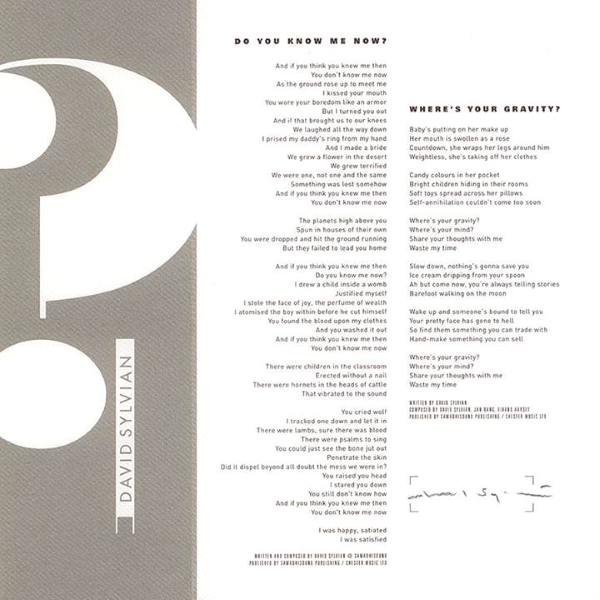
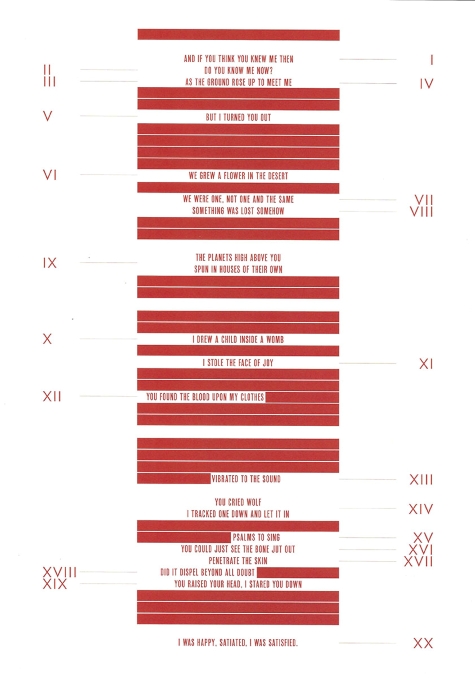
Below: inner lyric sheet, each of which was personally signed by Sylvian
Writer Mark Fisher – author of Ghosts of My Life (2014) – penned a piece called Voices of the Disconnected: Nine Remarks on 21st Century Telephony for the booklet accompanying the release of the collected tracks used in the installation. He writes: ‘Mostly, what we hear on the songs are the anonymised voices of the disconnected, those who, to reverse [Sherry] Turkle’s terms, are de-tethered [from technology, particularly the mobile phone]; those who cannot be reached, who have no means of writing themselves into existence. Without a home, without a job, without a phone – those who literally have no place in the system…The narratives are elliptical, the events that led to the disconnection are like so many traumatic black holes at the (absent) centre of these conversations.’ (2015)
There is both re-connection and an acute consciousness of the distance that exists between individuals who were once close.
‘We were one, not one and the same
Something was lost somehow
And if you think you knew me then
You don’t know me now’
Sylvian’s lyric recounts trauma in specific detail, physical harm (probably self-harm), the compassion of another person, and yet that pervading gulf which now prevails between them.
‘I stole the face of joy
The perfume of wealth
I atomised the boy within before he cut himself
You found the blood upon my clothes
And you washed it out
And if you think you knew me then
You don’t know me now’
The juxtaposition of a graphic, matter-of-fact description of injury with an expression of the circumstance of the individual and their relationships is startling, heightened by the perfect scansion of the lines and their delivery.
‘You could see the bone jut out
Penetrate the skin
Did it dispel beyond all doubt the mess we’re in’
The final words are confounding, turning thoughts upside down. A return to a specific past moment, but precisely when is unclear.
‘I was happy, satiated
I was satisfied’
Late in 2023 Sylvian shared online a quote from the late poet Franz Wright with whom he collaborated on there’s a light that enters houses with no other house in sight (read more here): ‘And how hard it is to pretend to be in the same world as everyone else, to have to constantly pretend to be the person they all used to know.’ The sentiment seemed related to that articulated in ‘Do You Know Me Now?’ Wright’s words, said Sylvian, had ‘everything to do with psychological states following traumatic events and/or major illness… how one is transformed by it, how one can never be what one once was and yet is treated as such…’
When Sylvian and Universal came to curate an elaborate 10-cd retrospective of his work on the samadhisound label between 2003-2014, it too was entitled Do You Know Me Now? Perhaps it was a reference to Sylvian’s musical path taking him far from the ballads of his ’80s trilogy, from Brilliant Trees to Secrets of the Beehive, and even farther from the more overt pop of Japan. Or perhaps the reference was to the decade that had passed since the work collected in that retrospective set was completed, a period during which Sylvian said he had himself ‘lived through a number of other traumatic, life-changing events.’ (2021)
A video of the song was created to promote the collection, directed by Yuka Fujii on the same trip as the trailer for ‘Grains (sweet paulownia wood)’. ‘The success of this minor piece spurred the two on as they continued their drive culminating at Georgia O’Keeffe’s Ghost Ranch. There they shot material for what became the short film ‘Do You Know Me Now?’, which comprises many still images taken by Sylvian and Fujii. Sylvian’s focus was the landscape and, as has so often been the case, Fujii’s primary focus was Sylvian.’ David was said to regard Yuka’s photographs as ‘some of the most intimate late portraits of himself. They capture something of the interior life of a relatively solitary soul. As one reviewer of the boxset Do You Know Me Now? put it, a man in the process of performing “a disappearing act”. While not exactly true, it’s perhaps close enough.’ (2023)
As if to confirm the title’s mystery of identity, Sylvian’s face is consistently obscured from the camera as he is seen in still photographs and short video clips alongside shots of the desert landscape. We see the three crosses and simply constructed building of the Penitente Morada in Abiquiu, New Mexico, sacred meeting-place of the Penitente Brotherhood dating from the eighteenth century, juxtaposed with images of monumental cloud formations in the broad New Mexico skies.
‘As it was out of season,’ wrote Fujii, ‘the small pilgrimage site we visited, nestled high in the desert mountains, had few visitors. In the souvenir shop a postcard caught my eye. It was like a compass pivoting, indicating a particular direction to be taken. Later, guided by magnetic pull, we found ourselves driving through layered rocky mountains where a magnificent ancient landscape opened up and enveloped us. Without these photos and video clips – this evidence of personal experience – I might now wonder if this was a dream or reality.’ (2023)
Promotional lyric video for ‘Do You Know Me Now?’, produced in 2023 to coincide with the boxset of the same name covering the samadhisound years
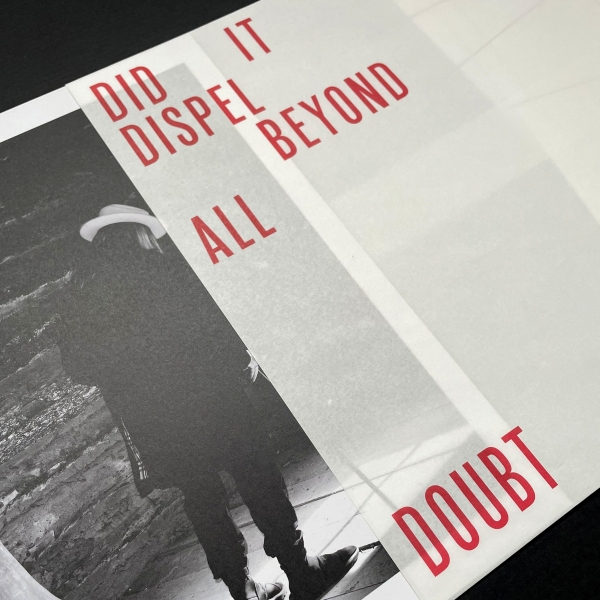
Immaculately reproduced images from the shoot were subsequently brought together in a sumptuous set published by Grönland Records and credited to both Fujii and Sylvian. Styled The Perfume of Wealth after the line from ‘Do You Know Me Now?’, the lyrics of the song formed a framework for the visual art.
The basic piece had been presented to collaborators Jan Bang and Erik Honoré in the form of the vocal and simple acoustic guitar accompaniment, similar to the demos ‘Tear Me Apart’ and ‘Last Bullet’. The pair approached the task of building up the track as they had approached the pieces they interpreted for 2011’s Died in the Wool. ‘The process was very much about finding new landscapes for his voice, building something around his existing vocal performances,’ said Erik of their Died in the Wool contributions, drawing the parallel with ‘Do You Know Me Now?’ for which he created a string arrangement to complement both his and Bang’s intricate sampling work. (2025)
Jan Bang’s album Narrative from the Subtropics (2013) and Erik Honoré’s Heliographs (2014) provide a contemporaneous insight into their mastery in the crafting of affecting textural landscapes in sound. These albums have been referenced on this site previously in connection with the pair’s work on Uncommon Deities (see here) and are well worth exploring. For my playlist I book-end ‘Do You Know Me Now?’ with ‘The Deep Serene’ from Jan’s release – which features guitar from Eivind Aarset whose work also adorns the Sylvian track – and ‘Last Chance Gas & Water’ from Erik’s disc.
‘Do You Know Me Now?’
Eivind Aarset – electric guitar; Jan Bang – samples; Erik Honoré – samples, synthesiser, string arrangement; David Sylvian – vocals, acoustic guitars
Music and lyrics by David Sylvian
Produced and mixed by David Sylvian with valued input from Jan and Erik. Released on 10″ white vinyl, samadhisound, 2013, and subsequently on my heart’s in my hand, and my hand is pierced, and my hand’s in the bag, and the bag is shut, and my heart is caught by Phil Collins/various artists, Shady Lane Productions, 2015, and on the re-release of Sleepwalkers, Grönland, 2023.
lyrics © copyright samadhisound publishing
The original installation was produced for In Every Dream a Heartache, a solo exhibition by Phil Collins at Museum Ludwig, Cologne, 18 April – 21 July 2013.
The featured image accompanied the announcement of ‘Do You Know Me Know?’ on davidsylvian.com in 2013.
Full sources and acknowledgements for this article can be found here.
Download links: ‘Do You Know Me Now?’ (bandcamp); ‘The Deep Serene’ (bandcamp); ‘Last Chance Gas & Water’ (bandcamp)
Physical media links: Sleepwalkers (bandcamp); Narrative from the Subtropics (discogs); Heliographs (bandcamp)
‘Looking up I saw the clouds depicted in David’s recent photographs…If you open your arms wide, you may receive unexpected gifts from the heavens. This is how we came to create the video for ‘Do You Know Me Now?’…The question posed in his song evaporates in the desert air.’ Yuka Fujii, 2023


You’ve really deepened my appreciation for this track, and beautifully pieced together the many and varied aspects of its evolution.
To consider the juxtaposition of unidentified conversations from a booth in a homeless centre of Cologne to a journey with a lifelong friend under the majestic skies of New Mexico – common in both their solitude and their intimacy, but worlds apart in place and feeling – is quite extraordinary.
Thank you.
LikeLiked by 1 person
Here we have (and more) – Art by Phil Collins (not the musician and actor) the visual artist, literature, theatre, Jean Genet (inferentially this also reminds me of a Bowie track + with a wider exhibition of Phil Collins work – ‘In Every Dream Home A Heartache’ – a nod to Ferry’s song, Roxy Music’s delivery (1973), or a ‘nod’ to pop art per se or something else? Whichever applies, thumbs up from me), a David Sylvian song (words and music), a homeless facility in the centre of Cologne called GULLIVER, the free to use telephone, specially designed listening booths in the Museum Ludwig, The Big Issue, New York and London, anonymised conversations from the telephone booths used as the inspiration for a song, the political pop of the 80’s, ‘And if you think you knew me then – You don’t know me now’ (Sylvian, 2013), a fantastic sleeve design by Chris Bigg (reminds me both of a Bauhaus poster, circa 1919, a partly obscured image of the song writer a la ‘Bete Noire’, Ferry, 1987, but more than that – conveying or anticipating the lyrics, for me. Superb lyrics from Sylvian to the composition – DO YOU KNOW ME NOW?
Trauma, Franz Wright, major illness, solitary living, New Mexico, Fujii, the promotional lyric video for the song (2023). For me, this song (together with ‘Beautiful Country’, are two) of the finest examples of 21st Century David Sylvian. Aarset, Bang, Honore, Sylvian (musicians and vocalist on ‘Do You Know Me Now?)
(The above subject matter: WOW! What a great, deep and thorough article, the VB).
I understand CHANGES that occur in lives, not least my own. I read again my comment posted four years ago on ‘Song’ (VB links for work in the 2012-2014 period refers) and this, whilst now personally challenging, on a couple of levels, made me smile – it took me back – and makes me (still) feel positive, despite certain (not insurmountable) changes since then.
LikeLiked by 1 person
I have the pleasure to live in a world where the music of David Sylvian has been a constant companion for 40+years. He has unknowingly signposted major events in my life and certain tracks have become harder to listen to due to their emotional timestamp. Sometimes I take this remarkable individual for granted, the music merely being a beautiful, aural backdrop. Your piece has reminded me that Sylvian is an artist and one deserving of the full meaning of that title. The creation of this track is testament to his reaction to and interpretation of the emotional impact modern art. A beautiful article, thank you!
LikeLiked by 1 person