
The collaboration between Ryuichi Sakamoto and Alva Noto, alias German electronics pioneer Carsten Nicolai, began with the album Vrioon in 2002. When the pair first met, Ryuichi was engaged in a bossa nova project with Jaques and Paula Morelenbaum which probably couldn’t be farther removed from the music that they would make together. ‘I like collaborating with people who have something I don’t have – a skill, an idea,’ said Sakamoto. ‘I’m always looking for something surprising – like everyone else, I need inspiration and triggers. Listening to new things, looking for new sounds has become part of my nature. And I think that’s why you collaborate – to stay open. Unexpected things happen and you must be very flexible. You can of course hide by yourself, digging into your inner depths – we all need that kind of space sometimes. But working with other people’s ideas and artistic presentation can be so enriching.’
On Vrioon two worlds come together: Ryuichi’s acoustic piano, echoes of that instrument’s long tradition, a practice embracing influences from across genres and cultures and articulated through the conventions of musical notation; Carsten’s experiments with sound frequencies embracing both high and low extremes, a self-confessed wariness of melody but evident appreciation for rhythm. What the duo shared was an inquisitive approach and openness to experimentation.
One of the first challenges was finding a way to communicate. ‘Everything for me was defined by frequency and time,’ Carsten explained. ‘Rhythm was loop lengths. I didn’t care about divisions, or a clock, or bars… bars didn’t exist for me. It was just a grid system. I was not into scales, just frequency. For me the basic frequency was 50hz because it’s the same way as electricity is oscillating… I realised when I started working with Ryuichi that my scale was not working with his scale because he worked with a classical notation system. The closest to an ‘A’ is 55hz… So I needed to retune everything!’ (2019)
The following release was Insen (2005), by which time their approach was evolving. Sakamoto: ‘On the first album Vrioon, he did not touch my piano recordings at all, he just added his sound. So it started in a simple way. Then on the second one he manipulated my piano sound, so the collaboration went deeper.’
After an ep release, revep (2006), based around treatments of the Merry Christmas Mr. Lawrence theme, the following instalment in what the performers would christen their VIRUS recordings (according to the first letter of each album title in the order of their release) would introduce a completely new element within the context of their work together. ‘I think after we finished the Insen tour, which was a very intense touring schedule, we realised that we could even push things further,’ said Carsten. ‘Not only in a recording environment but also in a live situation. And I think this helped making the fourth collaboration, utp_, so different.’
Sakamoto and Nicolai received a commission to celebrate the 400th anniversary of the city of Mannheim for which they extended the collaboration to the contemporary classical players of Ensemble Modern. Carsten: ‘Ryuichi and I were very happy that we got this offer…because we had already made future plans to work with an orchestra. It helped us pushing our work to a new level… It was very exciting to work with Ensemble Modern. It was very inspiring and ground-breaking, especially since we were in the luxurious situation of working with them for more than a year. They’re very well trained and very open minded to use their instruments in ways that you usually would not expect. It was a process of pushing each other’s limits and expectations further to find a new way of musical communication.’

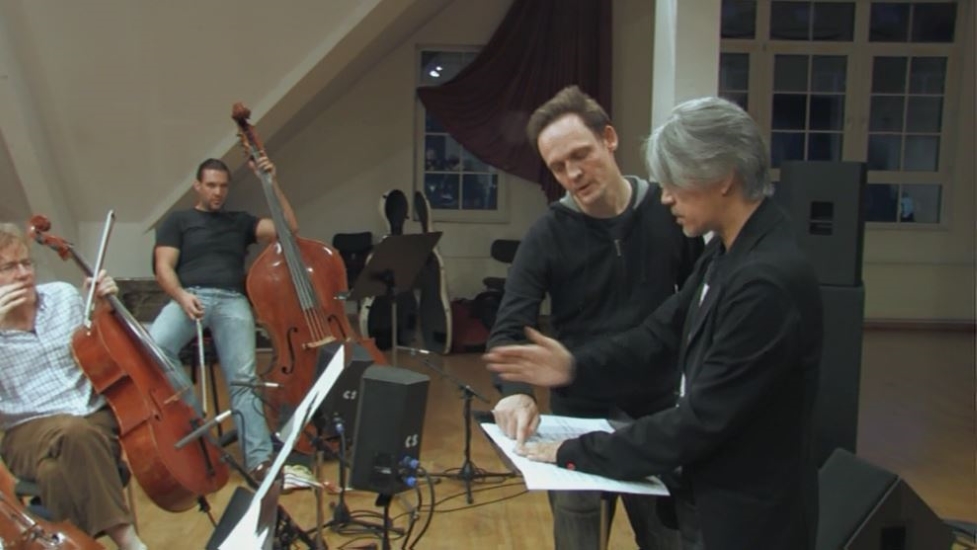
The eventual release of utp_ included both a cd and dvd component, the latter including the live performance of the piece in Mannheim and a documentary charting the development of the music and the accompanying visual presentation. It’s an absorbing insight demonstrating how the creativity of each player in the ensemble was embraced in the articulation of the vision that Sakamoto and Nicolai had for the work. A clear structure was in place, which Carsten explains to the musicians was based on the grid pattern of Mannheim’s streets, it having been designed as a ‘model’ city: a kind of utopia as hinted at in the title of the piece. Each block was taken to represent one segment of the 72-minute duration, these being structured in a number of sections entitled ‘Attack’, ‘Grain’, ‘Particle’, ‘Transition’ etc.
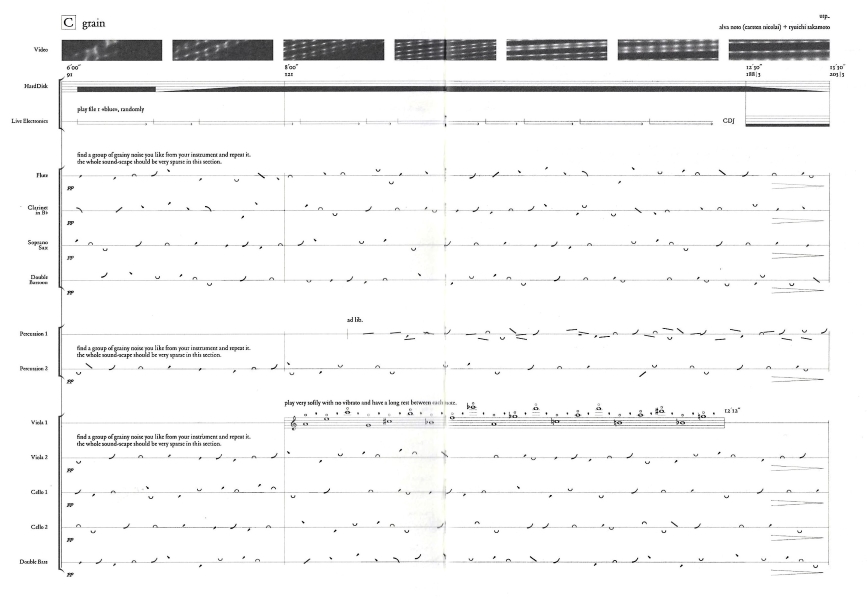
The musicians’ score based on Sakamoto’s original manuscripts is replicated in a booklet with the cd/dvd set and here we see the invitation provided for the musicians’ own interpretations. For instance, for ‘Particle 1’ the note reads: ‘Find a short noise, like a particle, from your instrument and repeat it. You could play a few particles in a group at a time. In this section, it should be very sparse and soft in the beginning then gradually get very dense and loud towards the “peak”. After the “peak”, it should get gradually sparse and soft again towards the end of this section.” The documentary shows the musicians working through these directions in a process known as ‘try-outs’ where the duo and ensemble exchange ideas as they evolve the piece.
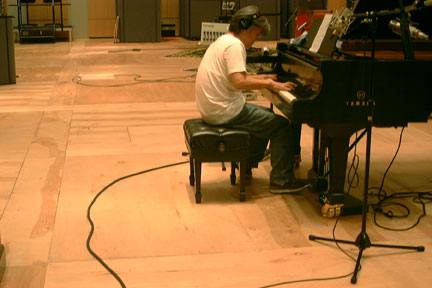
Watching the performance of utp_ at the Nationaltheater, Mannheim in November 2007, a melody enters at around the 8 min 30 sec mark. It sounds like it could have its origins in notes from Sakamoto’s piano then processed by Nicolai’s electronics, but it’s difficult to be certain as Ryuichi’s playing is barely recognisable throughout, in the live performance often being relayed only to Carsten for processing and not to the front of house mix. Indeed for much of the time Ryuichi is reaching inside the grand piano, dragging items along the piano strings and investigating percussive possibilities rather than striking the keys. This is ‘Grains’, the players following the score’s direction to ‘find a grainy noise you like from your instrument and repeat it. The whole soundscape should be very sparse…’ Only the lead viola has scored notes to play, for other instruments there are shapes that represent only the trajectory of the sound to be performed.
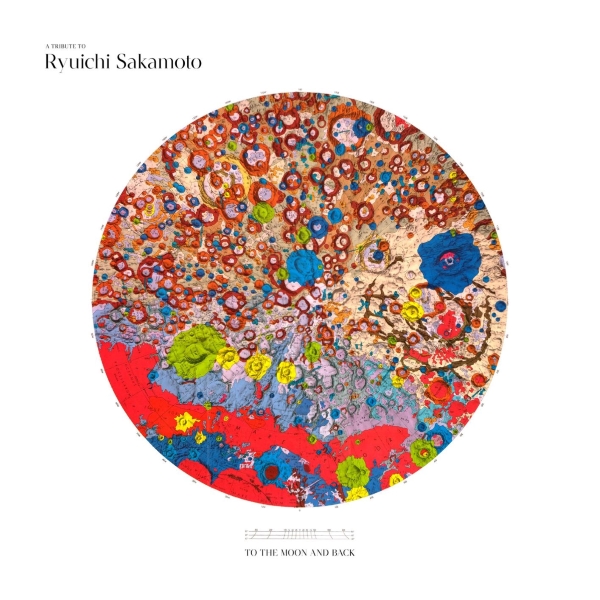
In 2022 an announcement was made by Milan Records, the label which carried many of Ryuichi Sakamoto’s soundtracks and later career solo works. ‘In celebration of Ryuichi Sakamoto’s 70th birthday,’ it read, ‘Milan Records will release A Tribute to Ryuichi Sakamoto – To the Moon and Back, a collection of songs from Sakamoto’s vast catalogue newly reworked and remodelled by contemporary artists and collaborators.
‘Envisioned by Sakamoto’s management team and Milan Records, A Tribute to Ryuichi Sakamoto – To the Moon and Back features artists across generation and genre, each with their own connection to the iconic musician, and hand-selected for the project as either past collaborators, friends, admirers, or personal favourites of Sakamoto.
‘From contemporary admirers of Sakamoto’s work like Thundercat, Devonté Hynes, and Hildur Guðnadóttir to longtime collaborators and friends like David Sylvian, Alva Noto, Cornelius, and Fennesz, plus some of Sakamoto’s personal favourites like Lim Giong, Gabrial Wek, and 404.zero, the included artists reflect the breadth of Sakamoto’s influence on contemporary music. Given full access to the musician’s extensive catalogue of solo releases and film scores, each artist personally selected their contribution and put their unique spin on Sakamoto’s originals.
‘The result is a collection that reflects the many dimensions of Sakamoto’s career, from the diversity of sound the consummate musician has traversed to the continued legacy of his work on artists of all backgrounds.’
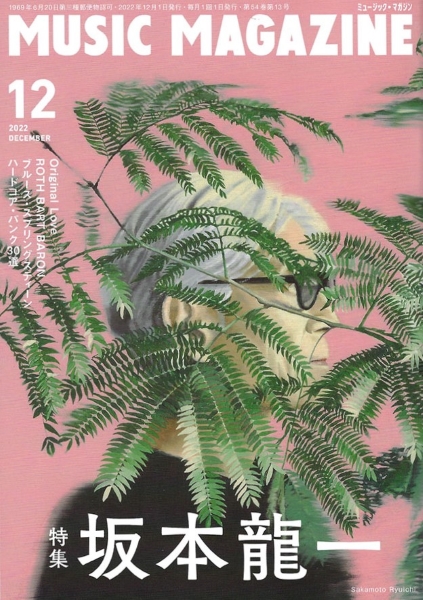
For his contribution, David Sylvian took the second section of utp_ as his source from Ryuichi’s catalogue, the track ‘Grains’, later explaining, ‘I’m very fond of the work he did with Carsten.’ The advance track listing made it clear that the music had been developed upon, carrying the subtitle ‘sweet paulownia wood’. Anticipation was raised further when Sylvian was interviewed for the Japanese publication Music Magazine in the weeks leading up to release. Asked about his part in …To the Moon and Back, Sylvian said, ‘I am not a remixer, but I wanted to be a part of this tribute. So I suggested that we produce a new song. Most of the songs we’ve written together up until now, like ‘World Citizen – I Won’t Be Disappointed’, were independent of an album. So it felt very natural to choose a piece from Ryuichi’s catalogue and write a melody and lyrics in response to it.
‘Like most of my decisions, the choice of this was piece was instinctive… I felt a connection with the song.’
The interviewer then went on to comment, ‘This is your first time singing in 10 years. What were your thoughts as you went about it?’
‘I was given one week to write the song and prepare my voice. Writing the song was easy, but preparing my voice was a bit of a challenge.’
When the release date came in December 2022, all the elements of the track created 15 years earlier were present: the recurring melody, the slow bowing of the lead viola, reverberating shimmers from within the piano, deep bass stuttering against the rhythm, and the snap and fizz of Alva Noto electronics. Overlaid though was a vocal melody that brought new dimensions to the piece. It’s so perfectly matched with the original music that if I wasn’t aware of the back-story I’d be convinced that the instrumentation had been created around the vocal. For me it’s a reminder of Sylvian’s innate ability to find space and cues for a vocal melody in all kinds of musical material, from the soundtrack grandeur of the theme to Merry Christmas Mr. Lawrence where his counter-melody gave us ‘Forbidden Colours’, to the vocal parts put to angular raw material in the writing sessions with Robert Fripp and Trey Gunn, to his responses to the guitar improvisations of Derek Bailey for Blemish and to group improvisations for Manafon.
To hear the singing voice again for the first time since 2013’s ‘Do You Know Me Now?’ was nothing short of wonderful. And after an absence of new sung material for the best part of a decade, the voice still held all of its richness and nuance. Sylvian said that the piece was recorded around January/February of 2022. ‘I’m ashamed to say I did no preparation,’ he admitted. ‘There simply wasn’t time. I worked with what I had, did the best I was able under the circumstances.’
Artists contributing to the project were asked to provide a short promotional film. Yuka Fujii was with Sylvian at the end of November ’22 and created what he described as a ‘trailer’ which within a week or so of filming was available online, so we got to see a glimpse of Sylvian in the dry desert autumn. It was subsequently stated that the video was shot as ‘Sylvian travelled through America’s desert states in the company of his close friend Yuka Fujii. He had explored much of the landscape before but, as he points out, it’s frequently refreshing to witness the world through another person’s eyes. When arriving at a place of interest they would stop for a day or so to take in the landscape. One such break unexpectedly produced a short video, shot as a trailer for the track ‘Grains (sweet paulownia wood)’.’ (2023)
As far as I am aware Sylvian has never spoken about the lyric he penned, although he did describe the completed track as ‘a tribute to Ryuichi’ in line with the theme of …To the Moon and Back. Sadly, Ryuichi would pass just over three months from the release of the album, not long after his 71st birthday.
Any specific interpretation of the words is personal and subject to differ from the author’s intentions, but it seems to me a tender outpouring to one whose time in this world is drawing to a close, someone whose life and achievements deserve celebration.
‘I sit beside his bed
brushing the weather from his hands
If I’m no longer making sense
I no longer think I can’
‘Take the earth out of his mouth
and the boot from off his chest
there is nothing more to ask of him
he done better than his best’
‘Put a crown upon his head please
yes, let’s anoint the one
celebrate his history
come sing along’
Images are recalled, scenes of significance and perhaps some shared memories:
‘There was snowfall in New York City
earthquakes down below
dappled sunlight in vineyards
where nothing ever grows’
As we honour a birthday – ‘mark the day he was born’ – there is reference to the birth and to a mysterious female presence. It may be completely fanciful, but I think of ‘mother’ as a muse, a mother of invention, companion and inspiration for the duration of a life.
‘on sweet paulownia wood she found the tone
his body did the rest
She’d dust strings with cocaine
rubbed her finger on his lips
“come on tell me what you see child
and I’ll leave you with a kiss”.’
Sylvian did offer an insight into the relevance of the track’s sub-title – paulownia wood is used in the construction of a koto.
All in all, for this listener, ‘Grains (sweet paulownia wood)’ is another stunning track to add to many in Sylvian’s oeuvre, for the invention of its composition, the words, the voice, and the surprise of its arrival. Other unexpected ‘one-offs’ have delighted over the years, ‘Pop Song’ and ‘Where’s Your Gravity?’ among them, this certainly ranks alongside those for me.
Sylvian was asked whether there was any other work from Sakamoto’s back catalogue that might have been considered for ‘remodelling’? ‘B-2 unit was a long-term favourite of mine,’ he responded. ‘I’d always liked the idea of recording a version of ‘Thatness and Thereness’ but the jewel in the crown for me was ‘Riot in Lagos’. He could have built an entire record around that piece alone and I’d have been terribly happy.’ (See ‘Taking Islands in Africa’ for more about B-2 unit/’Riot in Lagos’).
In the event, the Japanese artist Cornelius reinterpreted ‘Thatness and Thereness’ for …To the Moon and Back. Alva Noto’s contribution to the album was both through the cover art, featuring NASA images of a lunar geological survey, and a version of Sakamoto’s theme for Bertolucci’s movie The Sheltering Sky, which brings something of his touch from the duo’s work together on The Revenant. The latter was Ryuichi’s first project following an imposed break from all work due to his cancer diagnosis, scoring the film directed by Alejandro González Iñárritu. It was an invitation he couldn’t resist and one which reunited him with his VIRUS series partner.

The ‘reason I called Carsten was simply, physically, the amount of music for this film is just gigantic,’ Sakamoto told Rolling Stone, ‘and naturally Alejandro wants acoustic music, like strings or whatever and very, um, edgy electronic music. Processed music. So it seemed very natural to call Carsten you know?’ (2015)
‘It took Alejandro and The Revenant to bring us back together, to learn we had more to say. For this I am grateful. I think we complement each other the way a painter will use many materials in a painting for different textures and expressions that can’t be realised by only one. Disparate elements create something unique, more than the sum of the parts.’ (2016)
Another notable remodel on …To the Moon and Back is a reimagining of the Sylvian/Sakamoto collaboration ‘World Citizen – I Won’t be Disappointed’ by Icelandic artist – and another Oscar-winning soundtrack composer – Hildur Guðnadóttir. The song seems to have been completely re-recorded by Hildur with her compatriot Skúli Sverrisson who had played bass for the original NYC sessions for the Sylvian/Sakamoto version. Hildur’s slow and pensive vocal, set against her plaintive cello, gives the track a completely different complexion. ‘Hildur can do no wrong,’ was Sylvian’s conclusion. ‘Her remodel is my favourite on this album.’
‘Grains (sweet paulownia wood) – David Sylvian remodel’
Alva Noto/Carsten Nicolai – electronics; Ryuichi Sakamoto – piano, electronics; David Sylvian – vocal
Ensemble Modern – Dietmar Wiesner – flute, piccolo; Nina Janβen – clarinet, bass clarinet; John Corbett – bass clarinet; Johannes Schwartz – bassoon, contrabassoon; Rumi Ogawa – percussion; Rainer Römer – percussion; Patrick Jüdt – viola; Yuval Gotlibovich – viola; Eva Böcker – cello; Michael M. Kasper – cello; Aaron Baird – double bass; Norbert Ommer – sound direction
Music by Ryuichi Sakamoto & Carsten Nicolai with Ensemble Modern. Lyrics by David Sylvian.
Remodel produced and performed by David Sylvian.
From A Tribute to Ryuichi Sakamoto – To the Moon and Back, Milan, 2022. Produced by Noriko Sora.
Lyrics © samadhisound publishing
‘Grains (sweet paulownia wood)’ – official YouTube link. It is highly recommended to listen to this music via physical media or lossless digital file. If you are able to, please support the artists by purchasing rather than streaming music.
Download links: ‘Grains (sweet paulownia wood) – David Sylvian remodel’ (Apple), ‘The Sheltering Sky – Alva Noto remodel’ (Apple), ‘World Citizen – I Won’t be Disappointed – Hildur Guðnadóttir remodel’ (Apple), ‘Grains’ (Apple)
Physical media links: A Tribute to Ryuichi Sakamoto – To the Moon and Back (Amazon); utp_ (Amazon) (Raster Noton)
Ryuichi Sakamoto and Carsten Nicolai quotes are taken from interviews in 2009 & 2011 and David Sylvian quotes from 2022-23, unless otherwise indicated. Full sources and acknowledgements for this article can be found here.
David Sylvian and Hildur Guðnadóttir have collaborated on the track ‘Every Grief I meet’ from the Touch label’s tribute to Philip Jeck, rpm, more details on bandcamp here.
The VIRUS album series by Alva Noto and Ryuichi Sakamoto is being re-released as a boxset in both vinyl and cd formats – further details as Raster Noton here.
‘Ryuichi’s business partner once said to me, “You two are like brothers. Sometimes you agree, sometimes you don’t, but you have a bond that only brothers can have.” I think that accurately describes our relationship and the respect we have for each other’s work.’ David Sylvian, 2022
More about collaborations with Ryuichi Sakamoto since 2000:
Zero Landmine
World Citizen – Chain Music
Concert for Japan
Life, Life
Dumb Type – 2022

a beautiful article about a beautiful track. I love Sylvian’s interpretation of the melody of Grains. The line “They placed their fingers on his spine
T9 and 2” is filled with such cold, clinical and medical detail that it broke my heart first time I heard it properly. Sylvian’s voice is so detached too, making it all the more beautiful. Thank you for this article!
LikeLiked by 1 person
Thanks Paul. I agree about that line – you describe its impact perfectly.
LikeLike
Thank you so much for this. I was interested in the back story on what got David back in front of a microphone. God I’d love more music from this incredible artist.
LikeLiked by 1 person
Can I again encourage you to do a crowd funding to finance a proper publishing? I would love to see all these brilliant articles in a nice book. I would be in! Thanks for all your work, it is always so rewarding to read this.
LikeLiked by 1 person
Thank you for the encouragement, Peter. No current plans, but who knows what might be possible in time…
LikeLike