Early in January this year I made my way along The Strand in central London to 180 Studios, very much within my old stomping ground as a mid-80s student. Entering the basement down the black-walled staircase, I was led to a darkened space where bean bags were laid out on the ground in a circle, each visitor invited to recline and turn their attention to the ceiling above, which was in fact taken up by a huge LED screen.
What followed was what its creator describes as ‘a total sensory experience.’ This was Ryoji Ikeda’s installation, data-cosm [N˚1]. It’s difficult to convey the sensations evoked when overwhelmed by the images on the screen above you. Digital patterns passing quickly overhead, so disorienting that you start to wonder whether it is in fact you who is moving at pace. Data panels, apparently relating to weather conditions in locations across the world, but presented so quickly it’s impossible to be sure. Some passages are dominated by black and bright white, as if you have been plunged at microscopic scale into the inner workings of a computer chip, experiencing the lightning-quick processing of bits and bytes. Then an assault of colour with predominant red, perhaps climate maps of an overheating world, offset by the blue of the oceans. The next moment there are two white lines of horizon and we seem to be hurtling towards them at a speed that only the imagined spaceships of sci-fi can travel.
Alongside the images is a soundtrack of digital music; there are long lines of sound but it’s the incessant glitches that live in the memory, like a cacophony of agitated insects sounding an urgent alarm. There are times when the assault on the senses is too much to bear, I cover my face for a few seconds’ respite, just like one of the visitors in the promotional film for the installation.
Promotional video for data-cosm [N˚1] at 180 Studios, London. The run was extended into 2026 by popular demand.
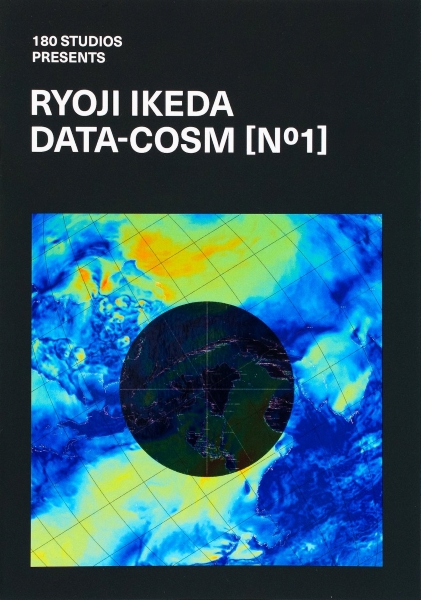
‘data-cosm [N˚1] functions as a giant microscope, a scientific apparatus, a clinical device, a monitoring scheme, and a window to an infinitely vast space,’ reads the introductory statement from the studio. Ahead of the premiere of the piece, specially commissioned for the space as part of an ongoing collaboration between the artist and curators, Ryoji Ikeda appeared for an extremely rare Q&A. He was introduced as ‘a true visionary, Japan’s leading composer and visual artist, Ryoji focuses on the essential characteristics of sound itself and of visuals as light, using both mathematical precision and mathematical aesthetics. He is globally renowned and respected as one of the few international artists working convincingly across both visual and sonic media – a master of orchestrating sound, visuals, materials, physical phenomena, and mathematical notions into immersive live performances and installations.’
Ikeda described his latest creation: ‘In short, with this piece, I took the tiniest scale of nature to the largest scale of the observable universe. It’s a seventeen-minute journey about scale. People should not be preoccupied with the data, because it’s about pure experience – and then you can decipher what it is – if you like. It’s a composition, like a song. I compose sound into music, and I compose pixels and light into video. I compose with data, but it’s just a material for me.
‘Everything is scientifically correct, but that is not the point.’
Ryoji’s website lists exhibitions all over the world in recent years – South Korea, US, Indonesia, Switzerland and Estonia in 2025 alone, as well as the London showing. This was a culmination of decades of work. ’22 years ago, I started doing data-driven projects. Of course, technology was very different then. I started from scratch. I designed the font and pixel by pixel. We developed our aesthetic, the graphic part first. Then we developed our own software from 100s of programmes from scratch…It was a long journey. Actual production [of data-cosm [N˚1]] was three years, but still, in a sense because we had to really learn this massive dataset and the science behind the data, the genome, the quantum mechanics, it took twenty-two years. This is like my graduation from university or something.’
22 years earlier was also exactly the time when Ryoji Ikeda and David Sylvian’s first musical work was released. The Japanese cd-single release of Sylvian/Sakamoto’s ‘World Citizen’/‘World Citizen (I Won’t Be Disappointed)’ was released in 2003 and carried a remix of ‘World Citizen’ by Ikeda, who featured on the original version of Sakamoto’s ‘Chain Music’ which provided the spark for the song (read more here). Ryoji created his mix in New York that August. Sylvian’s composition is treated with typically uncompromising electronic effects in the first phase of the song, which then suddenly depart to leave Sylvian’s voice against thick electric guitar chords. This change in musical environment is akin to the experience of one’s head ducking underwater to enter a different reality. Meanwhile, the vocal proclaims:
‘His world is suffering
Her world is suffering
Their world is suffering
World Citizen’
The remix was also included on the subsequent samadhisound release of the cd to other markets. Ryuichi Sakamoto’s album Chasm followed in 2004, including ‘World Citizen/re-cycled’ with Ryoji credited for “processing”. For this version, Sylvian’s lyric is pared back to the repeated exhortation to be a ‘World Citizen’. Ryuichi’s piano rings clear and there is a spectacularly expressive electric guitar solo from Keigo Oyamada, aka Cornelius.
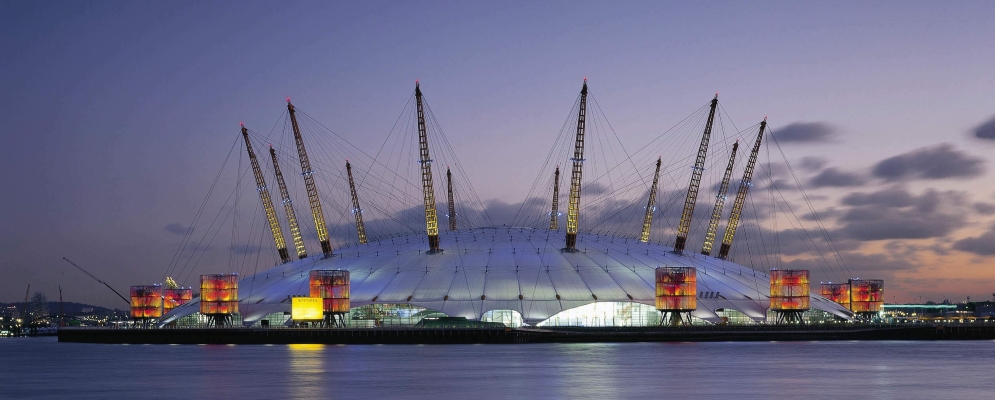
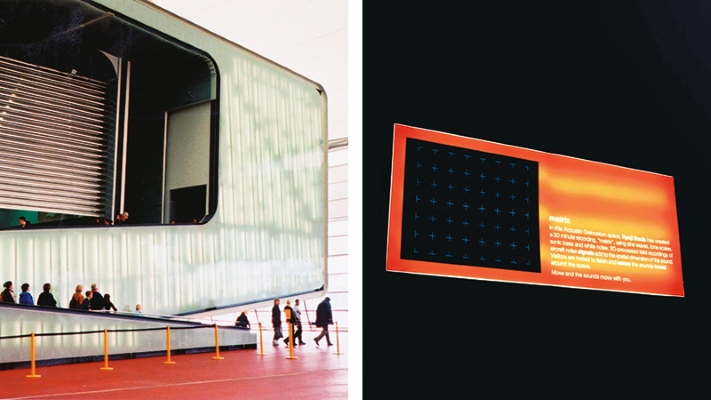
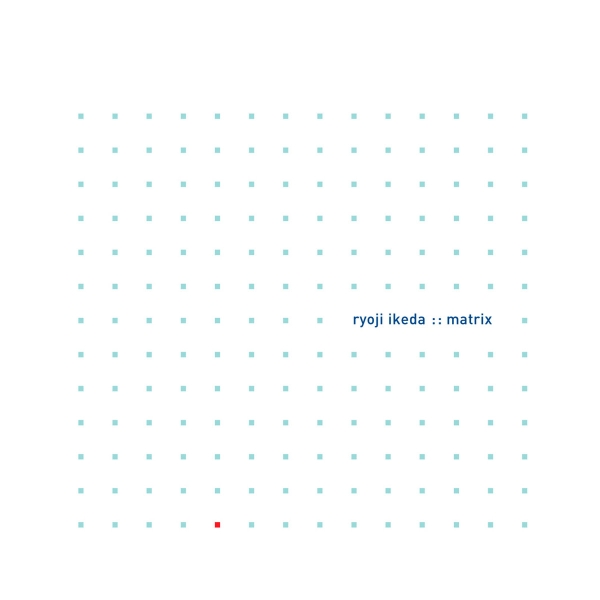
Ikeda was at this time releasing records through Touch, Mike Harding’s excellent imprint for experimental music whose roster included artists such as Christian Fennesz and Philip Jeck. +/- (1996) comprises intense electronic pulses. ‘The sound signals can be thought of in the same way as light is made spotlight,’ explains the label website. Matrix (2000) is a work linked to a series of installations, including one as part of the inaugural exhibition at London’s Millennium Dome, within ‘The Mind Zone’.
The visitor sign within the Dome invited people to ‘listen and sense the sounds travel around the space. Move and the sounds move with you.’ Ryoji’s website explains: ‘Matrix is a series of sound installations employing pure sine waves and white noises as a sculptural material…As visitors pass through the sound field, subtle oscillation patterns occur around their ears, caused by their own movements interfering with the sounds. It is a very personal experience, and only through the visitors’ physical engagement in the sound space can the real character of the work be perceived.’
His most recent release at the time of the work for Sylvian (and as it turned out, his final Touch album to date), was op.. Given the electronic experimentation of his work to that point, the format was a complete surprise. ‘One notable aspect fans of his previous work will highlight upon,’ read the launch statement, ‘is his declaration that “no electronic sounds have been used on this recording”. This is not to say that Ikeda has in any way renounced the world of electronic music that he has done so much to shape over the past seven years.’ (2002)
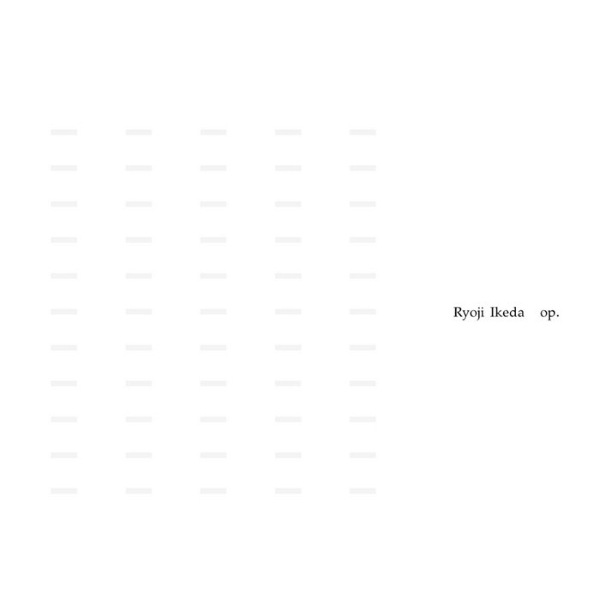
The op. of the title stood for opus, the classical music world’s method of classification for a composer’s oeuvre by date. These first three works in Ikeda’s ‘contemporary classical’ catalogue were written for 9 strings (op.1) and for string quartet (op. 2&3). This was ‘a brave and deliberate step that also lends a new dimension to his previous output,’ continued the release announcement, ‘with the acoustic space created by his string arrangements being subject to the same forensic attention to detail as before.’
op. earned a review in The Guardian with their correspondent, John L Walters, noting some connection with earlier electronic work, as well as the differentiation when working with people rather than machines. ‘At first this sounds truly minimal: slow-moving layers of overlapping sound with hardly any pulse. It harks back to experimental pioneers such as Morton Feldman; it has the austerity of an electronic piece made from tone generators. Yet musicians, however closely they follow the score, don’t behave quite like tone generators. Within the ultra-restrained ensemble playing, you can hear vestiges of personality, of performance and expression, and you experience Ikeda’s music entering a new dimension.’ (2003)

Sylvian would now invite Ryoji to participate in the project to reimagine Blemish, resulting in the album of remixes dubbed The Good Son vs The Only Daughter, and it would be his setting of ‘The Only Daughter’ that opened the cd. In an unexpected twist, Sylvian’s electronics were stripped away and the glitch effects on the vocal were removed to restore the original unprocessed recording. These elements, which could be considered akin to Ikeda’s palette to date, were replaced with acoustic instrumentation consistent with the ‘new dimension’ he entered with op.. Indeed, some of the same players from the Musiques Nouvelles Ensemble featured on both op. and the new version of ‘The Only Daughter’, for which the ensemble comprises violin, viola, cello, flute and French horn. It’s a completely different accompaniment to the one with which we were familiar from Blemish, but equally as fitting. There is an underlying discordance in what is a spacious yet detailed arrangement, and the piano – performed by Ryoji himself – is cold as ice, concluding in an unsettling cadence.
Sylvian was impressed. ‘There are some extraordinary artists that really do have an inspired take on work that’s presented to them for remixing. When the remit isn’t “try and make this more appealing to a wider audience,” the potential for creative results is raised considerably,’ he declared, describing Ryoji’s work on ‘The Only Daughter’ as ‘simply remarkable.’ (2010)
‘Ikeda had done a wonderful remix of the ‘World Citizen’ piece that Ryuichi and I had worked on together, and I felt that he really got to the heart of the piece very successfully and elaborated upon the emotional heart of the work in a striking manner. And I thought that it would be very interesting to hear how we would get to grips with something from the Blemish album. And again he came up with a striking reinterpretation of ‘The Only Daughter’ which really displays his commitment to the process of remixing material, as well as enormous range – surprising range – in terms of his own ability, his own technical knowledge.’ (2005)
A month on from experiencing data-cosm [N˚1] at 180 Studios, I was back in London, this time at The Barbican where a weekend’s celebration of Ryoji Ikeda’s classical work was taking place. ‘I have never been formally educated or trained as a composer,’ he explained in the programme notes. ‘For years, writing classical music for acoustic instruments has been an enormous challenge for me, and the process has always been painstakingly difficult, despite the great opportunities I have had through commissions.
‘At the outset, I deliberately restricted myself by excluding my usual artistic tools – such as electronic audiovisual components and digital technologies – from my creative palette. This was an attempt to strip myself bare artistically: a long journey had begun.
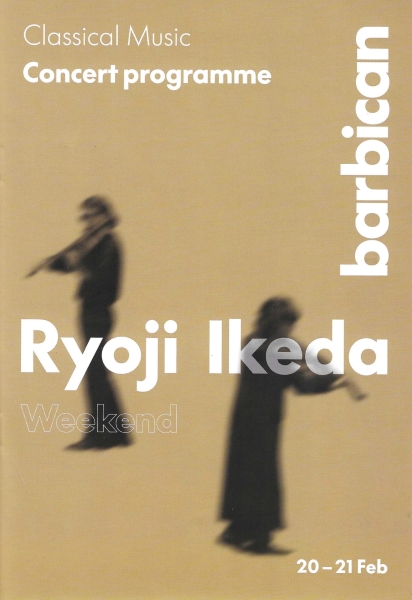
‘Since then, I have worked hard to absorb and understand the language and grammar of classical music as much as I could, though it has never felt sufficient. I have endeavoured to weave sound textures into coherent musical structures. For me it feels like writing a novel in a foreign language – similar to the experience I have had working with scientists and mathematicians to create visual artworks. Such a quixotic challenge pushes me to my limits, but at the same time, it invariably opens hidden artistic doors.’
BBC Radio 3 recorded Ikeda’s Metal Music for subsequent broadcast, which includes movements for a duo of triangles, a duo of crotales – small metal discs usually struck with mallets but here bowed to produce continuous tones like sine waves, and cymbals. ‘All these concerts are purely acoustic, without any use of microphones or speakers. This decision was made to honour the richness of acoustic instruments and the artistry of human performance, without mixing in digital elements.’
The concert I chose to attend was performed in St Giles Cripplegate, a medieval church which survived the Great Fire of London of 1666 and The Blitz and now sits incongruously within the Brutalist architecture of the Barbican estate. The Solem quartet are performing two works that I know from Touch’s op. release.
‘My op. 2 and op.3 were written many years ago during a workshop session with student players at the New National Theatre in Tokyo,’ writes Ikeda in the accompanying notes. ‘At the time, I was supposed to write music for a contemporary dance piece, but the session went in a totally unexpected direction and I ended up experimenting with “controlled chance operations”.
‘In this piece, each player in the string quartet is given a specific musical scale and spontaneously chooses which notes to play. Each musician is also given a precise timeline that determines exactly how long he or she should play for. This means that every performance is different and the audience encounters a unique realisation every time.’
The pieces are familiar but in extended form, the notes of each instrument seemingly responding to one another. Extended tones, no lyrical melodies, but intertwining resonance. At the conclusion, Ikeda moves forward to take a bow with the musicians. As he leaves the venue he declines a polite invitation from an audience member for a photograph. He is a man who wishes to be represented by his work and to remain in the background. ‘My job is to make something,’ he says, ‘not to talk.’
The remixes for David Sylvian embrace both the digital and the acoustic aspects of Ryoji Ikeda’s craft. On my playlist I like to interweave the ‘World Citizen’ tracks with ‘Matrix 2.4’, ‘2.5’ and ‘2.10’ from the Matrix cd, and to bookend ‘The Only Daughter’ remix with Movements III and IV from ‘op. 1 [for 9 strings]’. This was a brief crossing of two musical paths, providing a gateway to a fascinating artist whose singular work has flourished across the globe in subsequent years.
‘World Citizen (Ryoji Ikeda remix)’
Original track: Steve Jansen – drums; Amedeo Pace – guitars; Ryuichi Sakamoto – keyboards; Skúli Sverrisson – bass; David Sylvian – vocals.
Music and lyrics by David Sylvian
Remixed by Ryoji Ikeda at cci studio, New York, August 2003
Produced by David Sylvian & Ryuichi Sakamoto. From World Citizen by David Sylvian & Ryuichi Sakamoto, Warner Music Japan, 2003. Re-released on samadhisound, 2004.
Lyrics © samadhisound publishing
‘World Citizen (Ryoji Ikeda remix)’ – official YouTube link. It is highly recommended to listen to this music via physical media or lossless digital file. If you are able to, please support the artists by purchasing rather than streaming music.
‘World Citizen/re-cycled’
Ryoji Ikeda – processing; Keigo Oyamada – electric guitar; Ryuichi Sakamoto – keyboards; David Sylvian – vocals.
Music and lyrics by David Sylvian
Produced by Ryuichi Sakamoto. From Chasm by Ryuichi Sakamoto, Warner Music Japan, 2004.
Lyrics © samadhisound publishing
‘World Citizen/re-cycled’ – official YouTube link. It is highly recommended to listen to this music via physical media or lossless digital file. If you are able to, please support the artists by purchasing rather than streaming music.
‘The Only Daughter (remixed by Ryoji Ikeda)’
Original track: David Sylvian – all instruments, vocal
Music and lyrics by David Sylvian
Remixed by Ryoji Ikeda
Fabienne Dussenwart – flute; Pascal Moreau – French horn; Wilbert Aerts – violin; Dominica Eyckmans – viola; Jean-Paul Zanutel – cello; Ryoji Ikeda – piano
Produced by David Sylvian. From The Good Son vs The Only Daughter: The Blemish Remixes by David Sylvian, samadhisound, 2005.
Lyrics © samadhisound publishing
‘The Only Daughter (remixed by Ryoji Ikeda)’ – official YouTube link. It is highly recommended to listen to this music via physical media or lossless digital file. If you are able to, please support the artists by purchasing rather than streaming music.
Full sources and acknowledgments for this article can be found here.
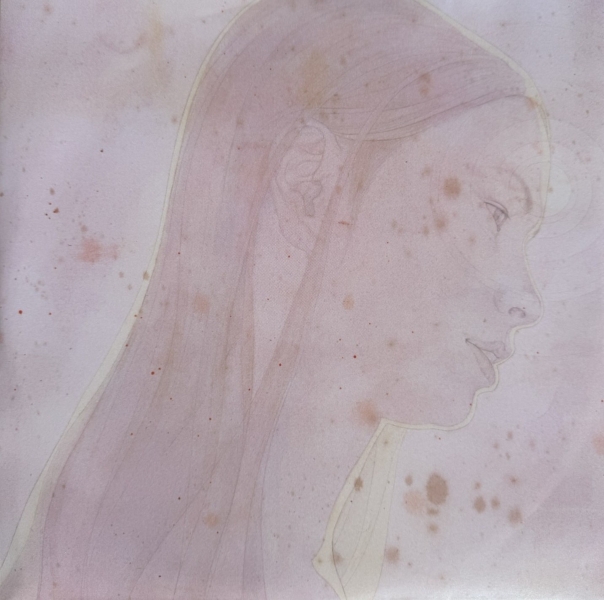
The featured image is artwork by Atsushi Fukui from the inner sleeve of the vinyl release of The Good Son vs The Only Daughter
Download links: ‘World Citizen (Ryoji Ikeda remix)’ (Apple); ‘Matrix 2.4, 2.5 & 2.10’ (bandcamp); ‘World Citizen/re-cycled’ (Apple); ‘op.1 III’ (bandcamp), ‘The Only Daughter (remixed by Ryoji Ikeda)’ (Apple); ‘op.1 IV’ (bandcamp)
Physical media: Chasm (discogs); op. (discogs); Matrix (discogs); The Good Son vs The Only Daughter (burningshed)
‘Ryoji Ikeda has done a couple of remixes for me, and his take on ‘The Only Daughter’ was simply remarkable.’ David Sylvian, 2010

