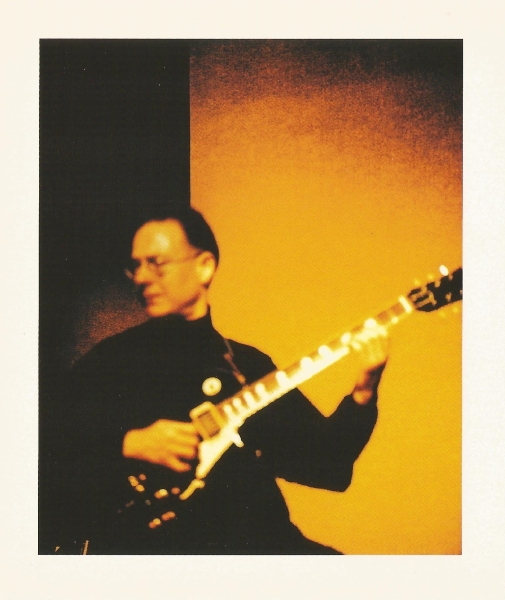
The months before Sylvian/Fripp first stepped into the public gaze were dominated for Robert Fripp by a dispute with his management company, EG. ‘From April ’91 to March ’92, when I first played in Japan with David Sylvian and Trey Gunn, that was virtually full time, my life. Miserable. I’m dying…No artist can stand and fight something like this, because you give up two or three years of your career, at the least. It brought me close to bankruptcy, because of instead of working, I spent a year purely dealing with it.’
Robert’s royalties had not been paid and he would discover that income had been diverted to meet debts incurred by individuals with unlimited liability to the London insurance market, as so called “Lloyd’s names”. ‘In order to keep themselves solvent they used any money that was available to them, including their artists’. And in order to meet their liabilities they sold the EG record catalogue and the EG publishing catalogue, including all my work. And in my cases, they didn’t have the right to do so.’
Sylvian, too, was dealing with some momentous events in 1991. He spoke of enduring a dark time that led him to a period of psychoanalysis. A treasured relationship had come to an end. The promotional launch of the Rain Tree Crow project was messy, with his bandmates speaking openly of disagreements at the mixing stage of the project. As those ’92 live shows with Robert commenced in Tokyo, light was dawning through David’s romance with Ingrid Chavez. A transatlantic move from London to Minneapolis was soon to follow.
‘My headspace was one of survival,’ Fripp much later reflected. ‘I kept going. And what would this mean? It will probably mean beginning at eight in the morning and going on ’til 11 at night. Endless emails. They’re brutal. I don’t know if you’ve ever been in litigation on that level….But when one musician goes up against the music industry, it’s essentially the end of your life. So my headspace in 1991 into ’92 was one of survival, and a key part for me in that was working with David Sylvian, who in his own life, I believe, was going through some changes. And rather than the nonsense of the music industry, working with David was going to a real place.’ (2023)
The preceding years had been dedicated to leading Guitar Craft, residential courses that were concerned with the development of playing technique, the discipline of the mind and body, and the clarity of intention. ‘Guitar Craft is a way of awakening Conscience by developing a relationship with the guitar, with music, and with ourselves,’ as the website reads today. The courses owed much to Fripp’s own experience with J.G. Bennett at Sherborne (see ‘Gone to Earth’). ‘Guitar Craft wouldn’t have been possible without Sherborne House, because without the foundation of a personal practice that I began at Sherborne, there would be nothing available for a personal practice within Guitar Craft. Without the foundation of a practice…I wouldn’t have been able to present the seminars in Guitar Craft.’ (1999)
‘Without a practice, without a discipline, life is pretty much a series of contingent events, moving from one situation to another, jumping from one mess to another, or simply sleeping through it all,’ Robert would later write. ‘With a practice, we develop a structure of acting in the world; within which we construct an interior architecture, moving to realise what we are, uniquely, born to achieve.’ (2020)
Sylvian was impressed by Robert’s total dedication to his vocation. ‘He’s a tremendous musician. He is a very disciplined player. Even now, he spends an enormous amount of time rehearsing, practising, developing his playing ability. He says that in three years’ time he believes that he will be a much better guitarist than he is now. So he still has ambition as a player and I think that’s very admirable.’
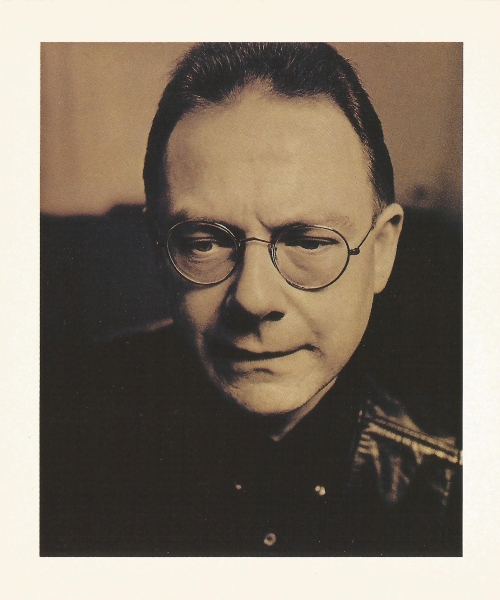
As Fripp returned to life as a performing musician in 1992, he took advantage of the technological advances that had taken place in the intervening years. Sylvian has recalled how, when the pair convened with Trey Gunn at the singer’s London flat for a brief period of writing ahead of their trio shows, Robert brought with him various technology which he had not yet fully mastered.
The combination of advances in digital technology and Fripp’s desire to develop his own technique and practice of playing came together in an evolution of his Frippertronics, which had first been developed using a pair of reel-to-reel tape recorders to create loops of sound. In this analogue set up, a sound would be captured on the recording head of one machine, with the tape then threaded into a second machine that plays that sound back a few seconds later. The audio of the second reel-to-reel is then routed back to the first, resulting in a performance that develops in a blend of real-time and recorded tones.
Now it was possible to use digital rack-mounted units to increase the possibilities. The Revox tape machines were replaced by a pair of TC Electronic 2290 digital delay units. Two were used because each give a mono output, so by manipulating the inputs to each, Fripp could produce an enveloping stereo “soundscape”. Key to this was the range of effects now available. Fripp was still using the Roland GR-300 guitar synthesiser that had been put to good use on Gone to Earth, together with ‘all my early analogue pedals, including the fuzz, put into a rack.’ He could now supplement these further.
‘The TC2290 works as a patch bay because it has five send/returns, so I can have up to five effects units coming in and going out,’ Fripp explained in an article exploring the detail of the new set up. Among the digital effects units he was feeding in were the Roland GP-16 and the newly released Korg A2 signal processor. The guitarist now had a dizzying array of possibilities at his disposal.
‘I use a TC Electronic Ground Control; a digital, programmable foot-pedal which handles up to eight combinations of effects over MIDI,’ explained Fripp. ‘All these multi-effects go into the TC2290s, which have up to 64 seconds of delay memory. TC’s distributor in Oswestry [Systems Workshop] tell me they shouldn’t be able to do that, but David Sylvian programmed it in for me, so in addition to its basic superb chorusing, flanging and 64-second delay, it can also be used as a patch bay…On the foot control for the TC2290, in addition to being able to summon up instant effects setup programs already written with the Ground Control, I can take them in or out in combination using my foot.’
Finally, the signal was routed into the Eventide H3000 harmoniser which was controlled by another foot-pedal and deployed as a ‘pitch shifter, [it] comes out with an octave above…Then it goes off down the line…usually it goes straight out to the board.’
Nowhere is all this gadgetry more engagingly deployed than in the closing of The First Day. King Crimson biographer Sid Smith highlighted the significance of the final piece on the occasion of the album’s 30th anniversary. ‘The track ‘Bringing Down the Light’,’ he wrote, ‘showcased the first recorded instance of Fripp’s innovative contemporary Soundscapes technique, providing a truly exceptional and captivating experience.’
It’s a piece that completes the arc of the album’s progression. ‘Throughout the album there is a kind of sense of frustration, anger and mental chaos, as well as world chaos, which is finally resolved in some sense of optimism, some sense of new light,’ said Sylvian. ‘Increasingly, as the album progresses, there becomes more hope. There’s a way out. In the song ‘Darshan’, we’re talking about spiritual initiation. ‘Bringing Down The Light’ speaks for itself. There’s a journey being made, that’s about revelation in a way.’
Robert’s gentle extended single notes are projected across the stereo mix and then coalesce as they echo back through use of the delays. There’s a comfort in the experience, as if the sounds glide right through you, the familiar blended with the new, building up with a broad range of pitch from resonant bass to soaring soprano. Then, around 2 min 40 sec into the track, a double-note figure is overlayed above the accumulated enveloping soundscape, an ascension that itself repeats as the piece continues to evolve. Rather than a studio fade, the final note dissolves into the air and we are left in its radiance as The First Day gives way to silence.
‘The soundscapes are remarkable in that they are always true,’ said Fripp. ‘You can’t hide a thing within them. If nothing’s happening, then obviously you can tell it’s only sound. But ‘Bringing Down the Light’ makes me weak when I hear it. It’s stunningly personal and yet I think it goes far beyond me at the same time.’
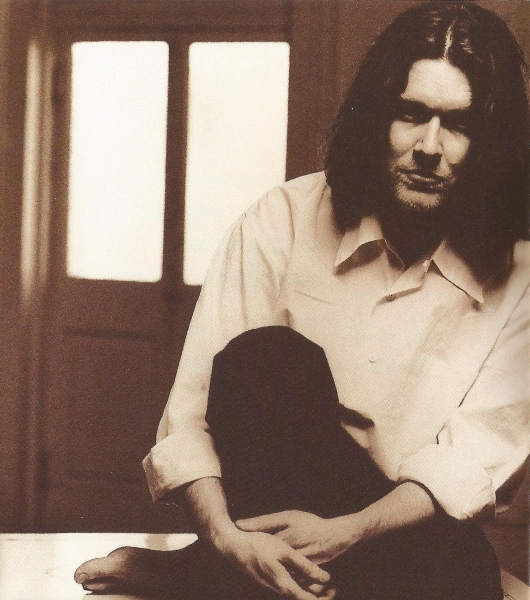
David Sylvian’s explorations into the Hindu religion and his experience of travelling to meet Mother Meera in Germany were a significant influence on the album. ‘God’s Monkey’ speaks of human birth (‘One push/you fall in/born in darkness’) and the monkey-god Hanuman. ‘Darshan’ recalls the one-to-one intimacy of receiving a blessing at the feet of Mother Meera, something Sylvian would return to in the song ‘Thalheim’ for Dead Bees on a Cake (read more here).
‘The East has always been a source of interest,’ said Sylvian at the time. ‘And also the belief system there has been of interest to me. But I have my own approach to life which is made up of… you know, you soak in so much in a lifetime and then you begin to adapt. You just take those elements that are important to you and you live your life in a certain way. And my life may have some references to an Eastern way of life, Eastern beliefs and philosophy, and some to the West. The figure of Christ is a very important figure to me, as is the figure of Buddha. I don’t follow any particular religion.’
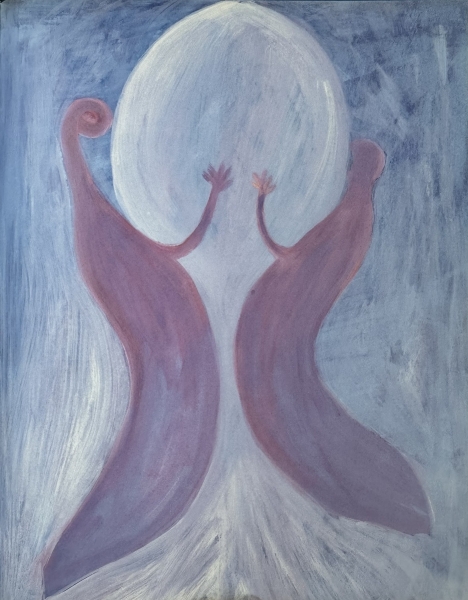
‘Bringing Down the Light’ is undoubtedly performed by Robert alone, but it seems that David chose the track name, adopting the title of a book published by Mother Meera in 1990. Subtitled ‘Journey of a Soul after Death’, its pages contain paintings by the author depicting the last days and after-death experience of her devotee Mr Reddy, the man who recognised her, even as a young girl, as a manifestation of the Divine Mother.
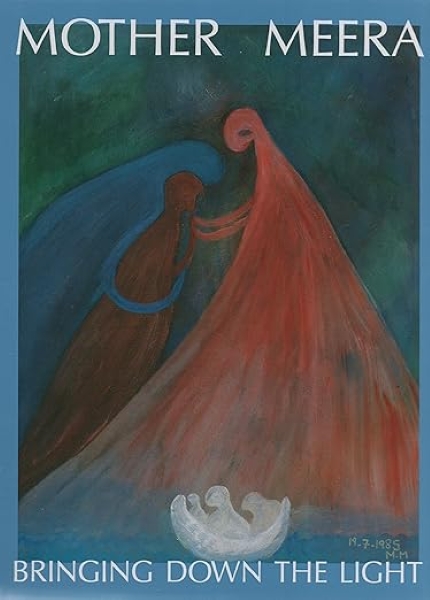
‘We have to try to reveal that Light which is in us as a bud,’ reads Mother Meera’s preface to the paintings. ‘It must blossom like a flower. In all things, everywhere, in all beings the light is hidden, and it must be revealed. If we try with all our hearts we will be successful… We will live perpetually in the Paramatman Light and be Paramatman. I want the Paramatman Light to blossom everywhere.’
Mother Meera ‘brings down’ this light to help speed individual transformation and thereby to impact the world. ‘Paramatman is infinite light and the origin of everything – of being, of knowledge, of bliss, of peace, of every atman, of every soul…Paramatman is everywhere, in all of creation – earth, water, fire, air, space, animals – at all times. But we can only see the light sometimes. The light has the quality of love, grace, power, bliss, jnana (knowledge). Without it nothing can exist’ (1991). It is the light received at her feet at darshan, it is the light to which Mr Reddy returned.
Sylvian said in a promotional interview for the album, ‘Things are getting very chaotic in the world. People are losing hope, they are losing belief in institutions of all kind. It’s important that they know there is a direct link to these spiritual powers, these spiritual energies, that are very very potent right now upon the earth. The energy on the earth right now is very very powerful, and there are people on the earth to guide us…because of the crisis that we’re in right now.’
As the journey of The First Day is resolved in ‘Bringing Down the Light’, so perhaps both Fripp and Sylvian took steps towards resolution of their own, exploring a shared creative spirit as each emerged from times of personal challenge, and in doing so, found the will and inspiration to continue. Sylvian: ‘It’s a resolution to the album which is very hopeful and uplifting.’ And Fripp’s perspective? ‘I was very fortunate that music, in the form of David Sylvian and I, came together and took me out of this totally utterly wretched period…and brought back a little light. And the light has been growing.’
The First Day was released in July 1993. It was only days later that Edie Fripp, Robert’s mother, would leave this world.
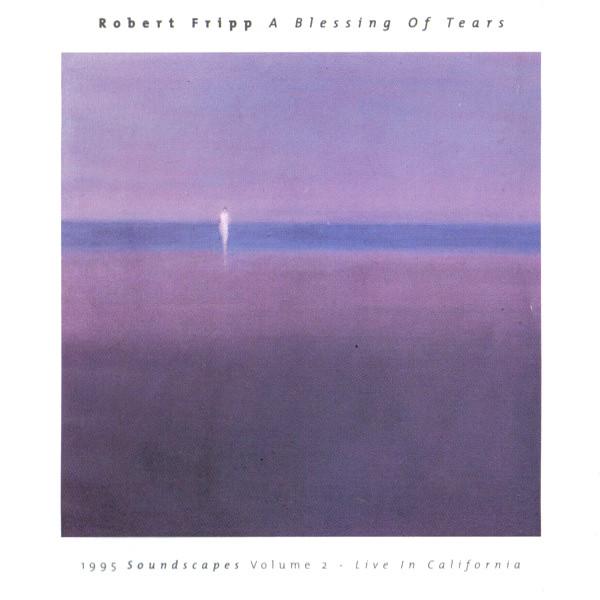
The soundscape approach initiated for ‘Bringing Down the Light’ was again in evidence in a series of early releases on the newly formed Discipline Global Mobile label, an organisation founded on the principles of fairness and transparency, an antidote to the forces that had poisoned some of Robert’s previous professional relationships in the music industry. A Blessing of Tears was volume 2 of a 1995 soundscape series, comprising solo pieces recorded live in California that same year.
The cd booklet carried words from the eulogy for Edie that was delivered at Wimborne Minster on 30 July 1993 ‘to celebrate her life and commemorate her death.’ In these soundscapes, Fripp seems to find eloquent expression for depths of emotion he experienced on the passing of his mother. The album’s title – A Blessing of Tears – touchingly encapsulates the sorrow of parting, whilst acknowledging that what makes that sadness acute is the joy of having loved and been loved by somebody so close. Reading Robert’s words for his mother whilst listening to this music, including ‘The Cathedral of Tears’ and the closing ‘Returning II’, is incredibly poignant.
‘Death is far more than a mere inevitability: it makes a contribution to life to continue. At the completion of a life lived well, something of what has been acquired is returned to life and living things. Our contemporary culture seems to be the only culture in history which doubts that an individual consciousness, concentrated within one particular life, is an ongoing and continuous action contained within the growing overall human consciousness.
‘My mother gave me her unqualified love and support, without which the difficulties of the music industry, particularly the very hard early years of constant travelling and pressure, would have been overwhelming for me. I wish to acknowledge publicly and gratefully that my mother’s unconditional love has been the foundation of my life.’
When Sylvian/Fripp commenced their full band tour to promote The First Day in October 1993, David Sylvian and Ingrid Chavez were accompanied by their new-born, Ameera Daya. Affirming this benevolent continuity of life and human consciousness, the tour programme noted on its title page, ‘The road to graceland 1993 tour is dedicated to the memory of Edie Fripp and to the birth of the child of David and Ingrid Sylvian.’
‘I’ve enjoyed being around Robert,’ declared David. ‘One thing we do have in common is some kind of set of values with which we live by and is the basic motivation for the work itself. And that’s something I’ve been looking for in collaborative partners for a long time in the work. Because nothing is more important to me than the principle of the work, the function of the work in society. When it goes out into society it must have a job to do, you know. And I find that Robert and I both have those very similar viewpoints.
‘If a work is true to itself, it embodies certain energies that are beyond the mind and the ego of the artist, the creator. The artist acts as medium, these energies come through the artist and are embodied in the work. When the listener comes into contact with the work they come into contact with those original energies, if they are open. So a connection is made, a cycle is made. This interests me.’
In an interview with Andy Burns on the 30th Anniversary of The First Day‘s release, Robert reflected on the essence of music and the kinship between the musicians. ‘The thing is, music has an intelligence all of its own. Now, I’m 77. It doesn’t matter to me very much if people want to be cynical about that. Bearing in mind, one of the further abusive situations within the life of a working player of my age was engaging with the press commentary that I have done over the past fifty-four years, a lot of which was hostile. And if we move on to social media today, for me to make a bold statement like, “music has an intelligence entirely of its own, and it’s not that the musicians create the music, but the music creates the musician,” …for me, this is fact. And if this is not within anyone’s direct experience, that’s entirely fine. Please don’t believe me. Trust your own experience and interrogate your own experience.
‘How to do that? Find a piece of music that really speaks to you, that profoundly moves you and listen. And if we move, I don’t know whether it would be best to say inside the sound or completely outside the sound, but there is something utterly direct, and the music speaks regardless of the person that’s playing it, and becomes immediately available to the person listening to it. You put on the music, and it speaks directly, and that is to be trusted, and that is the experience that we interrogate and we follow it back. Now at a certain point in my life, if we follow it back, we arrive at silence. Silence is where the music is before it’s born. In my experience music moves from silence, and where do we find silence? We find silence in love.
‘Now this is a conversation which I can have today with David Sylvian. We remain in touch by email. I could have this conversation with David today. And I could have that conversation with David in 1991 and 1985, so that is essentially the background I share with David. It’s not the background of most working players. It’s more the background of an artist, which David definitely is. My background is in the pragmatic side of making music where, if you’re working with superb professional musicians, you don’t sit down and talk about the origins of music are in love. You might shout out the key and have a count of 1, 2, 3, 4. David had rare sensitivities, and his background was not that of a working player like me. David was a more philosophical — reflective isn’t quite the word. But David is an artist, and an artist begins with a different set of strategies and questions to that of the working player and working with David was, and it continues to be, one of the high spots of my musical life.’ (2023)
‘Two TC2290s lurk gently, waiting to deliver Soundscapes to an uncaring world,’ wrote Robert in a 1999 diary entry. Soundscapes would be a continued means of expression over many years to come, albeit the technology would move on again over time. When the planet was thrust into the disconcerting and down-right scary days of pandemic, the archive was opened in service to unsettled hearts and minds. A series known as Music for Quiet Moments was launched in May 2020: ‘We will be releasing an ambient instrumental soundscape online every week for 50 weeks. Something to nourish us, and help us through these Uncertain Times,’ read the announcement.
‘Quiet moments are when we put time aside to be quiet,’ said Robert. ‘Sometimes quiet moments find us. Quiet may be experienced with sound, and also through sound; in a place we hold to be sacred, or maybe on a crowded subway train hurtling towards Piccadilly or Times Square.
‘Quiet Moments of my musical life, expressed in Soundscapes, are deeply personal; yet utterly impersonal: they address the concerns we share within our common humanity.’
Release 45 in the series was premiered on YouTube in March 2021. Entitled ‘Elegy’, it was taken from a performance at The Olympia in Paris on 22 September 2015. David Sylvian shared the piece with his social media followers with the simple observation, ‘Sometimes Robert just nails your heart to the mast.’
Official Youtube link for ‘Elegy’. The complete Music for Quiet Moments series was subsequently released in a cd boxset. ‘Elegy’, running at 44 minutes, was included on a cd of its own.
Fripp: ‘It is a remarkable opportunity to have had most of my life close to and involved in music.
‘Music as a language is probably the richest language we have, and perhaps as close to a perfect language as might be.
‘A language that has the power to change our state, a means of transport, a healing, it sets our feet dancing, it aids our contemplation, it is a generous Friend – giving of itself freely, asking nothing in return.
‘Only Silence has a greater power to move me.’ (2020)
‘Bringing Down the Light’
Robert Fripp – guitar
Music by Robert Fripp
Produced by David Sylvian & David Bottrill. From The First Day by David Sylvian & Robert Fripp, Virgin, 1993.
The First Day was recorded at Dreamland Studios, Woodstock, N.Y., and Kingsway Studios, New Orleans. Mixed at Electric Lady Studios, New York, N.Y.
December ’92 to March ’93
‘Bringing Down the Light’ – official YouTube link. It is highly recommended to listen to this music via physical media or lossless digital file. If you are able to, please support the artists by purchasing rather than streaming music.
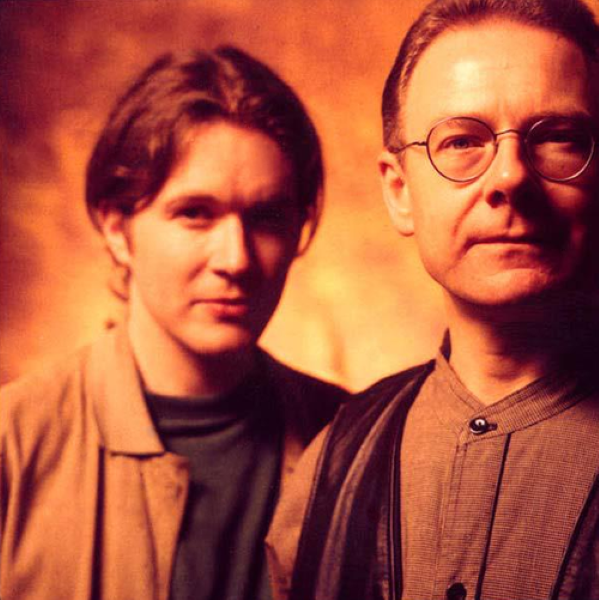
The featured image is from the postcard set which accompanied the limited edition cd of The First Day, photograph by Kevin Westenberg.
All artist quotes are from interviews in 1993/94 unless otherwise stated. Full sources and acknowledgments can be found here.
Andy Burns’ complete interview with Robert Fripp to mark the 30th anniversary of The First Day can be read here.
Robert Fripp’s book, The Guitar Circle, can be obtained at burning shed, here.
Download links: ‘Bringing Down the Light’ (Apple); ‘The Cathedral of Tears’ (dgmlive); ‘Returning II’ (dgmlive); ‘Elegy’ (dgmlive)
Physical media links: The First Day (burningshed) (Amazon); A Blessing of Tears (discogs); Music for Quiet Moments (discogs)
‘The musician has three disciplines: of the hands, the head, and the heart.’ Robert Fripp, 2014
More about The First Day:

“Bringing Down the Light” has long seemed to be a sui generis work in Robert’s body of Soundscapes and Frippertronics (along with “Dark Water,” a companion piece recorded in the same sessions for The First Day and released as a b-side). I am not aware of any Fripp soundscape released prior or since that possesses in texture or compositional structure anything in any way similar, and I have certainly tried to find such a thing in the intervening decades. The Soundscapes style he approached even immediately afterward (on 1999 and subsequent DGM releases) was already on to other methods — sometimes more dramatically crescendo-based (as on 1999), other times simply more streamlined in structure (as on much of A Blessing of Tears or Love Cannot Bear, for example). By comparison, “Bringing Down the Light” approaches the quality of a kind of Renaissance motet, much like Thomas Tallis’s “Spem in Alium.” It is utterly glorious and may be his most sublime Soundscapes achievement.
LikeLiked by 1 person
Thanks for sharing that, Steve. It’s amazing to me that Robert could maximise the possibilities of the new set up so effectively to sculpt this piece.
LikeLiked by 1 person
I enjoyed reading this. Fripp has a reputation, I think, of being helpful, affable and is a great musician.
After turning down Bryan Ferry as a potential King Crimson vocalist (either Robert, another group member, or the group collectively), I understand that RF recommended E.G. Management to BF – obviously this was twenty years before RF’s difficulties referred to herein. This worked out for BF et al.
I thank RF and King Crimson, for turning him down as a lead vocalist (as an ardent Roxy Music fan)!
The hands, the head, the heart, I’ve made reference to the last recently in another post of my own, in a similar context, but so accurate Robert, especially for the guitarist!
Thanks to all contributors.
LikeLiked by 2 people
I very much enjoyed reading this. I am an aspiring writer whose model of life and death is very similar to these 2 amazing musicians. I came to this page to learn more about them, initially after a moment of great conflict in my life resolved itself while listening to David Sylvian’s beautiful song “I Surrender.” A song I’ve listened to now for many years, but that has only just now begun to make real sense to me. David mentions that the unconditional love of his mother served as a foundation for him and mine is the promise of a son. I hope to add to this noble and ancient tradition just like these 2 great artists; to thank them for making me feel validated, seen, and inspired. Inspired to hold up a mirror to the world so that it may never forget its beauty.
LikeLiked by 1 person
You’ve probably read the article on ‘I Surrender’ on this site, but in case not, here is the link: https://sylvianvista.com/2018/04/11/i-surrender/.
LikeLike