
Anja Garbarek’s 2001 album Smiling & Waving is notable for a number of reasons. Firstly, two tracks are produced by Mark Hollis of Talk Talk: an extremely rare foray into music after his self-titled album, released in 1998, signalled a retreat from public to private life. That album had been playing in a London record store when Anja visited whilst preparing for the recording of Smiling & Waving. ‘I heard the most beautiful music,’ she told Anil Prasad in an interview for his Innerviews site. ‘It had the same spirit I wanted to achieve with the music I was currently working on. It turned out to be Mark Hollis’ solo album. I went straight home and called the record company and asked them what my chances were of working with Mark. I presumed he was still active, but they told me that he had retired from the music industry after releasing his solo album. Somehow, they managed to set up a meeting with him and we got on really well.’ (2019)
Also noteworthy is the appearance of Robert Wyatt for a duet on the track ‘The Diver’. This is one of the Hollis-produced songs and it was his idea to call in Wyatt and for the vocal to be shared. Robert’s voice shares a fragility with Anja’s own delivery and the acoustic arrangement has all the space and feel of Hollis’ solo opus, even featuring some of the same players – Chris Laurence on acoustic bass, Laurence Pendrous on piano, Melinda Maxwell on oboe and Martin Ditcham on percussion.
For followers of the music of the ex-members of Japan, Smiling & Waving was of particular interest for the contributions of both Steve Jansen and Richard Barbieri, together with musicians from their recent orbit: Steven Wilson and Theo Travis. Some of us will have witnessed this quartet on stage together in 1997 at the one-off Jansen/Barbieri/Karn gig at London’s Astoria 2. Hollis having contributed to two tracks, another producer was required for the remainder of Smiling & Waving. ‘BMG [Anja’s record company] organised meetings with a few different prospective producers, and it was Steven Wilson who I felt was the right man for the job,’ she explained. ‘He was able to draw on his circle of friends and bring Richard, Steve and Theo into the project.’ (2019)
A particular favourite of mine from the songs that Wilson co-produced with Anja is ‘Stay Tuned’. Steve’s drums, recorded in a studio basement to achieve a ‘more dirty sound’ and processed so as to degrade their sound into the middle distance, accompany ‘analogue fx’ from Richard Barbieri, liquid strings and a tender vocal. Like all great tracks, the beauty of the melody is heightened with repeated listening. ‘What an extraordinary and totally underrated record it is,’ reflected Steven Wilson, ‘probably one of the top five records I’ve had the privilege to work on.’ (2014)

Steve Jansen enjoyed the studio experience with Garbarek. ‘I first worked with her in 2000 on her excellent solo album Smiling & Waving. It was one of those rare sessions where the artist wants to really explore ideas as opposed to simply asking you to play drums. We went on to perform a number of live shows for Anja’s music during the following years.’ The shows to support Smiling & Waving were, he said, ‘some of the most intricate live performances that seemed to hang by a thread every evening, the arrangements were that delicately poised.’ (2017)
‘We became quite close as friends,’ Steve told Innerviews, ‘Anja is very resolute when it comes to her music. She doesn’t always know how to find what she wants to hear, but she certainly knows what she doesn’t want to hear.’ (2019)
It was no surprise then that when Jansen was developing material for his debut solo album, he should involve Garbarek. The project had a long gestation. ‘I began developing the material for Slope in the early 2000s,’ he explained in an online listening party for the album, ‘a gradual process as there were other projects and tours going on around that time. I followed my instincts – “concepts” are not a good starting place for me. Another album (Snow Borne Sorrow) was also in the writing stage and some work intended for my solo project became diverted towards that.’
Jansen was based in the US during the early stages, living in one of the small collection of buildings at David Sylvian’s property in New Hampshire. Some of the album was recorded in the studio that Sylvian created there, a space Jansen described as ‘live, luxuriously spacious, professionally equipped and deep in snow for a third of the year. He and I worked closely throughout 2001-05 and supported one another’s projects – live/studio and a label.’
Steve’s meticulous approach to architecting sound is showcased throughout Slope. ‘My process was to complete writing the music before inviting singers to get involved – so once the music was sufficiently developed I’d propose it as a collaboration for a song at the singer’s discretion.’
Such was the case with what would become ‘Cancelled Pieces’ featuring Anja Garbarek on vocals. Jansen: ‘Anja’s own music often has unusual arrangements/treatments so I knew the intimacy in her voice would work well against the cold electronica, deconstructed parts and unusual sounds I was using. She accepted the challenge, but it wasn’t until over a year later that Anja returned her vocals to me – working remotely really opened up the freedom for contributors to take their time, experiment with ideas and offer alternatives.’
Part of the challenge may have been that the working process was very different to that which Anja employed for her own music. Her practice was to complete both the melodies and the lyrics, and then to develop arrangements working with her father, the renowned saxophonist Jan Garbarek (who incidentally was David Sylvian’s first pick as soloist for the ballad ‘Wave’ but was overseas at the time of Gone to Earth‘s recording). Individual parts in these arrangements would then be developed and laid down in the studio with the input of a producer and guest musicians.
How different then to be presented with a practically completed musical track of someone else’s making and to be challenged to carve space for a vocal. ‘I think I had had that song for about a year,’ Anja told Innerviews. ‘I’m sure that Steve had given up hope of me ever coming up with anything. His part was finished, it just required the lyrics and melody. I wasn’t sure what to do with it. It wasn’t my music. It already existed and I had to try to figure out where it was transporting me.
‘I had many different “pieces” in my head, but it was like a puzzle that didn’t fit together. You get given a piece of the sky, a car wheel and maybe a teddy bear, but you have no idea what the final picture is supposed to look like. But suddenly you find all the corners and everything else falls into place. After that, it was done in about an afternoon. I recorded the vocals at home and sent them back to him. I’m sure he almost died of shock when I called him and said I was finished.’ (2019)

Steve’s base track is intense and rhythmically unnerving. ‘‘Cancelled Pieces’ is in 3/4 with the drums in 4/4, so there’s a natural turnaround of the pattern against the instrumentation,’ he explained. ‘I don’t think many vocalists could have extracted such a natural song from this music. I was so impressed and also respect Anja’s poetically ambiguous lyrics too.’
Smiling & Waving is a series of vignettes giving glimpses of individuals encountering dark and threatening situations. The narrator of the opening track, ‘Her Room’, recounts ominously: ‘I am in her room. It’s I who live here now. I don’t know how I got here. There’s a man who comes every night.’ ‘Understanding the subject matter provides a whole other dimension,’ said Jansen of ‘Cancelled Pieces’. ‘Anja made a wonderfully theatrical video for my live show depicting her character’s role – a girl damaged by addiction and bad life choices, turned sex worker and now staring into the abyss.’
‘I have cancelled all the pieces
that were meant to make me whole
Now there’s no room to turn around’
‘I filmed all my parts at home using my husband as cameraman,’ explained Anja. ‘They wanted the main part to be against a white background, so we had to take all the pictures down from the kitchen wall. I also had a lot of fun running around in the cellar, dressing up, and using masks and mirrors. When I was happy with the images I had recorded, I sent the film to Shoko Ise in Japan who worked her magic on it and created the final video.’ (2019)
The only other performer on the track is David Sylvian. I must admit to missing this fact on initial release, perhaps due to the more overt vocal contributions that Sylvian made to ‘Playground Martyrs’ and ‘Ballad of a Deadman’, the latter a duet with Joan Wasser aka Joan as Police Woman (to be the subject of a future article). ‘Dave adds some great sounding guitar work,’ was Jansen’s description. Sylvian’s parts thread through the piece, moving from analogue warmth to over-drive, a human touch to offset aloof electronics.
Another role that Sylvian played in the development of Jansen’s album was to act as a kind of casting director, suggesting vocalists who might be able to develop some of Jansen’s compositions into songs, just as Anja Garbarek did with ‘Cancelled Pieces’. Thomas Feiner was a case in point. Jansen: ‘Thankfully he invited Thomas Feiner’s band Anywhen to reissue on the label [samadhisound] and as a result Thomas then became a vocalist contender for Slope.’
‘I was surprised to say the least…’ remembered Feiner. ‘An e-mail from David Sylvian! My initial thought was that this was some spammer with a better than average taste in choosing a fake name. Luckily I actually opened that e-mail! The original offer from David was for me to release any solo material I might have coming, so we kept in touch.’
It wouldn’t be until 2008, after the release of Slope, that samadhisound would issue an expanded version of Anywhen’s The Opiates (originally from 2001), featuring two new songs by Feiner, ‘Yonderhead’ and ‘For Now’. ‘The band itself fell apart during the making of The Opiates,’ explained Feiner. ‘While David and the label were interested in re-releasing the record, it was decided that I should throw in some more of my own material to make it a revised version.’
‘For many this will be the first they have heard of Feiner,’ read the label’s launch announcement, ‘and it comes several years after Sylvian first heard the album, which he regards as a lost classic since it never came out in many territories.’ Sylvian expanded: ‘The dark, brooding, romantic nature of the material and, in particular, the emotional gravity of Thomas’ voice, came as something of a surprise to me as it was quite out of keeping with my listening habits of the time but I couldn’t help but be drawn into its widescreen, colour-drained, soundscapes.’
I remember playing the track ‘Dinah and the Beautiful Blue’ on repeat when The Opiates revised landed, the impossibly deep bass of Feiner’s vocal buoyed on the ebb and flow of a tide of luxuriant strings from the Warsaw Radio Symphony Orchestra. The album’s title resounded with Sylvian’s choice of name for his management company, Opium Arts, no doubt in part a reference to Jean Cocteau’s addiction to the drug. Sylvian directed the art for the Feiner & Anywhen release and made the connection explicit by featuring on the cover a photograph, Jean Cocteau fumant l’Opium, Hôtel de Castille, 1938, by Cecil Beaton. ‘I was happy to leave it in the hands of David and Chris Bigg, whose work I have admired for many years,’ said Thomas. ‘I am very pleased with how it turned out. David and the label spared no efforts in trying to track down the Beaton image that was intended for the cover. I think they spent months on that, and I can only admire this kind of obsessive determination.’ (2008)

Before all this, however, the invitation to contribute to Steve Jansen’s Slope was accepted, the result being ‘Sow the Salt’. ‘This track is a heavy beast,’ said Jansen. ‘Thomas was the perfect man for the job, the gravitas of the soulful voice carrying the burden – the hard graft – the sowing of the salt – a folkloric covenantal curse.
‘Thomas came up with this vocal pretty quickly. Having worked so much with him since then (with our band Exit North in which four of us co-write together), I know that a piece of music either resonates with him or it doesn’t – not much middle ground.
‘As luck would have it, Thomas was travelling to Bratislava to record an orchestra for his own project and proposed that they also transcribe a score for this track – this added so much to the character of the track as well as tension and drama.’
Jansen and Feiner wouldn’t meet face-to-face until after Slope’s release, when David Sylvian’s The World is Everything tour kicked off in Stockholm in 2007, the connection later developing into Exit North. ‘I think Thomas’ voice has a tremendous amount of gravitas and resonance and his delivery is better than most native English singers. I feel very fortunate to be working with someone this good.’ (2018)
Another vocalist had originally taken a crack at developing a vocal part to the music that became ‘Sowing the Salt’. That rendition did not make it to the final track-list, but Tim Elsenburg’s other vocal interpretation was included as ‘Sleepyard’. Elsenburg was the vocalist for the band Sweet Billy Pilgrim whose debut release was an EP in 2004. The following year the band was credited with a remix of David Sylvian’s ‘The Heart Knows Better’ for the album The Good Son vs The Only Daughter.
It came about, Tim said, because of ‘people who knew people who knew people, plus some good old-fashioned luck. David was looking for people to rework his material and thanks to his open-mindedness I got the chance to have a go at remixing the song. Obviously, if he hadn’t have liked what I did, then it wouldn’t have made it onto the record, but thankfully he did and – in the process – opened many doors for us.’
One of these opportunities was to tackle one of the pieces for Jansen’s project. Elsenburg: ‘Steve heard some of my songs via David while he was putting the album together, and thought that my voice and my melodies might work well with some of the material he was preparing for Slope.’ (2009)
‘Tim actually wrote vocal parts for two tracks,’ Steve Jansen confirmed, ‘‘Sleepyard’ and the track that turned out to be ‘Sow the Salt’ which we felt wasn’t in the best key for him.’ The music for what would become ‘Sleepyard’ demanded a response from Elsenburg. ‘I loved what he sent me, in particular the irregular meter of the song (Jansen: ‘it’s in 7/4…so it does that skipping of the beat thing’) and the title – which I’d had in mind for a while – just seemed to fit the mood perfectly. I think it’s the fastest I’ve ever written a lyric. Actually, that’s not true. It’s the fastest I’ve ever written a lyric and then still liked it the next morning.’ (2009)
Jansen afforded a great deal of freedom to those invited to develop the tracks into songs. There was an intentional “letting go” after the detailed sculpting of the track to that point. ‘With the type of vocalists I tend to work with I feel it’d be a waste not to allow free scope with lyrical content,’ he said. ‘Since I’ve written the music and played most of the instruments, I’m really looking for someone else to inject their creativity into it, therefore I hope the music suggests something inspiring.’ (2014)
The approach was rewarded in Elsenburg’s evolution of ‘Sleepyard’. Jansen: ‘The vocal melody beautifully complemented the vibraphone arrangement, developing the line further. He also threw in a few guitar chords in the middle “heavy” section.’
For the final track of the album, the assignment for the invited participant was a little different. A vocal line and lyric had unexpectedly been developed for ‘Playground Martyrs’ already. ‘I recorded the piano at The Vestry in London – a simple set of chords intended for a song for a French female vocalist. I sent this over to Dave for a second opinion and to my surprise he sent it back with his vocal demo – singing into his laptop mic with the piano chords playing in the background – as a suggestion for whoever the female vocalist might be.’
The artist originally intended to pick up the assignment was unable to participate due to competing demands, but the intention was still to find an ‘outside’ voice to perform the song. ‘During the search I became attached to Dave’s version, so he recorded it properly but still with the hope of finding a female vocalist as we hadn’t planned for him to feature on the album on vocals – we were already doing that with our Nine Horses project.’ (Read more about ‘Playground Martyrs’ here).
Swedish artist Nina Kinert had released her debut album, Heartbreaktown, in 2004 and was identified as a perfect candidate. Sylvian recalled in a social media post, ‘When I found Nina, I kept her in mind as her voice is singularly beautiful…There’s a simplicity to her first album…I still find its basic production creates an intimacy between listener and voice,’ accompanying the comment with a link to Kinert’s ‘Hymn for you to Sing’ from the follow-up Let There Be Love, recorded around the same time as her vocal for Slope. (‘Who Am I Supposed to Be’ is another stand-out from that disc.)
‘Having received a positive response from Nina,’ said Jansen, ‘I was fortunate enough to now have two versions of the song. Both equally beautiful. I therefore decided, why not a reprise with a different arrangement/mix of the track?’ So Slope ends with Nina singing Sylvian’s words as a supremely touching alternative rendition. ‘She captured the feel of the piece wonderfully,’ David concluded.
Jansen: ‘Nina also made a film of herself singing the song for the live performance and video maker Shoko Ise overlaid some effected film imagery of families ice-skating at the very end in which the last figure poignantly falls.’
It took a long time for Steve Jansen to approach the making of a solo record, and once the project had started, it took a number of years to complete. I had always admired Steve’s drumming in Japan, for his brother’s projects and other commissions. However, Slope displays fuller aspects of his craft. Here Steve’s composition comes to the fore, and in the articulation of the pieces there is such a close attention to detail, especially in the computer programming, the music built up from disparate elements that coalesce to create engaging beats and atmospheres. Then to involve multiple songwriter-vocalists transforms the work, ensuring that what might have been quite claustrophobic is in fact opened up to touch a broad spectrum of emotion. It’s an album that deserves the expanded versions and re-releases that have been issued over the ensuing years.
‘Cancelled Pieces’
Anja Garbarek – lyrics, vocals; Steve Jansen – drums, electronic percussion, synths, sampled instruments; David Sylvian – guitars
Music by Steve Jansen. Lyrics by Anja Garbarek.
Produced, arranged, engineered and mixed by Steve Jansen at ‘the nest’, UK and samadhisound studios, USA. From Slope by Steve Jansen, samadhisound, 2007.
All computer programming by Steve Jansen
Anja Garbarek vocal recorded by John Mallinson in Oslo, Norway. David Sylvian guitar recorded by David Sylvian at samadhisound studios, USA.
A remix of the track by Steve Jansen, ‘Pieces Cancelled’, was released online and subsequently as part of the 3-cd expanded release of Slope issued by Burning Shed in 2013. It is my understanding that on some subsequent vinyl reissues of Slope, the remix is included in the album running order in error rather than the original version.
‘Playground Martyrs (reprise)’
Steve Jansen – synthesisers, piano, sampled instruments, string arrangement; Nina Kinert – vocals; David Sylvian – lyrics
Music by Steve Jansen. Lyrics by David Sylvian.
Produced, arranged, engineered and mixed by Steve Jansen at ‘the nest’, UK and samadhisound studios, USA. From Slope by Steve Jansen, samadhisound, 2007.
All computer programming by Steve Jansen
Nina Kinert vocal recorded by Love Olzon in Stockholm, Sweden
Lyrics © samadhisound publishing
All artists quotes are from 2022 unless indicated. Full sources and acknowledgments for this article can be found here.
The Slope twitter listening party hosted by Steve Jansen can be replayed here.
Anil Prasad’s detailed interviews with Steve Jansen and Anja Garbarek can be found on the Innerviews website here.
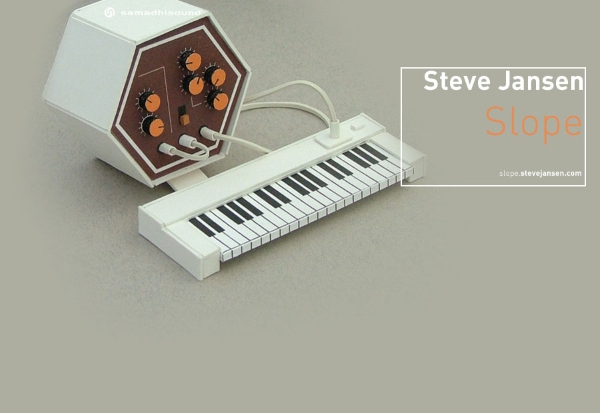
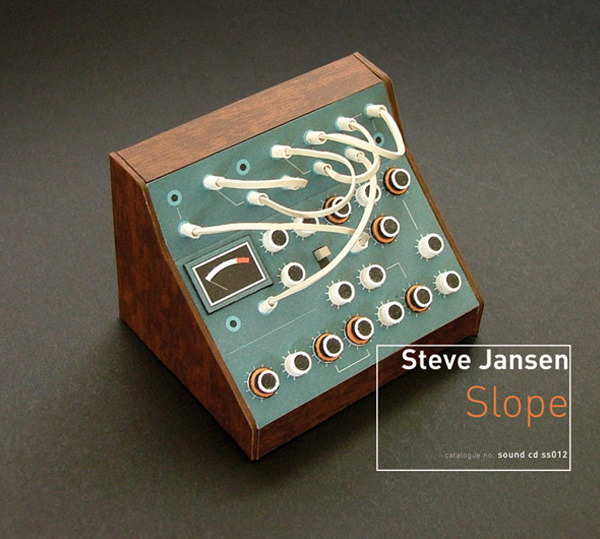
At the time of writing, Dan McPharlin’s full Analogue Miniatures series can be viewed on Flikr here.
Download links: ‘Cancelled Pieces’ (bandcamp), ‘Playground Martyrs (reprise)’ (bandcamp); ‘Stay Tuned’ (Apple); ‘Sow the Salt’ (bandcamp); ‘Dinah and the Beautiful Blue’ (bandcamp); ‘Sleepyard’ (bandcamp); ‘Who Am I Supposed to Be’ (Apple)
Physical media: Slope (Amazon); Smiling & Waving (Amazon); Let There Be Love (Amazon)
The Opiates revised by Thomas Feiner and Anywhen was released on samadhisound in 2008. David Sylvian is credited as Executive Producer. A further expanded version of the album is available on bandcamp here.
Sweet Billy Pilgrim released the album Twice Born Men on samadhisound in 2009. An expanded version of the album is available on bandcamp here.
‘I sent her the track ‘Cancelled Pieces’, believing that it was virtually impossible to come up with a vocal for it, but if anyone could, it would be Anja. She had it for a long time, I’d half given up hope, when suddenly it came back to me with all the parts you hear in the final mix. Anja is so good at allowing the timbre of the music to suggest a lyric and attitude for a song. I think she did an amazing job on it.’ Steve Jansen, 2019
Read the sister article here:

What an amazing retrospective for these two apparently ‘minor’ albums, that involve so many figures I love.
Reading you is like making a journey, thank you so much.
LikeLiked by 1 person
And thank you so much for reading and commenting.
LikeLike