
‘It’s rather a low-tech recording,’ said David Sylvian of Blemish, ‘although there are certain elements to the record which were developed with software, particularly Christian’s track [‘A Fire in the Forest’] and ‘Late Night Shopping’.’ The burbling electronic undertone and accelerating oscillations of the latter distinguish it from the Derek Bailey guitar improvisations that form the basis of the tracks either side in the album’s running order.
‘It just started out one day, I unplugged the guitar from the amp and the cable hit the floor and it created this hum, this buzz and it was very appealing to my ear. So, I recorded it, I double tracked it, and that was the beginning of the track. That’s what you hear, that’s the opening sound that you hear…I think there was one guitar overdub and then I put the vocal down, and everything seemed to make sense, and I built it up from there.’
The simple trudge of the bass-line is offset by lazy clusters of handclaps, lending the song a languid feel that borders on the soporific.
‘Ask me I might go
Why not take me with you?
Ask me I might go
Late night shopping’
The lyric recalls the most mundane domestic exchange between two individuals…
‘Tell me what we need
Write a list or something’
…perhaps a couple who have lost sight of the most important aspects of their existence and relationship. The hypnotic feel of the piece recalls the concepts of Gurdjieff and Ouspensky that Sylvian had referenced in earlier work, and which would shortly and explicitly resurface in ‘Sleepwalkers’. As Ouspensky said, ‘All the absurdities and all the contradictions of people, and of human life in general, become explained when we realise that people live in sleep, do everything in sleep, and do not know that they are asleep.’
‘The work reflects the world I/we live in,’ commented Sylvian. ‘Whilst Blemish can be viewed as a commentary on the deterioration of a couple’s relationship it can also be viewed as a comment on the state of the world. After all, the individual is a microcosm of what we see happening in the world on a global scale.’
Of ‘Late Night Shopping’ in particular, he expanded: ‘It’s a humorous piece but it’s also a healthy critique of life in America, I think…’
‘We can take the car
No one will be watching
We can lose ourselves
Late night shopping’
‘In America shopping is a constant, almost automatic activity, you do it even if you don’t need anything. I find the materialism of the States, its form of capitalism, very disturbing. Every ethical or moral value is subordinated to economics.’
‘We don’t need to need a thing
Late night shopping’
As Sylvian intones this phrase, the metallic chatter of the spinning wheels of a shopping trolley pans from one speaker to the other. ‘I think we shop to make ourselves feel better about ourselves. It’s not living with the unease that sits at the heart of our being, you know. The desire is to turn away from that and in turning away we develop all kinds of strange addictions, from shopping to alcohol, drugs, sex, whatever it is you become very obsessed with. All of these things that we should be able to consume with a regular appetite rather than an obsessive one. And I think that this is what we are doing, that we tend to feel this sense of unease in ourselves, in the soul of our being and we want to run. And we find things that comfort us. And in the US shopping is definitely right up there towards the top of the list. It’s one of those things that we use to make ourselves feel better about ourselves. It’s a comfort tool in some way.’
Government was also complicit. ‘After the Twin Towers tragedy, the imperative was: go out, buy, go to restaurants, keep the economy going. Then, when Saddam Hussein was captured, the major networks were quick to point out how the event would have positive repercussions on the stock market, on the financial state of the country. I wonder where the human element went in this system…shocking!’
So did the songwriter participate himself in the very activities on which he passed judgement? ‘Well, I do, that’s the thing,’ he admitted. ‘When I criticise people for doing this, I’m including myself. Absolutely, yeah. Because you know once you become a father and the shopping craze is on… it’s frightening.’ He did insist that he was a stranger to the aisles of Walmart and Kmart but added, ‘to think that days out with the children are spent in Borders, it’s scary.’
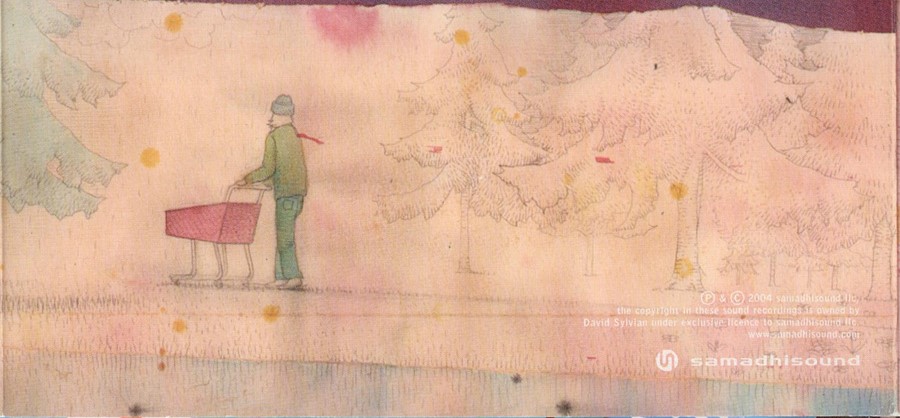
As if to emphasise the point, the inner panel of the Blemish cd featured an Atsushi Fukui painting of Sylvian walking amid the forest that surrounded his then home, snow covering the ground as was the case in the prolonged New Hampshire winters, yet incongruously the singer is pushing a supermarket shopping trolley. Extending the wry humour, the image was chosen to feature on t-shirts sold through Sylvian’s own website which had been launched to promote and distribute the first album released on his own independent label.
In light of such misgivings, Sylvian was asked whether America represented the ideal place to create art and raise a family? ‘Was it ever? Art can potentially be created anywhere. Adversity fires the creative juices. The outpouring can be cathartic. Family: there are certainly some places that are better than others when it comes to raising children. Clean water, good food, nurturing environment, good education. America is capable of supplying most of these requirements most of the time but the context in which they are provided concerns me. The culture is economically driven. The bottom line is the dollar rather than human values. In the long term this is likely to be the undoing of the nation.’
Looking again at the album’s running order, there is a logical flow to the final four tracks – two Derek Bailey pieces interleaved with the songs Sylvian pointed to as based on computer manipulation. ‘She is Not’, a miniature sketch of a woman and mother pictured in a family situation and then absent, as emphasised by the sudden ending to the track. ‘Late Night Shopping’ lamenting the distraction of materialism from the things that really matter in life. ‘How Little We Need to be Happy’, a sharp contrast to the world view that tells us that satisfaction comes from acquiring more and more physical possessions – at least in one reading of the title’s meaning – and ending with the hopeful line ‘Let’s rise up again’. And finally the cleansing of ‘A Fire in the Forest’, clinging onto the presence of the ‘sunshine above the grey skies’ despite everything around turning to ashes.
‘The work itself is very minimal,’ Sylvian said of Blemish, ‘and so, you know, there’s not a lot of layers, a lot of textures. I kept it very stripped down, very minimal.’ The approach laid open the possibility of reinterpretations of the material by others and the first alternative version of ‘Late Night Shopping’ to appear was by Chris Vrenna, aka Tweaker. Sylvian had contributed vocals to ‘Linoleum’ for the Tweaker album The Attraction to All Things Uncertain (2001), a song that itself was subject to multiple remixes. Asked then whether he would be interested in tackling a remix of David’s own material, Chris said, ‘I would do that in a heartbeat. I would work with him in any context, at any time, in any place, anyway, anywhere, ever. So, how’s that for a blanket statement? I would totally love to do something again.’
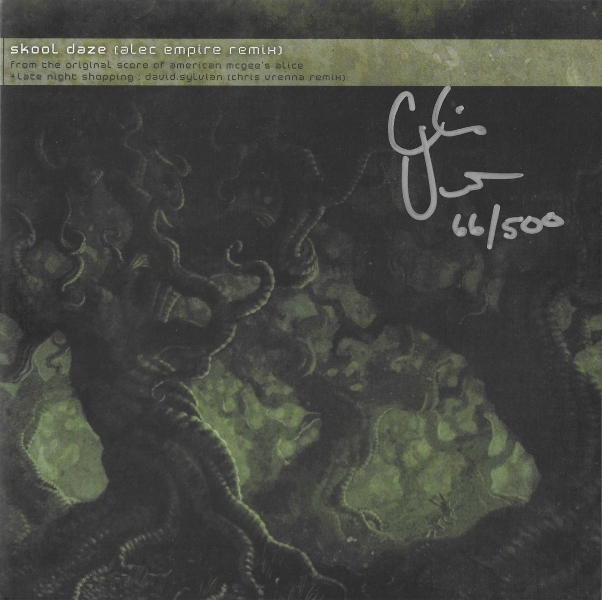
The Chris Vrenna remix of ‘Late Night Shopping’ was reported to be in the works in late summer 2003 and first saw release in April 2004 on a limited edition 7″ vinyl – unusually played at 33 1/3 rpm – the edition of 500 signed and numbered by Chris. The ‘A’ side was a reworking of Vrenna’s own soundtrack composition for an Electronic Arts computer game, American McGee’s Alice. The flip-side version of ‘Late Night Shopping’ was subsequently included on a cd, Causes 1 (2007), a compilation put together by Waxploitation Records to benefit aid agencies working to bring relief to the war-ravaged region of Darfur in Sudan.
Vrenna was a drummer before becoming immersed in electronic music and his version introduces a propulsive programmed rhythm. Also added are both a shimmering, expansive synthesiser line and, following the shopping trolley ‘sample’, an aggressive lead guitar part reminiscent of that heard on ‘Linoleum’. The treatments bring a whole new perspective and feel to the track.
Soon afterwards Sylvian made available for free download through his website an alternative take on Vrenna’s interpretation of ‘Late Night Shopping’ which he described as the ‘tweaking the tweaker remix’. Shorter in duration, the bright synth is absent, allowing synthetic bell sounds that Vrenna had added to come to the fore, with the reverb in the rhythmic elements dampened down.
When the full Blemish remix album The Good Son vs The Only Daughter was released in 2005, it was Burnt Friedman who was given the task of presenting a different take on ‘Late Night Shopping’. This assignment, together with that for the title track itself, were the first ‘toe in the water’ collaborations between Friedman and Sylvian, paving the way towards the Nine Horses project. For both remixes Friedman adds clarinet from Hayden Chisholm whose work would be integral to the Snow Borne Sorrow album.
Friedman’s ‘Late Night Shopping’ is notable for editing out the word ‘shopping’ completely, thus rendering the after-dark activities all the more mysterious.
In December 2024, David Sylvian continued his tradition of dropping a cut from his digital archives on the samadhisound soundcloud account as a small ‘gift for the holidays’ for followers of his music. On this occasion the track in question was ‘a remix of ‘Late Night Shopping’ by Atom™ which didn’t make it onto The Good Son vs The Only Daughter Blemish remix album. My gratitude to Uwe Schmidt.’ Bizarrely the track was only available on the platform for a few minutes before apparently being removed by soundcloud on copyright grounds, despite having been posted by the artist himself!
Uwe Schmidt was familiar to Sylvian not least as Burnt Friedman’s partner in the Flanger project, which Burnt told me was what first drew the attention of David and Steve Jansen to their music (see ‘The Librarian’). Uwe also used the pseudonym Atom Heart and under this name he was an early contributor to Ryuichi Sakamoto’s ‘Chain Music’ alongside Sylvian (see ‘World Citizen – Chain Music’).
Schmidt’s distorted treatments give the song a darker edge as glitches disrupt the flow, transposing the composition from the drudge of life lived in waking sleep towards the restless delirium of nightmare. ‘I enjoy Uwe’s daring and humour,’ commented Sylvian, ‘which I feel is on full display here.’ (2025)

For my playlist I include Flanger’s ‘Endless Summer’ with the Friedman and Schmidt remixes, a track from their album Templates, which was recorded in Uwe’s adopted home of Santiago, Chile, and a release that Sylvian and Steve Jansen admired. The playful blurring of the lines between acoustic and electronic instrumentation is a delight, with what sounds like (in Burnt Friedman’s words) ‘a tiny jazz ensemble playing’ in fact being the product of meticulous computer programming.
The soundcloud issue for Atom™ remix of ‘Late Night Shopping’ was subsequently overcome by officially releasing the track through bandcamp on a ‘name your price’ basis, with Sylvian indicating that no payment was necessary (link in footnotes).
‘Late Night Shopping’
David Sylvian – all instruments, vocal
Music and lyrics by David Sylvian
Produced by David Sylvian. From Blemish by David Sylvian, samadhisound, 2003.
Recorded at samadhisound studio February/March 2003
‘Late Night Shopping’ – official YouTube link. It is highly recommended to listen to this music via physical media or lossless digital file. If you are able to, please support the artists by purchasing rather than streaming music.
‘Late Night Shopping (Chris Vrenna remix)’
Original track: David Sylvian – all instruments, vocal
Music and lyrics by David Sylvian
Additional production and remix by Chris Vrenna and Clint Walsh. ‘B’ side of ‘Skool Daze (Alec Empire remix)’, Waxploitation, 2004
An adaptation of this version, the ‘tweaking the tweaker remix’, was made available for free download on davidsylvian.com, 2004. Remix by David Sylvian.
‘Late Night Shopping: remixed by Burnt Friedman’
Original track: David Sylvian – all instruments, vocal
Music and lyrics by David Sylvian
Remixed by Burnt Friedman, featuring Hayden Chisholm – clarinet
Produced by David Sylvian. From The Good Son vs The Only Daughter: The Blemish Remixes by David Sylvian, samadhisound, 2005.
‘Late Night Shopping: remixed by Burnt Friedman’ – official YouTube link. It is highly recommended to listen to this music via physical media or lossless digital file. If you are able to, please support the artists by purchasing rather than streaming music.
‘Late Night Shopping: remixed by Atom™’
Original track: David Sylvian – all instruments, vocal
Music and lyrics by David Sylvian
Remixed by Atom™/Uwe Schmidt
Produced by David Sylvian. Out-take from The Good Son vs The Only Daughter: The Blemish Remixes by David Sylvian, samadhisound, made available online 2025.
Lyrics © samadhisound publishing
Atom™ remix on bandcamp
All David Sylvian quotes are from interviews in 2003 and 2005 unless indicated. Full sources and acknowledgments for this article can be found here.
Download links: ‘Late Night Shopping’ (Apple), ‘Late Night Shopping (Chris Vrenna remix)’ (Apple); ‘Late Night Shopping: Burnt Friedman remix’ (Apple); ‘Late Night Shopping: Atom™ remix’ (bandcamp); ‘Endless Summer’ (Apple).
Physical media: Blemish (burningshed); The Good Son vs The Only Daughter (burningshed); Causes 1 (discogs); Templates (Amazon)
‘I felt the Blemish material offered a unique opportunity for certain individuals to really rework the compositions in a rather elaborate manner, because, with the exception of the Derek Bailey-related compositions, the material was recorded over drones or two chords. On top of that, there was the notion of working with artists I have come into contact with over the past year or so, and I used the remixes as a way of testing the waters for possible future collaborations.’ David Sylvian, 2005

More about Blemish:
Blemish
The Good Son – She is Not
How Little We Need to Be Happy
A Fire in the Forest
More about The Good Son vs The Only Daughter:

Just picked up on this – cursory read and listen (to one version). I don’t have the album – but when Sasha does our next downloads for our respective player and stick, this track will definitely be included on mine! I love David’s keyboard chord changes and the narrative from the title through – thumbs up for the Sylvian imagery – this is definitely pop art and David is right – it’s what the (developed) homo sapiens world has largely become. Very exciting, I’ll be coming back to this soon (probably more than once) for more reading, listening and looking. This also reminds me of a glance back to the early 80’s electronica…ripe for covering by such bands…original and tribute. Thanks, the VB, excellent work.
LikeLiked by 1 person
P.S. With part of the 3.3 year old comment/views I made on ‘A Fire In The Forest’, it’s clear to me now that I should have put more effort into looking into more of that album!
LikeLiked by 1 person
The Chris Vrenna remix is actually my favourite. It’s those extra synth and “aggressive” lead guitar elements – it gives the track a different perspective and feel, as referred to by the author (above), which can only be done if the melody is there, if muted (ambient). I think it also works better if the idea for the song and lyrics (tension) are ‘there’ too, which they are, even though the late night shopping might immediately be thought of as neutralising the anxiety. I suppose this might inevitably involve ‘arrangement’, in the sense of changing the feel of the song. Although Mick Ronson was already dead for about ten years at the time of these recordings, I’d have loved to see what he could of done with that track. This has also led my thought back to the earlier work of Japan in their earlier (Hansa) days, the glam rock influences were definitely there. All these (personal) thoughts have also led (via another track from the Blemish album) to a further post (by me) on ‘A Fire In The Forest’ article from circa 3 years ago.
LikeLike