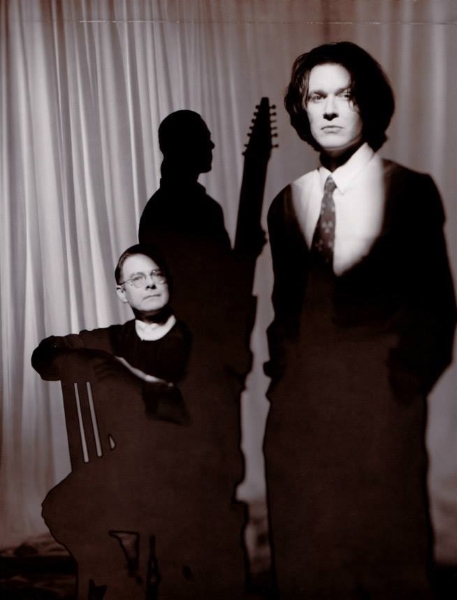
Trey Gunn knew that he wanted to pursue a life in music and, despite the prevailing spirit of contemporary culture, was keen to develop an understanding of the fundamentals. ‘I went to the University of Oregon and I studied composition. I had played classical music as a kid, like from 6 or 7, and played Bach or Bartok or whatever you did back then on piano, and transitioned to bass and acoustic guitar. I was in punk rock/new wave bands in the late ’70s and it was counter to the culture to study music. It was, “I’m going to go my own way,” and, “I’m NOT going to learn!” – I’m talking about the punk culture – and sometimes that was cool, sometimes that would produce unusual things…but I still felt like if I was going to be a professional, whatever that meant… basically on track to get really good at something, then I should learn about the materials, even though it was counter to everyone I knew… I thought, if I was a writer, I would want to learn how a sentence is structured; it just makes sense, even if you are going to be deviant… I wanted to learn more stuff and get exposed to more things.’
Rather than dedicate his energies to ‘academic level performance,’ Trey concentrated on classical composition and his playing at the time was primarily in punk rock bands in the local scene. ‘I felt like I needed both…the reckless thrashing and the rigorous study.’
As his years in Oregon were coming to a close, Gunn turned his attention to what the next step might be. ‘I thought, if this was 200 or 300 years ago, you would go and find the master musicians and say, “Teach me,” you know, and hang out at their house…and knock on their front door until they let you in, and we just didn’t do that anymore. I thought maybe I should do that and so I made a list of all the musicians that I thought I should contact and bug them. And when I made the list there were a lot of great musicians on it, but Robert [Fripp]’s name just kept going to the top. It was like, “You could learn something from this guy”.’ There were many other eminent candidates on the list, but ‘I had the feeling that they wouldn’t be able to tell you what Robert could tell you. And then two months later I saw a little ad in Downbeat magazine where he was giving a guitar course and I was like, “OK, there we go. I’m going”.’
So it was in May 1985 that Trey Gunn first met Robert Fripp during the third course of the inaugural Guitar Craft series which was held in Charlestown, West Virginia. At the time Trey was playing acoustic guitar as well as bass, but was dissatisfied with his expression. ‘I was already disillusioned with the guitar… I had this feeling like everything I did on the guitar just had this blues flavour that is fine, but it just does not fit me. I had this hunch suddenly one day that it had to do with the tuning. And then I remembered this instrument called a Chapman Stick that’s tuned in fifths and I thought, “Oh, maybe that’s what I should play,” and I even went down to Emmett Chapman’s house to look [at the instrument] but he couldn’t sell me one at that moment. Then a few months later I went to this course with Robert, and the first thing he did was, he said, “Everyone tune your guitar in fifths,” …and that totally changed everything for me.’ Once Trey did obtain a Stick, the regular guitar and bass were put away and he dedicated himself completely to touch guitar.
Part of the fascination may well have been that the instrument was so new that there was no history to draw upon, no conservatory in which to study it. ‘If you wanted to play any of these other instruments there’s hundreds of years of study and knowledge and pedagogy and people experimenting with how to play it, and you can just slot into that… I remember saying in an interview once that nobody’s going to know how to play this thing for fifty years…’
Gunn followed up that first course with a Level 2 gathering later the same year (Fripp having met David Sylvian in London for the landmark recording of ‘Wave’ in between times), subsequently attending further residentials in Dorset, England in 1986 and becoming a member of the League of Crafty Guitarists, the performing incarnation of Guitar Craft. As he left the guitar behind and embraced the Chapman Stick, so Trey’s relationship with Robert Fripp took a different turn. He became a member of the Fripp, fripp band, subsequently known as Sunday All Over the World, including Toyah in the line-up, and played on and co-wrote songs for Toyah’s album Ophelia’s Shadow (1991).
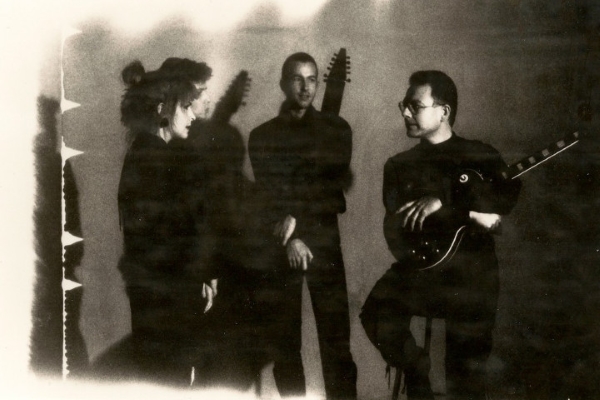
Mid-way through a Covid-times series of podcast interviews with fellow touch guitarist Markus Reuter, Gunn holds up a clutch of tapes to the webcam. ‘I have these eight cassette tapes of just Robert and I sitting in my back studio in New York, like in 1991, putting together ideas.’ New directions were emerging at that time. Indeed, Sylvian pinpoints an invitation from Fripp to join a reincarnation of King Crimson to this moment. ‘Robert approached me in late 1991 about whether I wanted to join a new King Crimson he was forming,’ he said. ‘Though very flattered, I decided that I didn’t feel equipped to take on the whole baggage and history that comes with being a member of King Crimson.’
Coincidentally, Sylvian then received the offer of a short tour in Japan. ‘We started discussing a collaboration on a more equal footing… I wasn’t intending to do the tour but I mentioned it to Robert, and Robert said, “Well, let’s use that as the impetus to write. Let’s do that tour and we’ll meet up two, two-and-a-half weeks before the tour is due to begin, one week of writing, one week of rehearsing, and then just go out and tour”.’
Gunn: ‘I was a pretty big fan of David’s and a pretty big fan of David’s stuff that Robert had played on, the Gone to Earth records in particular… Robert called and said David wants to do a series of concerts with him and he wondered if I would want to join them! And I was like, “Sure!!” So the three of us met at David’s apartment in London and we worked for about a week and just generated a whole bunch of material.’
Some of the ideas from those cassettes recorded by Trey and Robert in NYC in ’91 were taken into the writing sessions, the sound recordings from which are dated January/February 1992 in Trey’s archive. There were rehearsals in London’s John Henry’s Studios in mid-February, a final rehearsal in Tokyo on 29 Feb and then a pair of opening shows at the Terada Warehouse on 1 March, one in the afternoon and one in the evening.
Supporting Sylvian/Fripp/Gunn on their brief tour of Japan were The California Guitar Trio, Guitar Craft alumni and well known to Gunn from shared time on courses and in League of Crafty Guitarists performance. Occasionally, the Trio of Bert Lams, Hideyo Moriya and Paul Richards would return to the stage at the close of the main set to perform a couple of numbers such as ‘Blockhead’ and ‘Asturias’.
One of the tracks performed during every show of this first leg of the tour doubtless had its origin in the experiments of Fripp and Gunn. ‘Protopunk’ boasted intricate running lines from Fripp’s guitar interlaced with deft Stick fretboard-work from Gunn in the bass register. At times flowing freely, at others angular and threatening, with distressed keyboard atmospheres added by Sylvian.
We may not have access to those cassettes from Trey’s personal collection, but the DGM site hosts recordings from their extensive archive and some of these allow us to trace the developing interplay between the guitarist and the stick player. On 5 February ’92 the pair captured a piece in rehearsal christened ‘Bach Like’ which bears cascading lines similar to ‘Protopunk’, and ‘Stomp Idea I II III’ where they test out some highly rhythmic and textural possibilities that ultimately were not developed further.

Following the initial Sylvian/Fripp/Gunn shows in Japan, Robert received an invitation to perform over two nights in The Atrium of the World Financial Centre in New York on 19 & 20 May. ‘I invited Trey Gunn to join me for one performance,’ he recalled, ‘and The California Guitar Trio for the latter… Around these shows we added several other dates.’ The supplementary performances preceded those in New York and so the Robert Fripp String Quintet was born in the interval between the Sylvian/Fripp/Gunn outings in Japan and Italy.
Returning for more shows in November ’92, before Sylvian/Fripp took to the studio to record The First Day, the String Quintet was effectively the original touring group of musicians without Sylvian and became a context for the exploration of related musical ideas. In the video below from the official DGM/King Crimson YouTube channel, recorded on 11 November ’92, we are treated to a close-up look at Trey Gunn’s skill on Chapman Stick as he performs ‘Chromatic Fantasy in D Minor’, a J.S. Bach composition (BMV 903) arranged by Gunn himself, pointing back to those classical roots in childhood and university. Next the California Guitar Trio perform ‘Blockhead’, a piece they had played as part of the Sylvian/Fripp/Gunn shows in Japan, this time with stunning solo work from Robert Fripp. Finally there is ‘Hope’, a beautiful number from their repertoire that Trey and Robert experimented with as a duo at Applehead Studios near Woodstock the following month during preparations for recording The First Day.
The Sylvian/Fripp/Gunn shows have always been the subject of keen fascination amongst followers of the protagonists, both those who were lucky enough to witness them and those – like me – for whom distance precluded that experience. There have never been any official releases, leaving fans to guiltily glean what they could from woolly bootleg recordings. Robert Fripp has given hope that this might one day be rectified. In a Christmas greeting to readers of the fan-run archive site, davidsylvian.net, in 2020, Robert said: ‘We recorded all our performances with Trey Gunn in ’92 which have never ever been released. This trio format of David Sylvian, myself and Trey Gunn are among my happiest and most fulfilling performances with David. At the time David had no interest in them being released. For the future… I hope so. Working with David – probably the happiest touring of my life.’ Asked more recently whether there might be the opportunity for an extensive box-set collection of Sylvian/Fripp material such as DGM have produced for other King Crimson and Fripp solo projects, Robert said, ‘I think it’s possible. But there’s clearly not as much material… Yes, it is possible. It’s not yet in the calendar, but it is the topic of occasional discussion.’ (2023)
Amongst the Fripp/Gunn treasures in the DGM online archive there is a version of ‘Protopunk’ recorded at Applehead on 11 December 1992 (linked in the footnotes below), so we can enjoy a good quality recording of that track albeit sans Sylvian. Interestingly, the previous day the pair had set down an emerging version of ‘Vrooom’, showing that their preparatory sessions were pointing forward not only to the imminent recording with Sylvian but also to the plans evolving in Robert’s mind for the reforming of King Crimson, albeit Sylvian had declined and Trey was yet to be asked to be a part of it.
Once Sylvian arrived, having resolved visa issues that prevented him from taking part in preparatory rehearsals, proceedings moved to Dreamland studios where the early recording sessions for The First Day were to take place. At some point during their time in the studio, the lead guitar riff from the instrumental ‘Protopunk’ became the genesis of the vocal track ‘Brightness Falls’. Fascinatingly, the first trace of that motif in the DGM archive dates all the way back to September 1979, a brief guitar sketch catalogued as ‘Non Loop Idea VIII’ and now finally developed into a completed piece. Other components of ‘Protopunk’ would resurface in King Crimson’s new work. The DGM archive notes identify ‘a jagged riff that sounds very similar to the ‘Vrooom’ coda, and one or two descending motifs that would not eventually find a home until The ConstruKction of Light in 2000.’
‘Brightness Falls’ is the central track in the running order of The First Day and marks an important inflection point. ‘There are different viewpoints taken…,’ said Sylvian of the album. ‘As it develops there’s a move away from the survivalist approach to life, which I see as a negative way of looking at life and approaching life, to a more positive one.’
‘Baby, baby
I hate to go
Don’t leave me alone with this sorrow
The body’s heavy
The getting’s slow
Lost in moments
Caught in moments
The night is starless
And stands below
And I need you by my side’
From the seemingly hopeless desperation of the protagonist of the preceding ‘Firepower’, and from the weariness and darkness of the opening stanza of this track, a glint of light appears. Sylvian: ‘As the album progresses, more hope creeps in. In ‘Brightness Falls’ there’s a line ‘live in lightness/lost in lightness’… so it becomes more positive. A rejection of given values and a discovery of one’s own true values.’
‘Baby, Baby
The hurt heals slow
And who can believe in tomorrow?
When brightness falls
Who’ll come running?
When brightness falls
Who’ll come running in?’
The exhortation is to run towards the light whose radiance soon exudes from ‘Darshan’ and ‘Bringing Down the Light’ which close out the album.
‘Live in lightness
Lost in lightness’
‘And time’s no longer the greatest injustice of all
On this new day.’
As the vocal concludes there are spoken phrases from Sylvian in the mix. The repeating of ‘the house in which we live’ recalls one of the ballads from those early Sylvian/Fripp/Gunn shows that would never be heard on record or during the more expansive world tour that followed the release of The First Day. The words are perhaps an affirmation of a resolve to dwell in a place filled with light and love, a determination not to be cowed by the darkness.
‘Protopunk’
Robert Fripp – guitar, frippertronics; Trey Gunn – Chapman Stick; David Sylvian – keyboards
Played live on The First Day tour of Japan and Italy, 1992
‘Brightness Falls’
David Sylvian – guitar, keyboards, tapes, vocals; Robert Fripp – guitar, frippertronics; Trey Gunn – grand and tenor sticks, vocals; David Bottrill – treatments, sampled percussion, computer programming; Jerry Marotta – drums, percussion; Marc Anderson – percussion
(from full album credits)
Music by David Sylvian, Robert Fripp and Trey Gunn. Lyrics by David Sylvian.
Produced by David Sylvian & David Bottrill. From The First Day by David Sylvian & Robert Fripp, Virgin, 1993.
Recorded at Dreamland Studios, Woodstock, N.Y., and Kingsway Studios, New Orleans; mixed at Electric Lady Studios, New York, N.Y.
December ’92 to March ’93
Lyrics © samadhisound publishing
‘Brightness Falls’ – official YouTube link. It is highly recommended to listen to this music via physical media or lossless digital file. If you are able to, please support the artists by purchasing rather than streaming music.
Download links: ‘Bach Like’ (DGM Live), ‘Hope’ (DGM live), ‘Protopunk’ (DGM live), ‘Brightness Falls’ (Apple)
Physical media links: The First Day (burningshed) (Amazon)
Other tracks from the DGM archive mentioned in this article can be found here: ‘Stomp Idea I II III’ (DGM Live); ‘Vrooom’ (DGM Live), ‘Non Loop Idea VIII’ (DGM Live)
The featured image is a photograph by Kevin Westenberg from the tour catalogue for the Italy Sylvian/Fripp/Gun trio shows in 1992.
Robert Fripp & Trey Gunn contributed the track ‘Blast’ to Miniatures 2, a project put together by Morgan Fisher comprising tracks of around one minute in length from an array of artists. ‘Blast’ is a development of ‘Protopunk’ (Amazon).
David Sylvian quotes are taken from interviews in 1993/4 unless otherwise indicated. Trey Gunn quotes are taken from interviews in 2021-24. Full sources and acknowledgements for this article can be found here.
My thanks to Trey Gunn for reviewing the draft of this article before publication.
On the Sylvian/Fripp/Gunn shows: ‘This was quite a challenge and it’s very tense working in this manner. You’ve got two weeks to get it all together and you have to do the tour…The work was in a state of flux. While we were on tour, it was still evolving.’ David Sylvian, 1993


Thanks for yet another excellent piece, David.
LikeLiked by 1 person
Thank you for the feedback. It’s very much appreciated.
LikeLike