
In 2003, Clive Bell (who would later feature with David Sylvian on recordings such as When Loud Weather Buffeted Naoshima and the Twinkle³ project Upon This Fleeting Dream) visited Tokyo for The Wire magazine to investigate a newly-emerged music scene, and to attend one venue in particular – Off Site. Bell’s in-depth report describes the location. ‘As you leave Yoyogi station in Tokyo, the 60-odd storeys of the NTT DoCoMo skyscraper loom high above you…Like the offspring of a thunderous mating between the Empire State Building and Big Ben, the tower features a spire, glowing green lights in recesses, and a colossal clock lit up in white.’ Incongruously, Off Site is just 50 metres away, ‘one of a row of old, highly ordinary houses somehow clinging on in the shadow of Shinjuku’s skyscrapers. These are flimsy constructions of wood and plaster. Inside, Atsuhiro Ito and his wife have converted their house into a spartan gallery and performance space on the ground floor, seating about 50 maximum, and, upstairs, a welcoming cafe which also functions as a book and record shop.’
The poor state of the fabric meant that the owners were free to adapt the property according to their vision. One of the primary performers at Off Site was Toshimaru Nakamura, who explained, ‘Usually when you rent a place you can’t modify anything, but this place is very old, a kind of disposable house. Probably the landlord is planning to demolish it, so Ito could do anything he wanted.’ A downside, however, was that the ‘paper-thin walls’ meant there was little to insulate adjacent properties from the happenings within. ‘One of the neighbours came round with a noise inspector from the city government,’ Nakamura told Bell. ‘It’s very problematic, so we are forced to play quiet. I think he doesn’t like strange people coming in and out. It’s such a small street, it’s like his back yard. He would be happy if we closed down, but so far he hasn’t taken legal action.’
The upshot was that performers at the venue were forced out of necessity to play at very low volume. As it happens, their work in acoustic improvisation and micro-electronics was already inclining in that direction with the demands of Off Site serving to sharpen the focus. Nakamura: ‘I am playing with the room. When you look through a microscope, you see a microscopic world. It’s a whole universe, just the scale is different. So when you play quiet, you still have the same amount of freedom. Total, limitless freedom is just an illusion. Even if you can play very loud you have limits, for example the room itself or the capacity of the PA system. So I don’t feel restricted playing in a small room. It’s the same – I feel there’s enough space for me.’
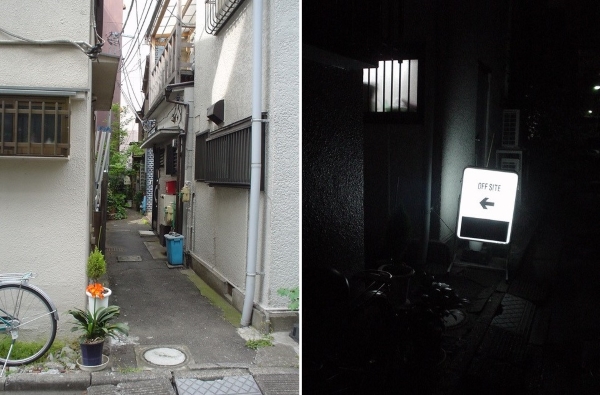
From the opening of the venue in 2000, a series of performances called ‘Meetings at Off Site’ were held, hosted by some or all of Toshimaru Nakamura, Tetuzi Akiyama and Taku Sugimoto, and on each occasion accompanied by a guest musician. A cd release of some of these early concerts carries the following note from Nakamura: ‘The sound in these performances is often so feeble that it welcomes into the music noises from outside, such as the whistle of a tofu vendor and the wooden clappers of people calling “Beware of fire” as they walk through the neighbourhood. All this has happened at the very end of a maze of narrow streets in the centre of Tokyo.’ Another artist who would later go on to collaborate with David Sylvian, Mark Wastell, performed for ‘Meeting at Off Site volume 18’ in January 2002, releasing the recording on his Confront label as Foldings. The disc joined Sylvian’s Blemish on the ‘best of’ lists in The Wire for 2003, one reviewer describing Foldings as ‘heroically disciplined…Much of the music is heartstoppingly quiet and infinitesimal.’
The styling of the series as ‘Meetings’ was appropriate not only to reference the presence of an invited guest musician, but also to acknowledge the participation of the audience in the gathering. ‘Sitting on small concrete stools, they listen like they mean it,’ was how Clive Bell described it, Toshi observing that ‘they try to enter the music.’
Nakamura had set aside playing the guitar in favour of producing sounds through a ‘no-input mixing board’ – literally a mixer with no instruments connected. In another 2003 interview, he described moving away from his former instrument: ‘One day I played the guitar with the mixing board first, with some effects…and I would touch a string on the guitar, and touch some knobs and change parameters of effects units. In the course of this trial I found myself touching the guitar less and less, and doing other things with the mixing board effects more and more. I thought OK, maybe just unplug the guitar from the mixing board and try it without guitar. It’s more focussed. When I am on stage with the guitar I just stiffen, my body is really stiff and it refuses to play the guitar, so I just got rid of the guitar and I felt really comfortable. I don’t know why I feel so comfortable, but I just naturally started to create music again…for me, no-input mixing board gives me this equal relationship between the music, including the space, the instrument, and me.’
Among the other leading performers at Off Site around the time of Clive Bell’s visit were partners Sachiko M. and Otomo Yoshihide. Sachiko’s musical practice had parallels with Toshimaru’s – whereas the latter performs with a mixing board with no musical inputs, Sachiko uses a sampler empty of samples. In a 2005 essay, Clive Bell recounts how, having purchased an Akai S20 sampler, Sachiko began to use it without anything loaded in the memory. ‘I was doing some work at home and noticed there was this really clear sound. Then I started experimenting, taking this “ooo” sound and changing the volume and pitch and doing various things.’ This was the start of her work with sine waves. ‘The result is often a piercingly clear sound,’ writes Bell, ‘apparently static and alarmingly high-pitched. If ever there was a musical representation of a laser beam, this is it. There is a raw physical excitement about this sound, even at a moderate volume, that evokes gut reactions.’

The inaugural performance at Off Site in June 2000 had been by a duo of Sachiko M. and Otomo Yoshihide, known as Filament. Their debut album – Filament 1 – was a combination of Sachiko’s pure and often austere sine waves with crackles and pulses derived from Yoshihide’s work with a turntable, which for this release seems to be another example of traditional musical content (this time from vinyl) being eschewed in favour of clicks and static derived from the spinning of the turntable itself, sometimes with extraneous articles attached akin to techniques employed on a prepared piano. ‘I am interested in the fact that people have started using the turntable as a musical instrument,’ said Otomo, ‘recycling it, in a way – just when its role as a practical piece of audio equipment was ending and it was about to retire from the scene’ (2001). The duo manipulate the frequency and intensity of sounds rather than perform anything recognisable as melody. Over time I’ve found that the key to me appreciating these explorations on the borders of music-making is to simply absorb what is present rather than to search for elements that are absent.
After the initial Vienna sessions held in 2004 for David Sylvian’s album Manafon, he convened a second group of musicians in Tokyo in 2006. Without exception, the individuals involved were the leading lights from Off Site. Present were Toshimaru Nakamura, one of his co-hosts from the venue – guitarist Tetuzi Akiyama, Sachiko M. and Otomo Yoshihide. Sylvian had met three of the four in Köln at the AMPLIFY 2004: addition festival staged by Jon Abbey’s label Erstwhile (see ‘Snow White in Appalachia’). Even before they met, Sylvian was aware of their work and keen to collaborate. ‘For my part I was familiar with large portions of their output going back to Toshi’s work with Tetuzi at Off Site, Otomo’s large and varied output with all kinds of ensembles and collaborations, a personal favourite being the Filament series of recordings, and numerous other works, in particular, those recorded for/with Günter Müller’s label Four 4 ears and Zorn’s Tzadik, so there’s was an immediate rapport.’
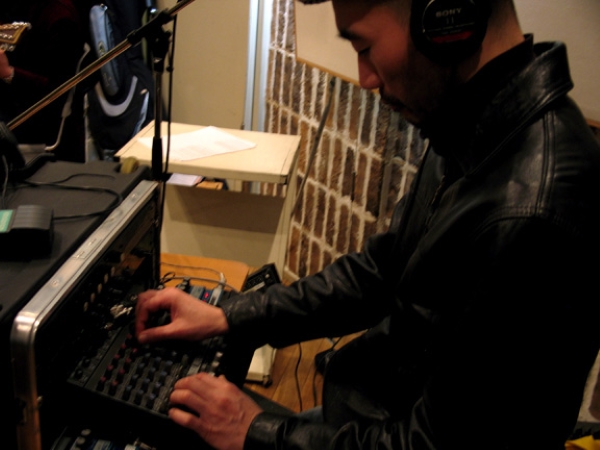
The Tokyo session would result in the longest track on the album once released, ‘The Greatest Living Englishman’, a piece Sylvian would describe as ‘the centrepiece of the album’. With the exception of some piano overdubs from John Tilbury added subsequently in London in 2007, the music is all contributed by the Tokyo line-up.
‘I knew what I wanted to do prior to ever getting in the studio with that quartet,’ said Sylvian. ‘I knew what the piece was about abstractly, I guess. I knew where I wanted to go with it. I’d asked Otomo, who was performing on turntables and acoustic guitar in the session, to bring in quartet music for the vinyl. So as soon as I heard certain elements come together, I thought, “This is it,” you know. Now we just need to overdub this, that and the other right there on the spot and suddenly the composition was all there. It was ready to go.
‘It was an amazing performance by the quartet, again very chamber-like in its intimacy and its sort of minimalism, if you like, the clarity of all the lines. There’s a great beauty to it.’
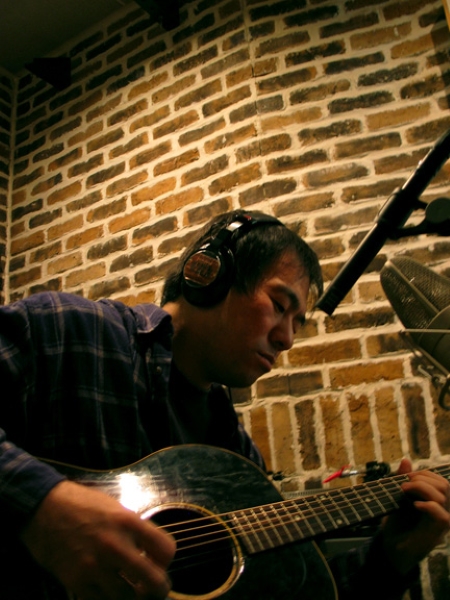

The improvisation was embellished immediately in the studio with some elements subsequently adjusted back at samadhisound. The ‘initial take suggested acoustic guitar overdubs which I requested of Otomo and Tetuzi on the spot. I later cut and pasted some interesting turntable activity from an alternate take onto this track. I also added an introduction by cutting and pasting elements from an earlier take. Tilbury was added to the coda. Melody and vocal added.’
The sparse backing that contextualises Sylvian’s vocal bears the characteristics of the music that was incubated at Off Site. In some quarters it was dubbed ‘onkyo’ (Japanese for ‘sound’ or ‘noise’) but few of those involved identified with that styling. Toshimaru Nakamura told Clive Bell: ‘I wouldn’t use the term myself. It describes too much. I prefer more neutral words like improvised or experimental. Music changes all the time. If you give it a name it seems as if it’s meant to be stopped there. I would rather leave it alone and let it go.’ Otomo Yoshihide: ‘Maybe I was the biggest problem: I started to say “onkyo” in Europe, because I felt this was a very important music for me, and I wanted to introduce this movement. After that everyone used this name, and sometimes naming means the music style gets fixed.’
Listening intently to the sound montage for ‘The Greatest Living Englishman’ as the Off Site crowd might have done, we can hear drones, glitches, shrill feedback frequencies and practically indescribable growls of electronic sound. There are short bursts of recorded music from the turntable, perhaps from the vinyl shown in photographs taken at the sessions – a Concord String Quartet recording of American composer Betsy Jolas’ Quatuor III (9 Etudes). On various occasions the noise of scratches and dust in the run-out grooves repeat like a looped sample. Single guitar strikes are traded between the two guitarists, the track credits helpfully indicating that Tetuzi Akiyama’s playing is in the left channel and Otomo Yoshihide’s in the right so that we can distinguish each from the other.

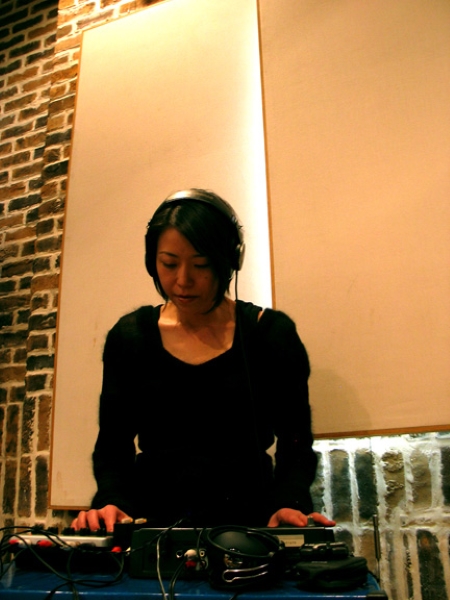
Tackling the vocal part was the ‘greatest challenge’ presented in the entirety of the album’s creation. ‘It was one of those pieces I really couldn’t get to work on. I knew it was going to be difficult and it certainly wasn’t an easy piece to write but it offered so many challenges as a vocalist…That’s what I’m looking for all the time and that was just a fantastic piece to get to grips with.’
Fiona Talkington, a presenter on BBC Radio 3’s Late Junction programme, asked Sylvian to expand upon the ‘challenges as a vocalist’ that he was seeking. ‘It’s where can a piece of music lead me melodically? Or how do I solve this issue, you know, this problem of moving from this guitar chord to this abstract sound made by god knows what electronic instrument, which has no key to it as such, back to a sample from a piece of modern quartet music, and link this all up and allow it to make sense without destroying what is already there – a beautiful, beautifully-fabricated piece improvised by a quartet.
‘So there’s so much at risk if you like. It’s got to sound integrated, it’s got to sound like I was there, a part of the ensemble. And it’s got to be intuitive. If you over-think it you’ll destroy it. And I guess that’s the key. You respond to the work intuitively and you hope that there’s wisdom in that, you know, that you don’t have to over-think it.’
Sylvian has spoken of disillusionment being a theme of Manafon, and another being the nature of the creative act. These threads came together in the title track with its fragments from the life of R.S. Thomas, reflections on his struggle with questions of faith, and admiration for his dedication to artistic expression through poetry (read more here). Both themes emerge again in ‘The Greatest Living Englishman’, the wry humour in the title being the protagonist’s realisation of falling tragically short both in life and in art.
‘Here we are then, here we are
Notes from a suicide
And he will never ever be
The greatest living Englishman’
‘His aspirations visited him nightly
And amounted to so little’
‘And the love that he engendered
Would never be enough
For him to feel alive
Warm and tender
He’d shut himself outside’
‘He had ideas above his station
Minor virtues go unmentioned’
‘I thought of it as a creative act of erasure, sort of self-erasure,’ said Sylvian of the song. ‘It seems to be about a writer that hasn’t achieved his goals in life or hasn’t found the recognition he felt he deserved, and so decides to kind of eradicate what he can of his work and ultimately his own life. Better to leave no impression at all than a mediocre one.
‘You know, he wanted to be great and, of course, there can only ever be one greatest Englishman at any given point in time, so basically he has the feelings that the rest of us feel that may not have reached potential, let’s say.’ Sylvian admitted in the same conversation that many of the character-songs on the album, such as ‘The Rabbit Skinner’ and ‘…Englishman’, might be interpreted as ‘self-portraits in one form or another’ and the comment above identifies himself, at least in part, with the sentiments expressed.
‘So it was just a kind of exploration of the psyche of a man that has that view of his work, insecurity about the work that he’s done, and I think ultimately…you [might] call it an act of cowardice or an act of bravery, but it’s a creative act to eradicate oneself, if there was an abiding aesthetic at least underlying the principle of [the work]. So it was fascinating to explore that…’
‘He’s erased a page of history
Much as he’d intended to’
Sylvian has stated that the lyrics on Manafon combine ‘the preciously poetic’ and the ‘clunkily prosaic’. There is pathos as the two elements come together in a stanza concluding with a mundane depiction of the luggage bay on the transport for a ‘journey he must make alone’:
‘It’s such a melancholy blue
Or a grey of no significance
Plastic coated surfaces
A space to place his suitcase
As he’s bussed from A to B’
…and the confinement of a hospital bed from which perspective we experience the scene in sight and sound:
‘But it’s such a melancholy blue
The curtains round the bed are drawn
Broadcast voices from the ward
The humming of machines are heard
But there are distances between
Yes, there are distances between’
Ultimately this man’s work was perceived to be overly self-obsessed…
‘The world could not embrace a man
With so much self in his writing’
…and in what amounts to an outburst with scansion distinct from the rest of the lyric, the subject expresses the suffocation he feels in his homeland and a feeling of hopeless inadequacy against the work of his countrymen:
‘Little England you fit like a straightjacket
Hemmed by the genius of others
He said “to conquer the world is not to leave a trace
Remove even the shadow of the memory of your face”’

I first heard Toshimaru Nakamura and Tetuzi Akiyama play at the Punkt festival in Norway in 2011, during an evening curated by David Sylvian as artist in residence that year. By now Sylvian had released Nakamura’s album Egrets on samadhisound (2010), the track ‘Semi’ alive with shards of Akiyama’s guitar, a suitable companion piece for ‘The Greatest Living Englishman’ on my playlist. In Kristiansand the pair appeared as part of the group Koboku Senjû (meaning something along the lines of “selection of dead trees”) along with a trio of Norwegian improvising musicians on saxophone, flute, trumpet and tuba, not that any of those instruments were played in a traditionally recognisable way. Toshi was centre stage, almost motionless at his no-input mixer, with Tetuzi on guitar to the right, side-on to the audience and surrounded by monitors. During the same outing in Norway the group performed at Cafeteateret in Oslo, the recording of which was subsequently released on vinyl as Joining The Queue to Become One of those Ordinary Ghosts.
David Sylvian wrote the sleeve-notes for that album and his writing conveys the extent to which these improvised performances can spark the imagination, creating vivid environments and triggering associations…
‘If we’re susceptible to the power of suggestion then, taking the title of this album as our lead, we’re moving amongst a “selection of dead trees” towards our own demise. We wake in the wee small hours of the morning, not in the comforting melancholy of a mournful Sinatra but amidst the anxiety and madness as exhibited by Max Von Sydow’s Johan Borg in Bergman’s The Hour of the Wolf. The forest is dark and the shadows voluminous and empty. Our own shadows startle us with an unfamiliar hostility. Wild life, as we call it, the dark majesty, the imposing immateriality of the feathered and furred, speak in one common tongue. We’ve travelled a long way from the harmonious comforts of home to the fringes, the outer reaches, the discordant ramblings of our own minds where reason gives way to intuition. We’re a dichotomy fluctuating between the feral and pure spirit. Freud’s “every phobia a fear of our own thoughts.” We leave our pasts behind that we might merge with the darkness. Devolution reveals itself as possible evolution. We reject the language known in favour of the primal, the savage tone. Until now, unsounded, snared. Senses heightened, straddling the breach between life and death, are we ready now? “I thank you that the limit has finally been transgressed. The mirror has been shattered. But what do the splinters reflect? Can you tell me that?” The words drift in the half-light, indifferent to our predicament, we are but ordinary ghosts, life and death, two sides of the same coin. Our unknowing greater than the sum of our knowledge. Listen and respond in your true voice, acutely aware that all responses are inclined to failure. From whisper to primal scream, there are degrees of fear, of recognition and awareness, of desperation and surrender. Listening, a participatory, creative act. Listen, there’s no such thing as silence. We are haunted, internally possessed. We’re the void waiting to be filled. We are the haunted and the haunting. “You do not see us, but we see you.” “Listen,” she said, “I’ll only repeat myself once, there’s no such thing as silence”.’ David Sylvian, November 2012 – including various quotes from the movie Hour of the Wolf, directed by Ingmar Bergman.
‘The Greatest Living Englishman’
Tetuzi Akiyama – electric and acoustic guitar (left channel); Sachiko M. – sine waves; Toshimaru Nakamura – no-input mixer ; John Tilbury – piano; Otomo Yoshihide – turntables, acoustic guitar (right channel) ; David Sylvian – vocals
Music by Tetuzi Akiyama, Sachiko M, Toshimaru Nakamura, Otomo Yoshihide and David Sylvian. Lyrics by David Sylvian.
Produced, engineered, edited and mixed by David Sylvian at samadhisound, 2008. From Manafon by David Sylvian, samadhisound, 2009.
Original sessions recorded between 2006/2007.
Lyrics © samadhisound publishing
‘The Greatest Living Englishman’ – official YouTube link. It is highly recommended to listen to this music via physical media or lossless digital file. If you are able to, please support the artists by purchasing rather than streaming music.
David Sylvian quotes are from interviews in 2009 unless otherwise indicated. Full sources and acknowledgements for this article can be found here.
The featured image is from a session by photographer Donald Milne which appeared in an article for The Wire to mark the release of Manafon in 2009. © Donald Milne.
Download links: ‘The Greatest Living Englishman’ (Apple); ‘Joining The Queue to Become One of those Ordinary Ghosts – Part Two’ (bandcamp)
Physical media: Manafon (Amazon); Egrets (discogs); Joining The Queue to Become One of those Ordinary Ghosts (bandcamp)
Interviewer: What are the stand-out tracks for you?
David Sylvian: ‘The greatest challenge was presented by what became ‘The Greatest Living Englishman’, so that’s the centrepiece of the album for me.’ 2009

More about Manafon:
Small Metal Gods
Snow White in Appalachia
Emily Dickinson
Manafon

🙏
LikeLike
…and thank you for reading
LikeLike
Thank you David. Another wonderful piece. I encountered Toshimaru Nakamura and his use of the no input mixer back in the early 2000s. His solo work is startlingly beautiful, creating a whole new sonic language. The no input mixer has become an important part of my work and it was a joy to discover the Sylvian and Nakamura collaboration. And who doesn’t love Martin Taxt’s tuba on ‘Joining the queue…’!
LikeLiked by 1 person
Seeing Koboku Senjû play at Punkt was a great experience – it was such a contrast between ‘new’ and ‘traditional’ instrumentation with Toshi sat practically motionless in front of the no-input mixing board, Martin next to him with the tuba. Of course, the performance was anything but traditional but the deep bass of the tuba cut through.
LikeLike