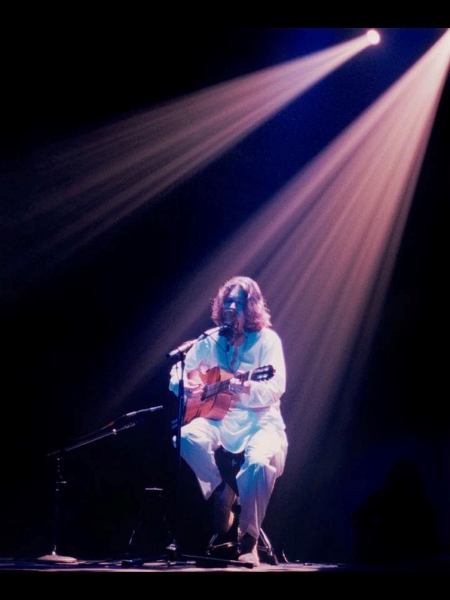
I was living some four hours’ drive from London in the mid-1990s. There was nobody I knew in the West Country of England who had heard of David Sylvian, yet alone followed his musical activities. Discovering news was difficult and I was always concerned that I’d miss something significant. Bamboo magazine had finished, its Winter 1992 edition being the last. For nearly a decade this fan-run labour of love had been a much-valued source of information and insight, its closure marking the start of Medium – an excellent official newsletter and label concentrating on the activities of Steve Jansen, Richard Barbieri and Mick Karn.
The internet was yet to reach my consciousness – my first email address was provided through freeserve, which didn’t launch until 1998. Then would come the sylvian arastar mailing list through which fans could share any information they’d come across, these snippets of news then delivered either immediately by email or in a regular digest. In the intervening years, Sylvian’s activities seemed distant, all the more so since the final edition of Bamboo recorded, ‘At the beginning of November [1992], David finally moved to America after months of waiting for his visa and Green Card to come through. He is now happily settled in Minneapolis.’
Fortunately the release of The First Day by Sylvian/Fripp and the ensuing tour, The Road to Graceland with its London dates at the Royal Albert Hall, were high profile enough to receive good coverage in the music press, together with the subsequently issued live recording, Damage. But what would follow?
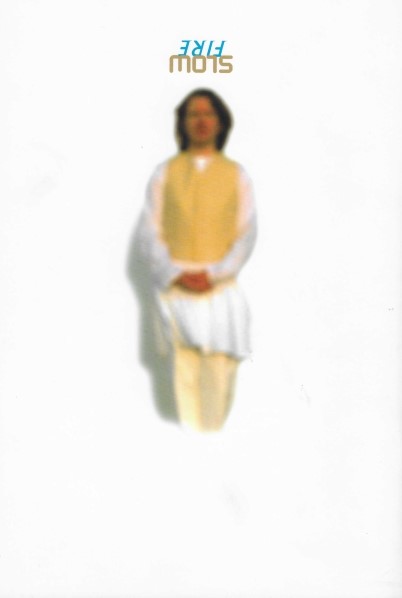
I must have managed to get myself onto a physical mailing list somehow, so was bowled over to receive a flyer through the post to my Devon address announcing a completely unexpected London live date at The Royal Festival Hall on the South Bank. ‘The concert will be a solo performance entitled Slow Fire – A Personal Retrospective,’ read the leaflet. ‘The show will feature songs drawn from throughout David Sylvian’s career, including a selection from Japan, Rain Tree Crow, Sylvian/Fripp, his solo works, as well as some completely new material.
‘Now resident in Minneapolis USA, Sylvian has been held in high esteem for many years as one of Britain’s most accomplished and enigmatic songwriters and performers. From the pioneering days of Japan through his solo career and collaborative work with the likes of Ryuichi Sakamoto, Holger Czukay and Robert Fripp, his openness to innovative methods of writing and recording has earned him a unique position in contemporary music.
‘This will be the only opportunity to see Sylvian in concert in the UK, prior to his return to the studio to record a new album, for release in 1996.’
Whatever the logistics, I had to be there. I remember being on business in seaside Torquay and using a public payphone to call up the box office, hoping that the details hadn’t reached me too late to secure a seat. I was in luck; the ticket would be posted to me and just a few weeks later I would be making the drive East to stay with family and take in the show.
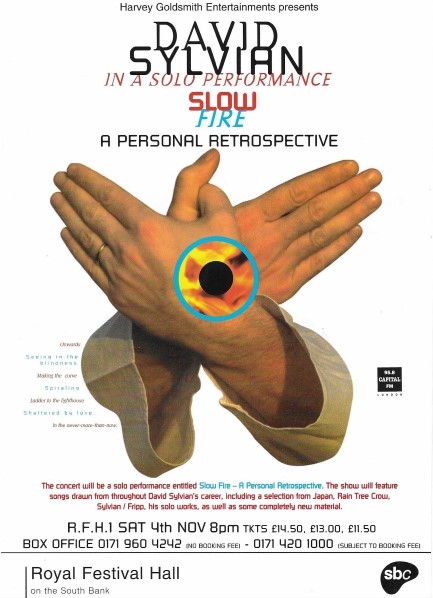
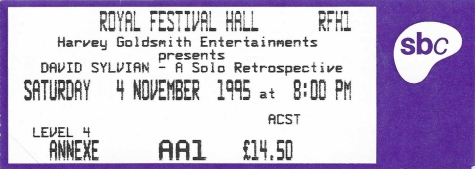
It wasn’t until I got to the venue and took in the sparse set-up on stage that it dawned on me that this was to be an entirely solo performance. Of course the flyer said ‘solo’, but I’d taken this to mean ‘not with Robert Fripp’ or any other collaborator for that matter, given so much of Sylvian’s output had been in collaboration with others since Secrets of the Beehive (1987) and the In Praise of Shamans tour that followed. Just the stand for an acoustic guitar, a high stool and before it a microphone for vocals stood centre-stage, a single Yamaha keyboard with rack of gear and second microphone off to the right. No significant stage dressing.
This was to be Sylvian and Sylvian alone. Quite an exposed setting for someone who had regularly professed to be a reluctant stage performer. Whilst this was a step back into solo work, as is so often the case with Sylvian’s musical development, the seeds of the project were to be found in his work just previous. ‘With Japan I didn’t enjoy the touring part of being a part of that band at all really, and, you know, that was an issue because the rest of the band really did enjoy touring,’ he said. ‘Not until I worked with Robert in the live context did I really begin to enjoy it on a whole different level…
‘What I saw in Robert was the level of commitment he brought to each and every performance. I mean it was really intense. And his level of focus was 100% and I had true admiration for that. And that taught me a lot about live performance and really opened my eyes to it and my heart to it. I mean I really hadn’t enjoyed live performance up until that time and that really began to increase my interest in that experience…
‘He is not a showman…the physicality of the performance isn’t of interest to him, it’s really the commitment as a player and what he brings to it in heart and mind, I mean that is 100%. And in that sense you get total value for money with Robert.’ (2002)
Sylvian enjoyed both tours undertaken with Fripp, but in the initial trio shows with Trey Gunn in both Japan and Italy there was a particular reference point. A week’s writing together at David’s London apartment, a week’s rehearsal, and they were on the road. This was a far cry from the slow gestation of the Rain Tree Crow material that preceded it.
The music, Sylvian said, ‘was evolving, as time went on, and there was quite a challenge. I think it was the degree of concentration, focus that we had to bring to the performance each night that allowed me to immerse myself in the performance – more so than in the past in terms of live performance – and enabled me to enjoy the context of live performance a great deal more than I ever had. I got a lot more out of it.’ (1999)
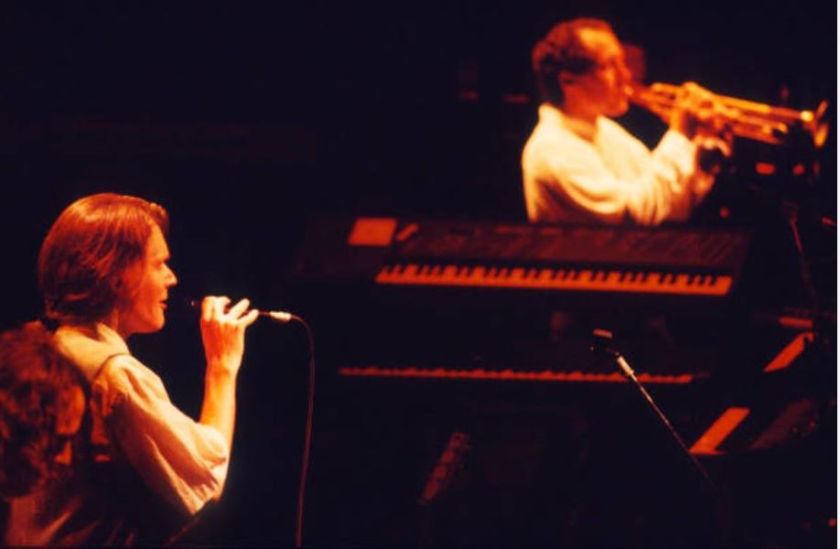
Slow Fire would position Sylvian as the focal point for all of the audience’s attention. The material might be more stable this time, largely being drawn from the back-catalogue, but the arrangements were inevitably adapted for the context of a single performer with a minimum of electronic tricks. Sylvian has always been open about his limitations as an instrumentalist. In particular, guitar parts on his solo releases to that date had often been taken by individuals he considered far more proficient than himself, the likes of Phil Palmer, Bill Nelson, David Torn. David had invited Bill Frisell to contribute to his reworking of Ryuichi Sakamoto’s ‘Tainai Kaiki’ (see ‘Heartbeat (Tainai Kaiki II))’ and, of course, there was Robert Fripp himself.
The level of personal commitment and concentration demanded by the performance was undoubtedly a further step up from those trio shows where the focus was shared with Robert and Trey Gunn.
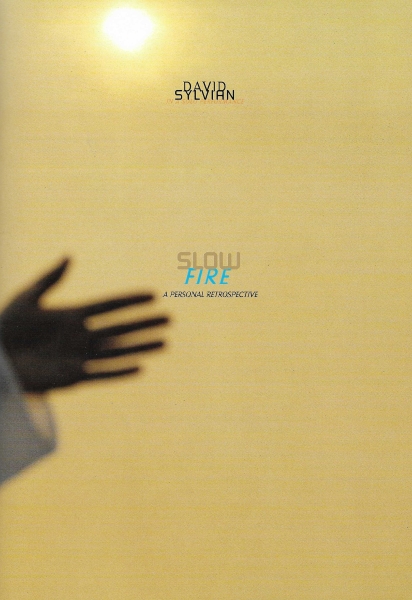
Slow Fire was debuted at the Time Zones festival in Bari, Italy on 29 August 1995. Sylvian appeared a little diffident as he entered the stage with acoustic guitar, commenting that the lighting was very bright as he settled onto the high stool mid-stage and requesting an adjustment to create ‘more ambience’.
The first six numbers were all vocal and guitar, starting with the familiar strummed pattern from the recorded version of ‘The Boy with the Gun’, then aptly into ‘Red Guitar’. The vocals were delivered at close quarters to an upright microphone of the type usually seen in a studio rather than a stage setting. As the set developed it was clear that Sylvian was confident to free himself from the precise sung melody from the records, creating some variation and even at times a proxy for the instrumental parts that embellish the album versions.
As a stripped-down version of ‘Brilliant Trees’ concluded, the Bari audience response moved from what had been warm applause to a burst of spontaneous and extended appreciation. The performer paused to take in the moment, now beaming. As the enthusiastic clapping subsided, he looked thoughtfully down and made what seemed an unplanned declaration. ‘This is the first time I’m playing this material in front of an audience,’ he said. ‘The last audience I had was my family in my attic, and I was still making mistakes then. So, if you hear any mistakes you can be assured they are made with a lot of passion at least. You don’t have to worry about them too much.’
In that instant the intimacy of Slow Fire was summed up. We were witnessing what those closest to him had heard in the studio in the attic of their Minneapolis home just days earlier, the evident nakedness and jeopardy of the performance forming the strongest of bonds between musician and audience. Family members could be glimpsed to the side of the stage, and we were being invited to share in what had previously been private to them.
Sylvian then launched into ‘Jean the Birdman’, familiar from The First Day as the lead single from the album and from the live performances in both trio and full band formation. As a some-time amateur guitarist I’ve always been interested in the playing technique on display during the Slow Fire shows. Maybe it’s because I started on an acoustic like the one in Sylvian’s hands. For a self-described ‘non-musician’ he deploys a good range on ‘…Birdman’, from the energetic strummed rhythm of the introduction, the shuffle that accompanies ‘stay with me, breathe deeply’ and ‘six hearts cut short, still dreaming they’re alive’, to open chord shapes that slide along the fretboard, dampening techniques from the left hand and the picked lead melody that follows the chorus. The vocal takes on a tinge of the blues and for an instrumental break Sylvian apes the lead line with his voice, replicating a Fripp solo from the original cut, his scat vocal diving deep into his register and ending in a momentary pause that was met with applause from the tour’s most exuberant audiences as the following verse began.
I know that for some people hearing the songs pared back to their bare bones took away some of their magic. That wasn’t my experience. There is no doubting that some of the joy and genius of the originals is in the artistry of the arrangements and the meticulous care taken in the instrumentation. Personally I enjoyed the confirmation that when you strip everything away, at the heart of it all is a song that stands up.
‘Weathered Wall’ was a case in point. Gone are the signature contributions of Jon Hassell, Holger Czukay and Steve Jansen, in favour of the sparest of rhythms played on just the two lowest strings on the guitar. No flashy technique and, in common with the entire setlist, no pedal driven effects. The approach places the vocal at the forefront and all the expression and flourish comes in the delivery of such a heartfelt lyric. For me there’s no need to make a judgement on the merits of the versions, it’s a pleasure to enjoy them as different perspectives on a treasured song.
In Praise of Shamans was the last time that many of these songs had been performed, a live undertaking that could have been accused of teetering on the edge of being over-complex and even over-blown. Here, the simplicity swept all that away and made for a connection between performer and audience that was both direct and immediate. By the end of that first show in Bari, the audience were on their feet and excitedly crowded around the stage for the encores. They had heard unrecorded numbers (of which more in a future article) as well as Japan’s ‘Nightporter’ – appearing on the set-list for the only time on the tour – and a rendition of ‘Ghosts’ that harked back to a solo TV performance on 12-string guitar in the midst of the band’s split (see more here). It was a scene transformed from the tentative start to the evening. As Sylvian received the crowd’s acclaim, he placed his hand on his heart, then bringing both hands together in the sign of namaste.
‘It was quite a daunting prospect to be honest,’ he said of the venture a few years later. ‘I don’t think I could have taken on that tour at any other point other than that moment of time. There are a number of reasons for that. For instance, the pleasures of performing live revealed to me through working with Robert Fripp. I think the primary experience taken from that collaboration was the pleasure of performing live. And at the same time, I had come into contact with teachers…and I saw the possibilities of doing a solo tour as something of a discipline.
‘It’s kind of presumptuous of a non-musician to take the stage alone and ask the audience to be engaged. But I had an increased level of confidence in my role as a vocalist, so that helped me somewhat. I felt a little more comfortable onstage due to working with Robert, and I had a spiritual discipline with which to focus my mind on the work to sit centre-stage and perform wholeheartedly. By viewing it in that light, I was able to undertake the tour and found it to be enormously rewarding as a result.’ (1999)
In a 2002 radio interview Sylvian reflected that to that date Slow Fire was ‘really the most rewarding experience I’ve ever had performing live. There was an enormous generosity on the part of the audience. I began to feel a real rapport with the people that were coming to the shows for the first time, which was wonderful. And I really did, I thoroughly enjoyed that tour.’
‘Jean the Birdman – live’
David Sylvian – guitar, vocals
Music by David Sylvian, Robert Fripp & Trey Gunn. Lyrics by David Sylvian.
‘Weathered Wall – live’
David Sylvian – guitar, vocals
Music by David Sylvian & Jon Hassell. Lyrics by David Sylvian.
Played live on the Slow Fire tour, 1995
lyrics © copyright samadhisound publishing
Photographer credit for the featured image is unknown, the work and copyright of the photographer is gratefully acknowledged. Full sources for this article can be found here.
‘You couldn’t get much more unplugged than the Slow Fire tour.’ David Sylvian, 2002
More about Sylvian live:
In Praise of Shamans
The Road to Graceland
Everything and Nothing
The World is Everything

Technically (😎), “Heartbeat (Tainai kaiki II)” was his reworking of “Tainai kaiki”, which appeared on the Japanese edition of Sakamoto’s Heartbeat album in late 1991. That very sparse version featured Arto Lindsay on vocals. When Sylvian made his contributions, it became “Tainai kaiki II”, with “Heartbeat” added to the title outside of Japan.
LikeLiked by 1 person
You are of course correct, Kevin. I shall adjust the wording to make this clearer. Thanks for reading.
LikeLike
I was often away on business in South Tuscany in 1995, and by chance I happened to read in a local newspaper of this misterious DS solo tour; for the moment the only known Italy dates (“preliminary” was specified) were Bari’s world premiere, and Pisa exactly one day after: a kind of “take or leave” affair, was my immediate thought.
No Live Nation online booking being available at the time, while returning home I managed to make a two hours detour for reaching the town of the Leaning Tower and I was fortunate enough to secure from a local dealer a couple of front row tickets at Teatro Verdi for me and Ferruccio, the invaluable friend of mine who first introduced me in 1986 to the world of DS.
And also in my case some 4-hours drive from home; but who cares? when you get so involved with a musician like DS. What you narrate, David, depicts exactly my feelings before, during and after that incredible concert.
The “to the bone” version of songs that I musically knew by heart and truly appreciated for their multilayered structure was shocking, and what did really emerge from that mystical performance was the depth and the warmth of his voice.
And, yes, not so bad as a musician our David, if we consider that a good musician is that who plays not so many notes, but the “right” ones. And we must not forget that – even at that time – the relative complexity inherent DS chords progression is probably one of the reason of his being so “uncool” for the mainstream.
But luckily for us, it is the reason why we are still moved by his artistry and his uprightness after so many years… 2024 – 1995 = … Oh no! A lifetime.
Bless you, TheVistaBlogger
LikeLiked by 1 person
And bless you for sharing these memories and perspectives! ‘What did really emerge from that mystical performance was the depth and the warmth of his voice.’ Yes – beautifully put. Thank you for taking the time to document your experiences of the show in Italy.
LikeLiked by 1 person
Dear Oldgondolier, I was there too 🙂
What a blessing experience it was! Thank you and thanks to both Davids 🙂
LikeLiked by 2 people
Thanks for a very nice piece David. It was a real treat to hear this version of Jean The BIrdman, one of my all-time favourite DS pieces. Cheers!
LikeLiked by 1 person
Probably a terribly boring point, but I wonder if you have any information regarding what models of acoustic guitar DS played at various points in his career? While having no special expertise about them myself, I’ve always been struck by the rather modest and careworn – even forlorn – guitar he plays for the wonderful (recirded) Japanese concert on the Blemish tour. It’s in such stark contrast to the hi-tech nature of the rest of the equipment but its tone works so beautifully on the songs. But as I say, I expect I’m being a dull boy.
LikeLiked by 1 person
Not boring or dull to me! I don’t know what model was played on Slow Fire, unfortunately. I may have some other information but not immediately to hand. If/when I locate it, I will post it here. If any readers know, please do comment on this post.
LikeLike
A wonderful account – really making me wish I had ever seen Sylvian perform live, and especially that solo tour. Thank you, David, for writing and sharing your knowledge and enthusiasm.
LikeLiked by 1 person
Thanks for reading, Janey, your feedback is sincerely appreciated.
LikeLike